Basic Information
Scientific classification
- Chinese name: Knocking Frog
- Scientific name: Cophixalus infacetus
- Order: Anura
- Family and genus: Rana davidae, Rana nymphaeus
Vital signs data
- Body length: Adults are generally about 1.5–2.5 cm in length, belonging to a very small, terrestrial rainforest frog.
- Weight: Individual weight is only a few grams or even less than one gram, and is greatly affected by individual size and nutritional status.
- Lifespan: It is estimated that it can survive for several years in the wild and can participate in the breeding season multiple times in a stable, humid forest environment.
Significant features
A typical "brooding frog," it can complete the development of eggs and larvae in damp, sheltered places on land, without relying on large bodies of water; the male frog's call is similar to a continuous knocking sound, which is very unique in the rainforest at night.
Distribution and Habitat
It is mainly distributed in the tropical mountain rainforests and cloud forests of Queensland in northeastern Australia, relying on the year-round humid understory environment with thick fallen leaves and abundant cover.
Appearance
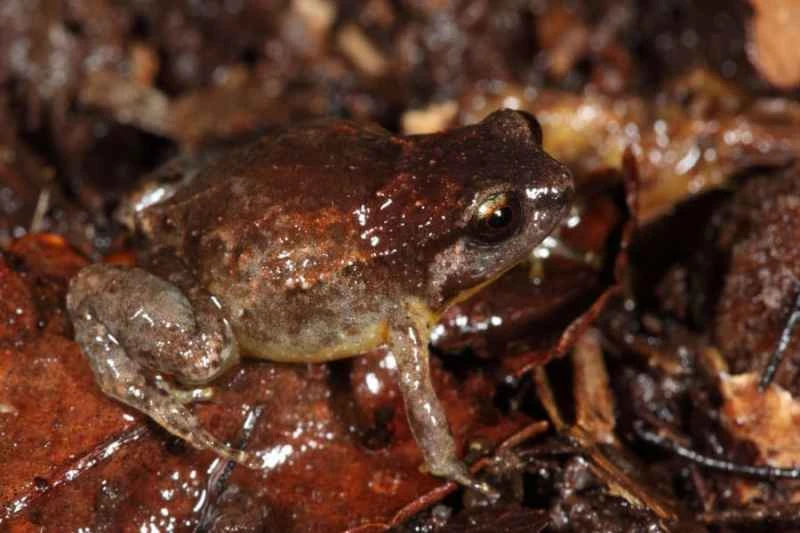
Small in size, with a short, round body, a brown or grayish-brown back with markings, relatively large eyes, and slender limbs, it is well-suited to moving slowly among damp leaf litter and moss.
Detailed introduction
The Tapping Nursery Frog ( Cophixalus infacetus ) is a small, secretive native Australian frog, belonging to the genus Cophixalus in the family Microhylidae. It is a typical "nursery frog," not reproducing in large open bodies of water, but rather completing the development of its eggs and larvae in moist, secluded terrestrial locations. It is a very unique group of frogs in the tropical mountain forest ecosystem.
Classification and nomenclature
Chinese reference name: Knocking Frog (general translation);
English name: Tapping Nursery Frog;
Scientific name: Cophixalus infacetus ;
Family: Microhylidae → Genus: Cophixalus
Appearance and Identification Features
The tapping frog is small in size, but its head and body are relatively "full," making it a typical small forest terrestrial frog.
Size: Adults are generally about 1.5–2.5 cm in length, belonging to the very small frogs;
Body shape: Short and round body, relatively wide head, and slightly short and blunt snout;
Back color: mostly brown, grayish-brown or yellowish-brown, often with irregular patterns or dark cloud-like spots, which helps to camouflage in the leaf litter.
Eyes: Relatively large eyes, which is advantageous for movement in dim forest environments;
Abdomen: The abdomen is lighter in color, and may be light gray, milky white or pale yellow.
Skin texture: The skin on the back has slight small warts or a grainy texture, but is not rough overall;
Limbs: The limbs are relatively slender, and the tips of the fingers and toes may be slightly enlarged, which is helpful for moving on damp fallen leaves and moss;
Overall impression: A small frog, its body size and color close to that of fallen leaves, easily overlooked if not carefully observed.
Distribution range and habitat
The knocking brood frog is a species endemic to the tropical montane rainforests of northeastern Australia .
Mainly distributed in the mountainous and hilly rainforest regions of northeastern Queensland;
It is commonly found in humid forests at low to medium altitudes.
Typical habitat characteristics include:
Tropical rainforests or cloud forests that are humid year-round, with a thick layer of fallen leaves and moss under the trees;
The accumulation of fallen logs, tree roots, rock crevices, and humus provides it with tiny hiding spaces;
High humidity and relatively stable temperature are conducive to the development of eggs in a terrestrial environment.
Lifestyle
The tapping frog is a nocturnal, terrestrial frog with a relatively small range of activity .
During the day, they mostly hide in piles of fallen leaves, moss, under fallen logs, or in crevices in rocks, making them difficult to spot;
They come out at dusk and night, slowly crawling or hopping around in the leaf litter and among tree roots to forage for food.
They generally do not stray far from damp, small-scale understory habitats and are more sensitive to dryness and strong light.
vocal characteristics
The English name "Tapping Nursery Frog" comes from its unique call:
The call of male frogs is often described as a sound similar to tapping wood or stone, such as "tok... tok... tok..." or "tup... tup...".
Its calls have a strong rhythm, like a continuous "knocking sound," and are especially clear in the quiet rainforest night;
They typically vocalize more frequently on damp, rainy nights or during the breeding season, often calling near the ground or low-lying shelters.
feeding habits
The tapping frog primarily feeds on very small invertebrates:
Small insects and their larvae, such as ants, small beetles, and springtails;
Small arthropods that inhabit leaf litter and moss;
They ambush tiny prey that pass by by moving slowly through the micro-environment of the forest.
Reproduction and characteristics of "raising tadpoles"
A notable characteristic of the genus *Rana* is that it does not rely on large bodies of water and often completes its development on land ; *Rana pulverata* also exhibits a similar characteristic.
The breeding season usually coincides with the local wet season and peak rainfall.
Male frogs attract female frogs by calling out in damp leaf litter, around tree roots, or near rock crevices.
Female frogs lay their eggs in damp but not waterlogged, secluded locations, such as piles of fallen leaves, under moss, or in layers of humus.
Eggs develop in high humidity environments, and many frog species that raise their young have a pattern close to "direct development": the embryo does not go through the typical free-swimming tadpole stage, and the larva completes most of the metamorphosis process in the egg, and is close to the morphology of a small frog when it hatches.
This "terrestrial brooding" method greatly reduces dependence on open water bodies and is a special adaptation to the microenvironment of the rainforest floor.
Protecting the status quo and threats
In global assessments, the knocking brood frog is generally considered to be at a relatively low threat level (e.g., Least Concern or near Least Concern) , but due to its limited distribution range and high dependence on moist forests, long-term monitoring is still required.
Potential threats include:
Deforestation and habitat fragmentation in tropical rainforests have led to a reduction in suitable understory microenvironments;
Invasive species and diseases (such as fungal diseases that affect amphibians) may impact small frog populations;
Climate change is altering rainfall patterns, affecting the humidity and stability of mountain rainforests.
Protecting montane rainforests, controlling invasive species, monitoring amphibian diseases, and limiting disturbance to key habitats can help maintain healthy populations of knocking tadpoles and other tadpoles in the long term.
Frequently Asked Questions
Q1: Why is it called "tapping to raise tadpoles"?
"Raising frogs" refers to the fact that many species complete the development of eggs and larvae in humid terrestrial environments, without relying on large bodies of water;
“Tapping” describes the male frog’s call as sounding like the continuous tapping of wood or pebbles in a quiet rainforest.
Q2: Are tapping frogs easy to spot in the wild?
Not so easy. It's very small, its color is similar to fallen leaves, it spends most of its time hiding under fallen leaves and fallen trees, and it's only active at night.
So usually, you hear the call first, and then use a flashlight to search carefully.
Q3: Do tapping frogs need ponds or streams to reproduce?
Unlike many frogs that rely on water to lay their eggs, juvenile frogs depend more on moist terrestrial environments, often laying their eggs in leaf litter or humus.
Most of the larval development process is completed inside the egg, which is a high degree of adaptation to the forest ground environment.
Q4: Is this frog dangerous to humans?
It is generally believed that it poses no direct danger to humans and will not attack unprovoked. For brief observation in the wild, handle it gently and wash your hands afterwards.
At the same time, avoid destroying their habitat.