Basic Information
Scientific classification
- Chinese name: Fanged Frog
- Scientific name: Adelotus brevis
- Order: Anura
- Family and genus: Rana tussockii (Family: Rana tussockii)
Vital signs data
- Body length: Adults are generally about 3–5 cm in length, belonging to small to medium-sized terrestrial frogs.
- Weight: Individual body weight usually ranges from a few grams to more than ten grams, depending on body length and nutritional status.
- Lifespan: It is estimated that they can live for several years in the wild. As long as the environment of streams and moist woodlands is relatively stable, adults can participate in reproduction multiple times.
Significant features
The male frog has distinctive "fang"-like bony protrusions on its lower jaw, used for fighting between males; it lives in humid forests and near streams, and is one of the representative ground frog species in eastern Australia.
Distribution and Habitat
It is mainly distributed in the humid regions of eastern and southeastern Australia, especially in the stream forests, mountain valleys and humid woodlands of southeastern Queensland to New South Wales.
Appearance
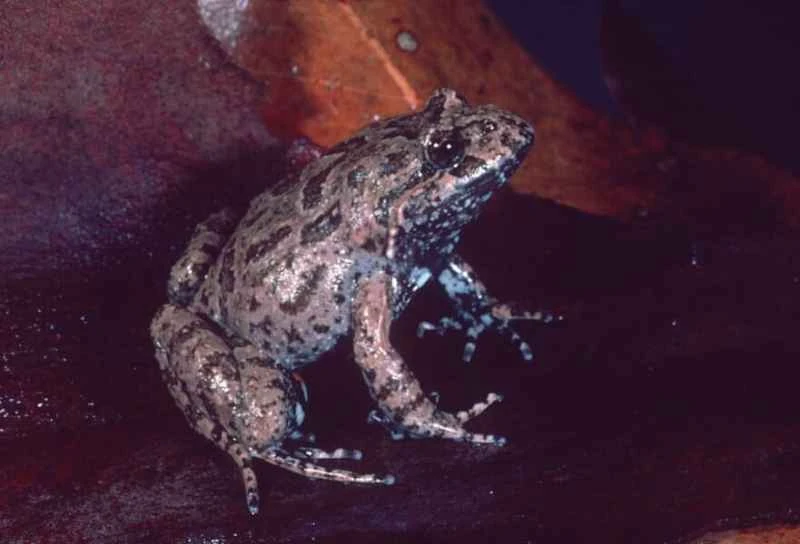
Small to medium-sized frogs with a slightly flattened body. Their backs are dark brown or grayish-brown with irregular dark spots. Male frogs have wider heads and a pair of bony "fangs" hidden in their lower jaws. Their ventral surface is lighter in color, and their limbs are of medium length.
Detailed introduction
The tusked frog ( Adelotus brevis ) is a small to medium-sized, native Australian frog with distinct sexual dimorphisms. It belongs to the genus Myobatrachidae (Tusked Frog). The male has bony protrusions on its lower jaw resembling small tusks, which it uses to push and butt other males during fights, hence its name "tusked frog."
Classification and nomenclature
Chinese reference name: Fanged Frog (general translation);
English name: Tusked Frog;
Scientific name: Adelotus brevis ;
Family: Myobatrachidae → Genus: Adelotus
Appearance and Identification Features
The tusked frog may look like an ordinary terrestrial frog, but the male's oral cavity and head structure are quite unique:
Size: Adults are generally about 3-5 cm in length, belonging to small to medium-sized frogs;
Sexual differences: Male frogs have wider heads and paired bony protrusions ("fangs") on their lower jaws, while female frogs have almost none or very little protrusion.
Body shape: The body is slightly flat, the head is relatively wide, and the snout is relatively short;
Back color: mostly dark brown, grayish brown or blackish hues, often with irregular dark spots or cloud-like spots, which helps to camouflage in damp fallen leaves and soil.
Abdomen: The abdomen is lighter in color, and may be light gray, milky white, or slightly patterned.
Skin texture: The skin on the back is slightly rough with small warts, but not as rough as that of a toad;
Limbs: The limbs are of medium length. The hind limbs are good for short-distance jumping, while the forelimbs are relatively strong and adapted to pushing and fighting between male frogs.
Distribution range and habitat
The tusked frog is a species endemic to the wet regions of eastern and southeastern Australia .
They are mainly distributed in the coastal and near-inland areas from southeastern Queensland to New South Wales;
It can also be found in some humid mountain forests and hilly areas.
Typical habitats include:
Moist forests, rainforests, and moist sclerophyllous forests near the stream;
A streamside environment with fallen leaves, fallen trees, and rocks in valleys and ravines;
The surface and leaf litter around puddles, mud pits and temporary water accumulation areas.
Lifestyle
The tusked frog is a nocturnal, terrestrial frog .
During the day, they mostly hide under fallen leaves, fallen trees, in crevices between rocks, or in caves along stream banks;
They come out at dusk and night, slowly crawling or hopping short distances around damp woodlands, streams and puddles.
They are more active during the wet season and on rainy nights.
vocalizations and behavior
During the breeding season, male frogs will make short, low calls in waterholes or streams to attract females and to declare their territory.
Males will use their lower jaw "fangs" and strong forelimbs to engage in close combat, butting and pushing each other;
This "armed melee" behavior is relatively rare among frogs and is a distinctive feature of the tusked frog.
feeding habits
Like most terrestrial frogs, the tusked frog primarily feeds on small invertebrates:
Surface insects, such as beetles, ants, and crickets;
Larvae, small spiders, and other arthropods in the damp leaf litter;
Occasionally, they prey on insects and other small invertebrates that pass by the water.
Reproduction and Development
The breeding season usually corresponds to the local rainy season or wet period;
Male frogs call out to attract female frogs in shallow puddles, still water areas by streams, or near temporary puddles.
Female frogs lay their eggs in shallow water or in moist microenvironments close to water bodies. Some species of the ground frog family will use foam nests or hidden puddles to protect their eggs.
Tadpoles develop in shallow water, and after metamorphosis, the young frogs return to live in the surrounding woodlands and leaf litter.
Protecting the status quo and threats
In the IUCN Red List, the tusked frog is currently generally assessed as Least Concern (LC) , indicating that its overall population is relatively stable.
Potential threats include:
Stream and wet forest habitats are shrinking and fragmenting due to logging, agriculture, or urban expansion;
Water pollution and hydrological changes affect the quality of breeding ponds and streams;
Climate change is altering rainfall patterns, impacting the stability of wet habitats.
Protecting stream corridors, reducing deforestation, and controlling pollution can help sustain the long-term survival of the tusked frog and other ground frog species.
Frequently Asked Questions
Q1: What does "fangs" in the name of the fanged frog refer to?
These refer to the paired bony protrusions inside the lower jaw of male frogs, resembling tiny "teeth," which they can butt and push against each other during male fights.
It is a very unique structure of this species.
Q2: Are tusked frogs easy to see in the wild?
It's not easy. They are mostly nocturnal, hiding under fallen leaves and fallen trees during the day, and their color is very similar to the ground.
They are usually first heard calling or discovered by chance near a puddle.
Q3: Are tusked frogs dangerous to humans? Do they bite?
Generally, they do not pose a danger to humans; the lower jaw "fangs" are mainly used for fighting among their own kind, rather than attacking large animals.
If it's just a short observation period, simply handle it gently and wash your hands afterwards.
Q4: What role does the tusked frog play in the ecosystem?
It preys on a large number of small invertebrates on the ground and is an important "insect controller." It also provides food for snakes, birds, and small mammals, and is an important part of the food web of woodland and stream ecosystems.