Basic Information
Scientific classification
- Chinese name: Taylor's toad frog
- Scientific name: Uperoleia tyleri
- Order: Anura
- Family and genus: Rhizophora, family Ranidae
Vital signs data
- Body length: Adults are generally about 2–3 cm in length, belonging to a very small, terrestrial frog species.
- Weight: Individual body weight is usually only a few grams or even less, and is greatly affected by individual size and nutritional status.
- Lifespan: It is estimated that it can survive for several years in the wild, and can participate in the breeding season multiple times as long as the seasonal wetland and grassland environment remains relatively stable.
Significant features
It is very small in size and looks somewhat like a small toad. It is nocturnal and terrestrial. Male frogs will make rhythmic calls at seasonal waterholes. It is one of the common small toadlets in Southwest Australia.
Distribution and Habitat
It is mainly distributed in the humid areas of southwestern Australia, and is often found in temporary waterholes, swamps, grasslands along streams, and small wetland environments around farmland.
Appearance
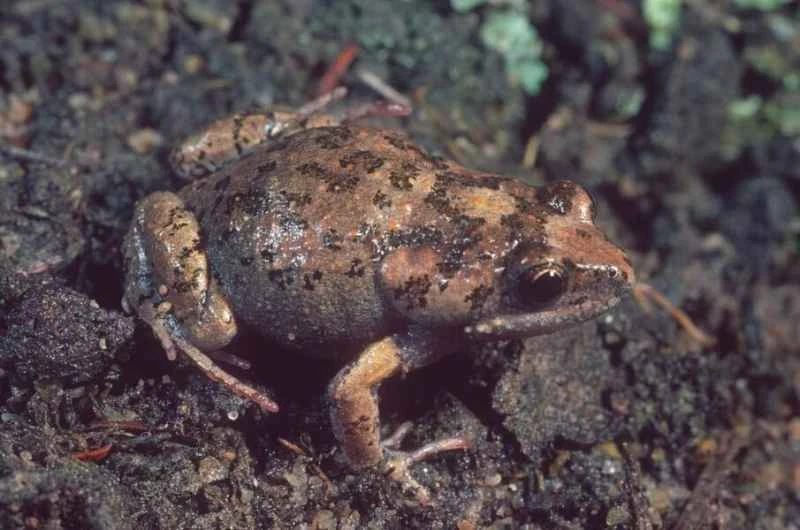
Its body is short, round, and sturdy, with a grayish-brown or brownish-gray back with dark spots, a lighter-colored abdomen, and slightly rough skin; its limbs are short and powerful, suitable for movement on land and in shallow water.
Detailed introduction
Tyler's Toadlet is a small, toad-like frog native to Australia, commonly known as *Uperoleia tyleri* , belonging to the genus *Myobatrachidae*. It inhabits wetlands, swamps, and areas near seasonal waterholes in southwestern Australia, and is a common "ground frog" heard on rainy nights.
Classification and nomenclature
Chinese reference name: Taylor's toad frog (general translation);
English name: Tyler's Toadlet;
Scientific name: Uperoleia tyleri ;
Family: Myobatrachidae → Genus: Uperoleia
Appearance and Identification Features
Although small in size, the Taylor toad frog has a relatively robust body, and its overall appearance is somewhat like a miniature toad.
Size: Adults are generally about 2-3 cm in length, belonging to the very small terrestrial frogs;
Body shape: The body is short, round and sturdy, the head is relatively wide, and the snout is relatively short;
Back color: mostly grayish brown, brownish brown or olive brown, often with irregular dark spots or cloud-like patterns;
Abdomen: The abdomen is lighter in color, and may be milky white, light gray, or slightly patterned.
Skin texture: The skin on the back is slightly rough and has small warts, giving it a somewhat "toad-like" appearance;
Limbs: The limbs are short and powerful, suitable for short jumps or crawling on land and in shallow water;
Lateral and groin areas: Rhizophora species often have orange or red patches on the groin, hind legs, etc. The morphology of the patches varies slightly among different species, which is one of the important detailed features for experts to identify species.
Distribution range and habitat
Taylor's toad frog is a species endemic to southwestern Australia .
Mainly distributed in the southwestern coastal plains and surrounding areas of Western Australia;
It is more common in areas with abundant rainfall and humid winters.
Typical habitats include:
Temporary or perennial waterholes, marshes, and edges of shallow wetlands;
Low-lying grasslands, thickets, and woodlands near streams;
Damp ground and leaf litter around farmland, roadside drainage ditches, and artificial water bodies.
Lifestyle
Taylor's toad frog is a nocturnal, terrestrial frog .
During the day, they mostly hide among rocks, fallen logs, grass, or piles of fallen leaves to avoid high temperatures and dehydration;
They are active in the evening and at night, especially after rain and in damp weather;
Their range is usually small, foraging and breeding within a small area of suitable wetlands and grasslands.
vocal characteristics
The short, rhythmic call of the male Tyler's toad frog is one of the important clues for identifying this species.
The call is often described as a series of clear "tik... tik... tik..." or a soft but rhythmic tapping sound;
They often sing in chorus near puddles, swamps and drainage ditches at night during the rainy season;
On a quiet night, the calls of several male frogs intertwine to form a background sound, indicating the presence of a hidden wetland microclimate nearby.
feeding habits
Like most small terrestrial frogs, the Taylor's toad frog primarily feeds on tiny invertebrates:
Small insects in the ground and leaf litter, such as ants, small beetles, and small crickets;
Spiders, mites, and other arthropods;
Occasionally, they prey on flying insects or larvae that are close to the ground.
Reproduction and Development
Their reproductive activities are closely related to seasonal rainfall and water body formation:
The breeding season usually falls during the local winter or months with higher rainfall.
Male frogs call out to attract female frogs in temporary water pits, shallow pools, and wetland edges;
Female frogs lay their eggs in shallow water or near damp ground, and the egg masses usually attach to or remain in shallow water environments.
Tadpoles develop in small bodies of water and do not require high water depth, but they need to stay in water for a certain period of time.
After metamorphosis, the young frog returns to live in the surrounding grassland and leaf litter.
Protecting the status quo and threats
In the IUCN Red List, the Taylor's toad frog is currently generally assessed as Least Concern (LC) , with the overall population remaining relatively stable in suitable habitats.
Potential threats include:
Wetlands are being drained, filled in, or converted into farmland and urban land, leading to a reduction in breeding water bodies;
Small puddles and marshes are polluted by pesticides, fertilizers, and urban runoff;
Climate change alters rainfall patterns, causing changes in the formation and duration of seasonal water bodies.
Maintaining natural wetlands and small water bodies around farmland, protecting native vegetation, and reducing pollution help ensure the long-term survival of the Taylor toad frog and other small terrestrial frogs.
Frequently Asked Questions
Q1: Why is the Taylor toad frog called "toadlet" (little toad)?
Although it is taxonomically classified as a frog rather than a typical toad, its small, stocky body and slightly rough skin give it an appearance somewhat similar to a miniature toad.
Therefore, the English common name for it is toadlet.
Q2: Are Taylor's toad frogs easy to spot in the wild?
Not so easy. They are very small, their color blends in with the soil and fallen leaves, and they are mostly active at night, hiding very well during the day.
Many observation records show that the male frog was first heard calling, and then the individual was found after a careful search in the water puddles or wetlands.
Q3: Is the Taylor's toad frog dangerous to humans?
It is generally believed that it poses no direct danger to humans and will not attack them unprovoked. Like other frogs, its skin secretions may slightly irritate the mucous membranes.
Simply wash your hands after observing the condition.
Q4: What role do these small frogs play in the ecosystem?
They prey on ants, small beetles, and other small invertebrates in large numbers, making them natural "pest controllers."
It is also a food source for snakes, birds, and small mammals, playing an important role in wetland and grassland food webs.