Basic Information
Scientific classification
- Chinese name: Purple-breasted crowned dove
- Scientific name: Southern crowned pigeon (Goura scheepmakeri)
- Classification: Landfowl
- Family and genus: Columbidae, Columbidae, Cormorant
Vital signs data
- Body length: Approximately 75 cm
- Weight: No verification information available.
- Lifespan: No verification data available.
Significant features
Dark chestnut breasts
Distribution and Habitat
It is found only in a large area of Papua New Guinea and Indonesia, but in small numbers. The Purple-breasted Crested Pigeon has become extinct in the southeastern part of the New Guinea Islands.
Appearance
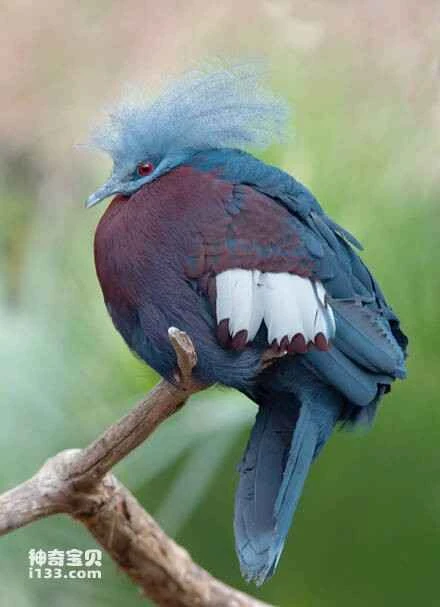
It is a large crested pigeon, 75 cm long, bluish-grey in color, with a blue filamentous crest, red pupils, and a dark chestnut breast. The male and female pigeons are similar.
The Purple-breasted Crested Pigeon has two subspecies, distinguished by the color of its shoulders and abdomen: the subspecies *G. s. sclateri*, mainly distributed in southwestern Papua New Guinea, has chestnut shoulders and a bluish-grey abdomen; the subspecies *G. s. scheepmakeri*, mainly distributed in southeastern Papua New Guinea, has bluish-grey shoulders and a chestnut abdomen.
Detailed introduction
The Southern crowned-pigeon (scientific name: Goura scheepmakeri) has two subspecies.
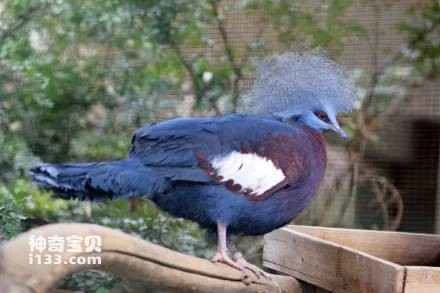
The Purple-breasted Crowned Pigeon was first described by Otto Finsch, whose live specimen was obtained from C. Scheepmaker of Amsterdam Zoo and named after him.
The Purple-breasted Crested Pigeon is docile and is mostly found in wetlands and alluvial plains at an altitude of about 500 meters. They usually stay in trees. They begin breeding at 15 months old, laying one egg at a time. After the egg hatches, they will care for the chicks for several months.
Due to deforestation and the high value of the meat and feathers of the Purple-breasted Crested Pigeon, humans (including local indigenous people) have been hunting this rare lowland bird extensively. The species was declared a threatened species in 1988; since then, from 1994 onwards, the Purple-breasted Crested Pigeon has been listed as a vulnerable species by the International Union for Conservation of Nature (IUCN), and its numbers have been gradually declining. It is also listed as a Category II protected species under the Convention on International Trade in Endangered Species of Wild Fauna and Flora (CITES).
Protect wild animals and ban the consumption of wild game.
Maintaining ecological balance is everyone's responsibility!