Basic Information
Scientific classification
- Chinese name: Blue Crowned Dove
- Scientific name: Western crested pigeon, Blue crested pigeon, Common crested pigeon, Western crested pigeon, Goura cristata, Blue Crowned Pigeon
- Classification: Landfowl
- Family and genus: Columbidae, Columbidae, Cormorant
Vital signs data
- Body length: 70-75 cm
- Weight: 1.8-2.4kg
- Lifespan: No verification data available.
Significant features
It is the most beautiful member of the pigeon family, and also the largest, almost as big as a turkey.
Distribution and Habitat
It is distributed in Indonesia.
They typically inhabit forests and swamps near water or partially submerged, as well as hilly forests below 350 meters in altitude. They also live in forests with dense secondary growth and mangroves.
Appearance
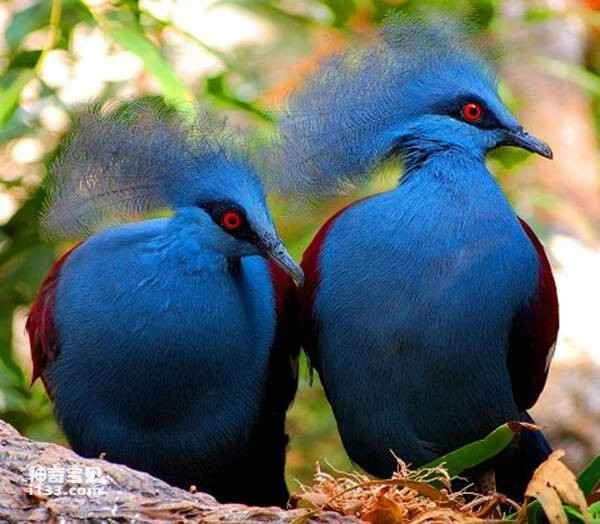
The Blue-crowned Pigeon measures 70-75 cm in length and weighs 1800-2400 grams. This species challenges conventional wisdom about pigeons; the largest pigeon in the world, resembling a small turkey, it is actually a close relative of the spherical dodo, yet it is also one of the most beautiful pigeons. Sexes are similar. It has a long, slender beak, and deep blue feathers extend to its eyes and cheeks. Its plumage is entirely blue, with smooth, clean feathers, a white patch on the tail and under the wings, and a slightly purplish tinge from the middle of the wings to the chest. It has bright red eyes, with darker feathers around the eyes, and small spots on its legs. Each foot has four toes, three pointing forward and one backward. The most striking feature of the Blue-crowned Pigeon is its prominent, pale blue, fan-shaped crest on its head, present in both males and females. This crest, resembling a phoenix crown, is an effective courtship tool during the breeding season, hence its name. The species' plumage may also be partially or entirely black.
The plumage is relatively soft and dense. The beak is short, with a soft cere at the base; the upper mandible is enlarged and hard, with a slightly curved tip. The nostrils are slit-like or covered by feathers. The neck is short. The wings are long and pointed or rounded, with 11 primary flight feathers and the fifth secondary flight feather absent. The tail is rounded or wedge-shaped. The legs are short and strong. The leading edge of the tarsus is covered with shield-like scales. The toes are four-toed, on the same plane, without webbing between them. The preen gland is underdeveloped.
Detailed introduction
The Blue Crowned Pigeon (scientific name: Goura cristata) has three subspecies.
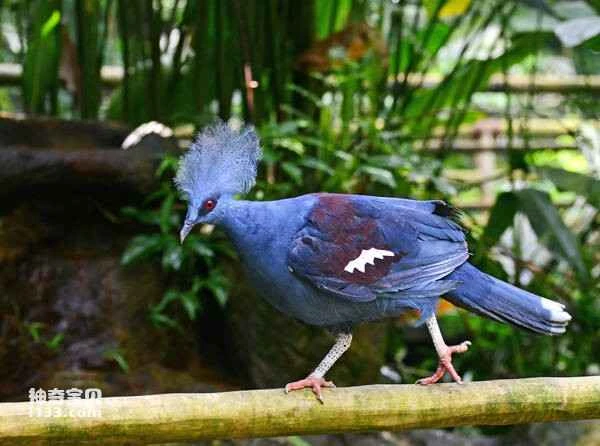
The Blue-crowned Pigeon is a resident bird. It nests in trees. They typically live and forage in small groups of 2-10 individuals, searching for fallen fruit and seeds, as well as any insects they encounter. Their habits are similar to those of a pheasant. Their main diet consists of various plant seeds, fruits, and insects. The Blue-crowned Pigeon's breeding season is in spring, during which the male and female will display their fan-shaped crests in courtship.
The Blue-crowned Pigeon is adorned with a pale blue, fan-shaped crest of feathers on its head; both males and females possess this tuft, resembling a crown. During the breeding season, males and females will display their fan-shaped crests, with the male calling loudly, bowing, and showcasing its fan-shaped tail and partially open wings. The male will also dance with its wings outstretched upwards, while the female will raise her wings high and circle around the male. Afterward, the male will show the female the nesting materials he has prepared, and together they will build a simple, disc-shaped nest in a tree. The female lays one white egg, about the size of a pigeon's egg, per clutch. Incubation occurs at night, with the male taking turns during the day, for a period of 28 days. The chicks are altricial, and the parents secrete pigeon milk to feed them for a month. Once the chicks mature, the parents continue to feed them for several more months. The young birds live with their parents until the following year, after which they begin to live independently.
The Blue-crowned Pigeon has been heavily hunted for food and its beautiful plumage (although its numbers are smaller than the other two species due to lower gun ownership in Indonesia compared to Papua New Guinea), and is likely affected by "significant" trade levels, extensive logging concessions within its range, and habitat loss due to substantial migration programs. Road construction, oil and mineral exploration have also increased intrusion and hunting. Like the Purple-breasted Pigeon and the Swinhoe's Pigeon, this species may already be uncommon in logging forests (2016). Conservation efforts are underway, and the species is protected in Indonesia for commercial trade and domestic use. All of West Papua has a single protected area, and there are three very large nature reserves in the Papuan interior, but most are in mountainous areas.
Protect wild animals and ban the consumption of wild game.
Maintaining ecological balance is everyone's responsibility!