Basic Information
Scientific classification
- Chinese name: jellyfish
- Scientific name: Medusozoa, Jelly Fish
- Classification: Coelenterates
- Genus and species: Jellyfish
Vital signs data
- Body length:
- weight:
- life:
Significant features
Jellyfish are very beautiful aquatic animals. Their bodies are shaped like transparent umbrellas, with varying diameters. The main component of a jellyfish's body is water, and it propels itself forward by jetting water from within its body. From a distance, they look like round umbrellas drifting swiftly in the water.
Distribution and Habitat
Jellyfish are found in waters all over the world, with more than two hundred species discovered. They can be found in tropical and temperate waters, shallow and deep seas, and even freshwater. Jellyfish existed as early as the Ediacaran period.
Appearance
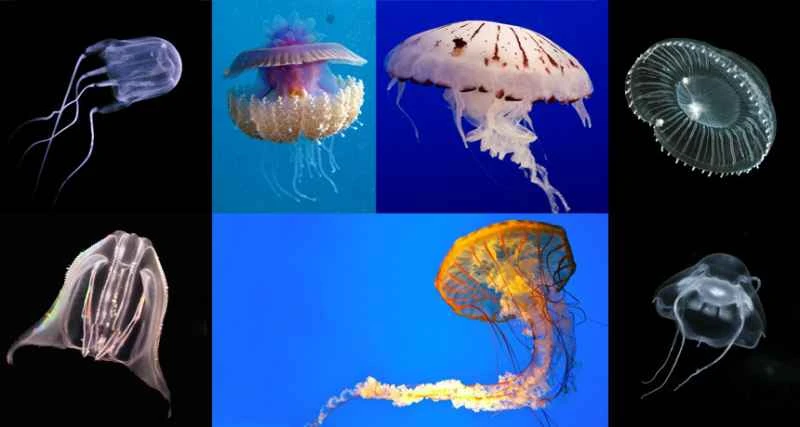
Jellyfish lack brains, skeletons, hearts, blood, gills, and mouths. Their bodies are typically over 95% water, and they resemble a transparent umbrella. The edge of the umbrella-shaped body has tendrils resembling tentacles, some of which can reach 20-30 meters in length. Jellyfish lack eyes and mouths, but they have "eyes" (or "points") in the notch along the edge of the umbrella that can sense light intensity. Most large, brightly colored, and eye-catching jellyfish found in coastal waters worldwide belong to the class Meconopsis. Their diameter is typically 2-40 centimeters, but the largest species, the lion's mane jellyfish, can reach 2 meters in diameter.
Detailed introduction
Jellyfish are important planktonic organisms in aquatic environments, including cnidarians such as Scyphozoa, Cruciformes, and Cubozoa. They can be found in tropical waters, temperate waters, shallow waters, oceans at depths of about 100 meters, and even freshwater areas. Jellyfish have existed for 650 million years, even predating dinosaurs. There are over 250 species of jellyfish worldwide, distributed in waters around the globe. All live in the ocean. The life cycle of jellyfish is very complex, varying greatly in length, with most jellyfish living only a few weeks or months. Related research is relatively scarce. The most unique is the Turritopsis nutricula, which can achieve "immortality" through repeated reproduction and transdifferentiation.
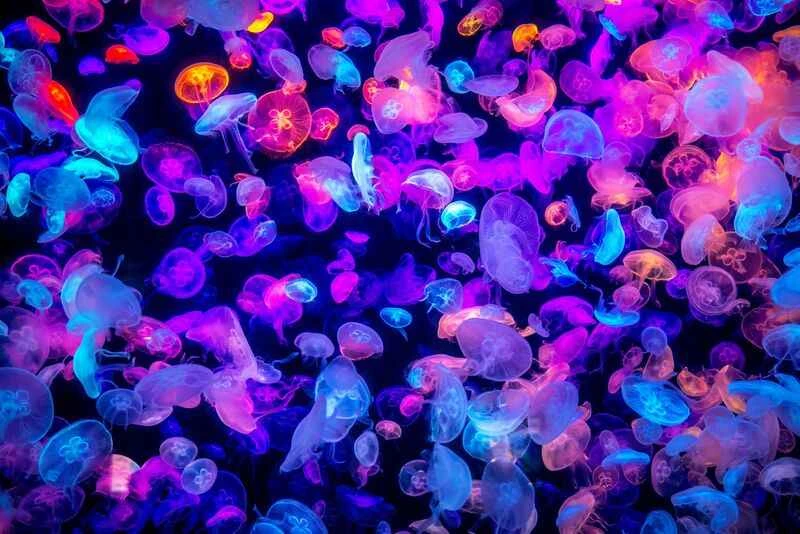
All jellyfish are carnivorous, feeding on fish and plankton. When hunting, jellyfish are passive, only catching animals that swim close to them. They use nematocysts on their tentacles to sting or kill their prey, then deliver the food to their mouths and digestive tracts. Most jellyfish are almost transparent, making them difficult for predators to spot. Some jellyfish are bioluminescent, attracting prey effortlessly with their faint glow.
Despite the protection of their nematocysts, jellyfish are still preyed upon by sea turtles and ocean sunfish, and are also a delicacy for many. If sea turtle populations decline, jellyfish reproduction rates will surge. Overpopulation of jellyfish will naturally affect the reproduction of other fish and plankton, leading to an imbalance in the ecosystem.

In the waters between Malaysia and Australia, there are two types of jellyfish, called the Australian box jellyfish and the hand jellyfish. Their venom is highly potent; a sting can cause death within minutes due to respiratory distress, earning them the nickname "killer jellyfish." A sting from such jellyfish can be fatal within a short time. However, in most cases, the sting only causes extreme pain, nausea, a rash, and welts, sometimes lasting for weeks. If breathing difficulties occur after a jellyfish sting, artificial respiration or an injection of cardiac stimulants should be performed immediately. Do not underestimate the danger, and seek medical attention promptly.
Although jellyfish appear beautiful and gentle, they are actually quite ferocious. Because jellyfish lack respiratory and circulatory systems, possessing only primitive digestive organs, their prey is immediately digested and absorbed within their cavities. Once a jellyfish encounters prey, it never lets it go easily. However, just as a rhinoceros coexists with the small bird that cleans its parasites, jellyfish also have their own symbiotic partners. One such partner is the small pufferfish (Nomeus gronovii), which, at only 7 centimeters long, can freely swim among the jellyfish's tentacles without fear. When a large fish approaches, the small pufferfish swims into the tentacles under the jellyfish's umbrella-like tentacles, using it as a safe "refuge," cleverly evading attacks using the jellyfish's stinging cells. Sometimes, the small pufferfish can even lure large fish into the jellyfish's hunting range, causing their death, and then consuming the scraps left behind. So why don't the stinging cells on the jellyfish's tentacles harm the small pomfret? This is because the small pomfret is agile and skillfully avoids the stinging threads, making it relatively unharmed, although occasionally it may accidentally die from them. The jellyfish and the small pomfret live in a symbiotic relationship, each benefiting the other. The jellyfish "protects" the small pomfret, while the small pomfret devours the small creatures that inhabit the jellyfish. Although jellyfish appear beautiful and gentle, they are actually quite fierce. Because jellyfish lack respiratory and circulatory systems, possessing only primitive digestive organs, their prey is immediately digested and absorbed in their endothelium. Once a jellyfish encounters its prey, it never lets it go easily. However, just like a rhinoceros and the bird that cleans its parasites, the jellyfish also has its own symbiotic partner. This is a species commonly known as the small pomfret, the dipterolance (Nomeus gronovii), which is only 7 centimeters long and can swim freely among the jellyfish's tentacles without any fear. When a large fish swims by, the small jellyfish swims to the tentacles under the jellyfish's umbrella, using it as a safe "refuge." Utilizing the jellyfish's stinging cells, it cleverly evades the predator's attack. Sometimes, the small jellyfish can even lure the large fish into the jellyfish's hunting range, causing its death, and then it can eat the scraps left behind. Why don't the stinging cells on the jellyfish's tentacles harm the small jellyfish? This is because the small jellyfish is agile and can skillfully avoid the stinging threads, making it difficult to be harmed. Only occasionally does it accidentally die from being stung by the stinging threads. The jellyfish and the small jellyfish live in symbiosis, mutually benefiting each other. The jellyfish "protects" the small jellyfish, while the small jellyfish devours the small creatures that inhabit the jellyfish's body.
Jellyfish can reproduce both asexually and sexually. After the sperm and egg of a jellyfish combine, it generally goes through four stages before developing into a jellyfish: planktonic body, polyp, discoid body, and jellyfish larva.
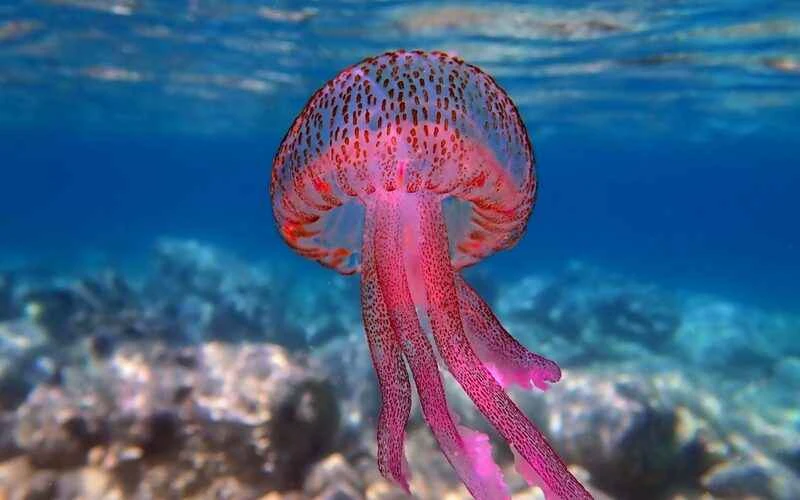
The bioluminescence mechanism of jellyfish has always been an important research topic. In 2008, Osamu Shimomura, a senior researcher at the Woods Hole Marine Biological Laboratory in the United States, Martin Chalfie, a professor at Columbia University, and Roger Tsien, a professor at the University of California, San Diego, were awarded the Nobel Prize in Chemistry for their research on the bioluminescence mechanism.
jellyfish's natural enemies
Currently, the following creatures in nature are known to prey on jellyfish:
Sharks: Sharks occasionally prey on jellyfish, but most of the time they do not.
Sea turtles feed on jellyfish. Except for their eyes, the rest of their bodies are resistant to jellyfish venom, and they close their eyes when hunting. However, due to the large amount of marine debris, sea turtles often mistake floating plastic bags for jellyfish and suffocate after ingesting them.
Mambo fish: feeds on jellyfish.
Purple snails: They are found in the warm waters of the tropical Pacific Ocean and love to eat jellyfish that float on the surface of the water.
Humans: Some people eat jellyfish and make it into a dish called jellyfish skin.