
Basic Information
Scientific classification
- Chinese name: Spider
- Scientific name: Web-weaving spider, flat spider, garden spider, octopus, pygmy spider, bougainvillea
- Classification: Arthropoda
- Classification: Arachnida, Chelicerata, Arachnida
Vital signs data
- Body length: 0.05 mm to 60 mm
- Weight: 1 mg - 230 g
- Lifespan: 8 months - 20 years
Significant features
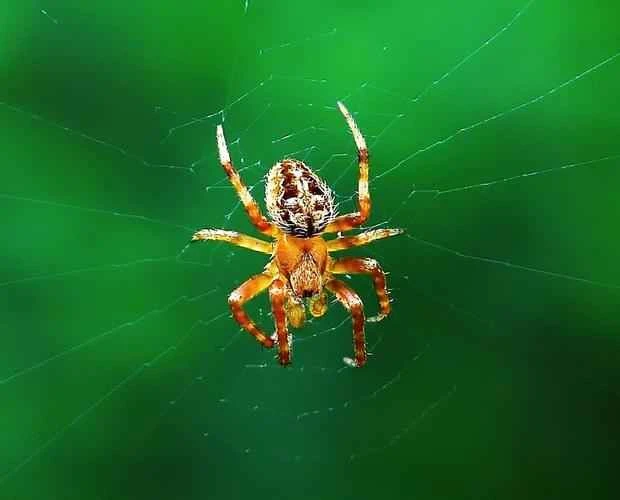
Spiders are arachnids with bodies divided into a cephalothorax and an abdomen. They have eight legs and no antennae. They mainly capture prey by spinning webs. Some species are venomous and use their venom to subdue their prey.
Distribution and Habitat
They are found all over the world, from the tropics to the Arctic, and mostly inhabit eaves, corners of walls and among trees, or live underwater in airy silk dwellings, or on mountaintops.
Appearance
Body structure: A spider's body is divided into a cephalothorax and an abdomen, connected by a slender peduncle. A pair of chelicerae (claws) are located at the front of the head, with fangs ending in venom gland ducts. The number of eyes varies among spiders, including simple, eight-eyed, six-eyed, and four-eyed spiders.
Leg features: Spiders have four pairs of legs on both sides of their thorax, with hard claws at the tips of the legs, used for walking and climbing.
Detailed introduction
Spiders (scientific name *Araneida*; *Araneae*, foreign name *Spider*) are also known as web-weavers, flat spiders, garden spiders, eight-legged hydras, and spiders with many legs. They are arthropods belonging to the subphylum Chelicerata. The spider's body has two segments: a cephalothorax and an abdomen, connected by a slender pedicel. A pair of chelicerae (chelicerae) are located at the front of the head, ending in venomous fangs with venom gland ducts. Four pairs of legs are located on either side of the thorax, with hard claws at the tips. Spiders typically have simple eyes, although some have eight, six, or four eyes, but they lack chewing organs. Wang Anshi's *Zi Shuo* records: "A spider sets up a web on one side, and when an animal touches it, it is killed; hence the name 'spider'." In ancient times, they were also called *hu* (pronounced "du yu") or *ci hua* (pronounced "qiu"). In some parts of Sichuan and Chongqing, they are called *zhe*, while in Cantonese they are called *qian hua*. As of June 2023, there are 132 families, 4325 genera, and 51164 species. Araneae are the most numerous order within the class Arachnida. The study of spiders is called arachnology.
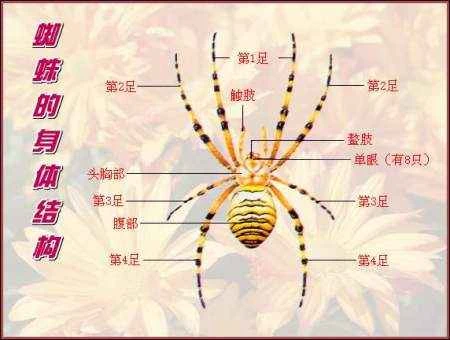
structure
1. Palpations
2. Head and chest
3. Abdomen
4. Feet
5. One eye (6 or 8 eyes)
Toxicity : All spiders, except for three groups of approximately 350 species in the families Spiralidae, Holarchaeidae, and Mesothorax, can inject venom to protect themselves or kill prey. However, only about 200 species bite humans and may cause health problems. Bites from many larger species may have some effect, but usually do not cause lasting health problems. A few species, such as the black widow spider, the giant garland spider, and the birch tarantula, can be fatal to humans.
Digestion
1. Book lungs
2. Spinning machine; spinning apparatus
3. Genital plate
4. Tracheal valve
In spiders, the body segments of most arthropods fuse into two segments: the cephalothorax and the abdomen, connected by a small, cylindrical stalk. Like all arthropods, their body cavity is small, the main one being the hemocoel. Hemolymph transports oxygen and nutrients to the tissues and removes waste through the hemocoel. Their digestive system is so narrow that spiders cannot eat large pieces of solid food. Therefore, they liquefy their food by filling it with digestive enzymes and grind it with their appendages near their mouths.
Locomotion : Except for the most primitive suborder Mesospidula, all spiders possess the most concentrated nervous system of all arthropods—all of them are interconnected. Unlike most arthropods, spiders do not have extensor muscles in their legs; instead, they extend their legs using hydraulic pressure.
Spider silk : Spiders possess silk sacs on their abdomens, from which they can extrude up to six types of silk from glands. The silk is secreted by silk gland cells; within the gland cavity, it is a viscous liquid. After being expelled through the spindle, it quickly solidifies into a filament upon contact with air. The silk has a specific gravity of 1.28, making it strong, tough, and elastic. Its lightweight, strength, and elasticity far surpass those of man-made materials. Furthermore, the genes for spider silk have been inserted into mammals and plants to explore their potential as silk-producing factories.
Web-dwelling spiders spend their days inside their webs and their nights guarding the entrance, waiting to hunt or venture out to forage. Male spiders dig a shallow pit under a clod of earth, while burrowing wolf spiders dig a deep, vertical burrow. Dancing spiders add a slipknot to the entrance, made of multiple layers of silk. The burrow of the giant spider can reach a meter in depth. This spider is small but highly venomous; a bite to a rabbit will kill it within four minutes.
When spiderlings begin their web-building life, if their silk cannot attach to any object but there is an updraft, they will take off and fly with the wind. Spiders of the families Orb-weavers, Wolf Spiders, Robber Spiders, and Jumping Spiders all possess the ability to "fly." (Spider flight: If a spider called a balloon spider is interested in balloons made by humans, it will also despise them. On a windless, sunny summer day, this spider will weave a silk thread that stretches straight into the air in the warmth of the sunlight. Like a soaring bird, it first finds a place with an updraft.) Whether the spider spins silk again, or spins silk first and then uses the surrounding heat molecules to create an updraft, I don't know. But in any case, the silk rises and rises until the spider knows it can support its own body, then it releases, soaring through the air for miles with the wind for several hours. Its heavy body is supported and carried by a single silk thread that weighs less than one percent of its own weight. The standardized conditions at this moment (which are the result of all sorts of incredible, minute adjustments, including adjustments to sunlight, wind, length, and the length of the woven silk thread) are very effective in preventing cannibalism and excessive density.
Spider silk is five times stronger than steel wire of the same volume. After spinning its web, the spider lies in the center, waiting patiently for insects to fall into its trap.
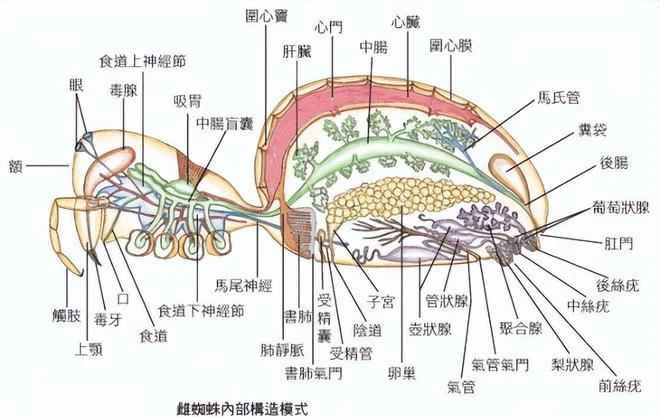
Anatomy : Spiders, unlike insects, have only two tagmas instead of three: the fused head and thorax (called the cephalothorax or prostomy) and the abdomen (called the metastomy). An exception is the assassin spider, whose cephalothorax is almost divided into two separate units. Except for a few very primitive spider species (such as the tarsiidae family), the abdomen is not externally separated. The abdomen and cephalothorax are connected by a thin lumbar region called the somite, allowing the spider's abdomen to move in any direction. This lumbar region is actually the final somite segment of the cephalothorax; most other members of the arachnid class have lost this segment (in scorpions, it is only detectable in the embryonic stage).
Spiders have two short pedipalps next to their mouthparts, which are significantly shorter than their legs and are similar to the antennae of insects. They have the functions of touch, smell and hearing. The ends of the male spider's pedipalps are shaped like gloves, which can be used to transfer sperm during mating. Hunting female spiders use their pedipalps to carry egg sacs.
Predation : Apart from Bagheera kiplingi, which is primarily herbivorous and omnivorous, most other known spiders are predators that are mainly carnivorous, feeding mainly on insects and other spiders. However, some larger species also prey on birds, lizards, and snakes. Many spider larvae feed on nectar, and there is statistical evidence that even adults feed on pollen.
Spiders have modified their stingers into fangs, typically used to inject venom into their prey. Because relatively few species' venom is dangerous to humans, scientists are now researching the medical uses of spider venom and its application as an insecticide.
Spiders use sticky webs as traps to capture, ambush, or directly hunt prey. Species that use webs or ambush tactics are extremely sensitive to vibrations in the air, ground, and silk, using them as warning lines; while aggressive predators possess eyesight up to ten times more accurate than dragonflies. Some aggressive predators employ different tactics for different prey and show signs of intelligence—they try various tactics with difficult prey and quickly learn which tactic to use with unfamiliar prey. Other species have modified body shapes and behavioral patterns that allow them to mimic ants when hunting. Spider webs come in many different sizes, shapes, and amounts of sticky silk. The spiral ball web is now considered to be one of the earliest forms. Even though spiders with ball webs are well-known and the most extensively studied, they are still a minority among all spider species, which produce many other types of webs, likely because their intricate webs are a formidable threat to predatory wasps.
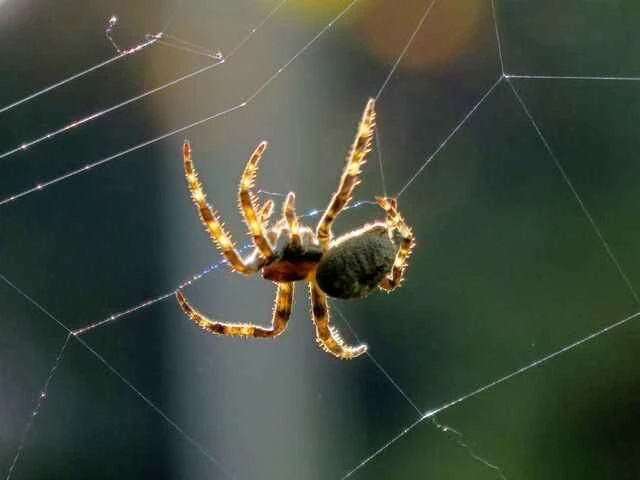
After spinning its web, the spider lies in the center, waiting patiently for insects to fall into its trap. A small leaf or a thin, withered twig lands on the web, and the spider trembles briefly before remaining still. However, if a careless insect bumps into the web, the spider eagerly scrambles over, spraying sticky silk to bind its prey, paralyzing it with its fangs, and then sucking up the liquid after the prey's tissues have dissolved. How does the spider know it's about to have a delicious meal? It has vibration sensors shaped like slits on its legs. When a withered twig or leaf touches the web, it remains still, so the spider only trembles for a fleeting moment. If it's an insect that bumps into the web, it will struggle, thus sending a vibration signal to the spider. Strangely, the spider's reaction to insects that bump into the web is completely different: if it's a fly, it immediately rushes to bind it; if it's a bee, the spider remains still. Is the spider afraid of bee stings? No. Scientists have discovered that spiders are most sensitive to vibrations in the 40-500 Hz frequency range. The frequency of a fly's wing flapping falls within this range, while a bee flaps its wings more than 1000 times per second, so it doesn't attract the spider's attention. It has been found that spider webs are extremely important to spiders' lives. Spider webs are not only traps and food sources for these animals, but also their communication lines, pathways, breeding grounds, and nurseries. Why don't spiders get stuck in the sticky silk as they move back and forth on their webs? Spiders usually use dry silk as a runway. When they need to walk on sticky silk, their eight legs secrete an oil as a lubricant, allowing them to move freely in and out of the web.
Reproduction : Before mating, the male spider weaves a sperm web, deposits a drop of sperm-containing fluid onto the web through its genital opening, and then sucks the sperm into its pedipalp. Some spiders exhibit courtship behaviors during mating, such as wolf spiders and jumping spiders waving their pedipalps. European robber spiders offer females flies wrapped in silk, mating while the female is feeding; if flies are unavailable, small stones are used instead. Most male spiders insert their left pedipalp into the left opening of the female's genital plate during mating, and their right pedipalp into the right opening. After the sperm enters the genital plate, it is transferred to the seminal receptacle, which connects to the oviduct. Fertilization occurs as the eggs pass through the oviduct to the genital opening. Some male spiders refill their copulatory organs with sperm after mating and mate again with the same female. After mating, some species of male spiders apply a secretion (genital plug) to the female's genital plate to prevent further mating. Some male spiders are eaten by the female after mating, but this is uncommon. Male black widow spiders die a few days after mating, and occasionally, due to their weakness after mating, they are preyed upon by female spiders.
Male spiders have modified their pedipalps (appendages next to their fangs) into syringes for injecting their genitals. To avoid being eaten before mating, male spiders display their primordial status through complex courtship rituals. In most species, males survive several matings, primarily due to their short lifespans, and in a few species, males can even live within their mate's web for a period. However, some species' males impal themselves on the female's fangs during mating. Like other male spiders, they stop eating and drinking after reaching maturity, relying solely on stored energy, making them ill-suited for the arduous journey. The slender red-backed male spider appears quite imposing within its web; once away from its safe haven, even ants cannot defeat it. This is likely to ensure its mate receives adequate nutrition, thereby increasing the potential number of offspring.
When the male redback spider inserts its sperm-producing organ into the female's body, it inverts itself using its forelimbs as a fulcrum, suspending its body near the female's mouth. While it injects sperm, the female, 200 times its size, begins to chew on its abdomen. Even more remarkably, the male has a chance to escape. It has two copulatory organs; after inseminating with one, it can escape the female's jaws and survive. However, within 20 minutes, the male usually returns to the female's web for a second mating, this time without hesitation. A male that mates twice delivers over 1000 more sperm than one that mates only once. This extra 1000 sperm is for the continuation of the entire species.
Some female spiders mate only once, while others may mate with multiple males successively. After mating, the female lays one egg sac containing several to a thousand eggs, or several egg sacs, each containing fewer eggs than the last. Some species die after laying their last egg sac or after caring for the young spiders; these females typically live for 1-2 years. Orthotic spiders have a lifespan of 20 years.
Some primitive species have egg sacs composed of several layers of silk, spherical or disc-shaped, attached to rocks, and some female spiders guard these sacs. Wolf spiders carry their egg sacs on their chelicerae or spindles. After hatching, the young wolf spiders climb onto their mother's back and remain for about 10 days before leaving. Some mother spiders take their young to bask in the sun, while some females feed them. In Europe, there is a species of spider where the mother dies when the young begin to feed, becoming food for them. The young spiders resemble adults, maturing through several molts. Females molt 6–12 times, and males 2–8 times. Some molt 1–2 times before hatching. Orthocheirans require 3–4 years to mature. They mostly overwinter as juveniles. Development and molting are controlled by hormones. Many young spiders can climb to the tips of leaves or treetops, raise their abdomens, and release several tufts of silk that are dispersed by the wind.
The female spider spins silk to form an egg sac containing fertilized eggs. The egg sac is attached to the web (in the case of a web-building spider), or laid under a stone or on a leaf. Some mother spiders guard the egg sac, while others carry it with them. The hatched spiderlings remain inside the egg sac for several days, molting 1-2 times within it. Spiderlings molt 4-10 times before reaching maturity. Spider silk plays a vital role in the life of a spider. Web-building is an instinct for many spider species. Webs come in various types, and the methods of web-building differ. Many spider species, especially spiderlings, can fly using silk.
Spiders are oviparous, with eggs typically encased in a silken egg sac. Females protect and carry these sacs in various ways, such as placing them on webs, under rocks, on branches, or holding them in their mouths or thoraxes. They undergo incomplete metamorphosis, with their abdomens remaining segmented during the embryonic stage. They may or may not build webs. Webs include orb-shaped webs, funnel-shaped webs, triangular webs, and irregular webs.
Spiders not only exhibit sexual dimorphism, with males being smaller than females, but some also display different colors. For example, male jumping spiders have bright body colors while females have dull body colors, and male crab spiders have red markings on their backs while females are entirely green.
Male spiders reach sexual maturity earlier than female spiders, and male spiders are present for a shorter period of time. Generally, most of the spiders collected are female spiders. Spiders have a unique mating method. For example, after mating, if the male is not killed by the female spider and manages to escape, he can mate again.
Before laying eggs, female spiders first create a "laying mat" with silk. They lay their eggs on it and then cover it with silk again, weaving the egg sacs into a fixed shape. A female spider usually lays only one egg sac, but some lay multiple sacs; for example, garden spiders lay 5-6 sacs, and red-spotted venomous spiders lay 13. The number of eggs a female spider can lay can range from a few to hundreds; for example, red-spotted venomous spiders can lay 60-720 eggs, and some species in the garden spider family can lay up to 1000 eggs.
Female wolf spiders weave egg pouches from silk, each containing hundreds of eggs. The hatched spiderlings remain inside the pouches, undergoing one molt before leaving. Because wolf spiders not only hunt with their egg pouches but also carry their young with them after hatching, they are called nanny spiders. Some females die after weaving the egg pouches, some continue living for a period after the young emerge, and some are even eaten alive by their own hatched young. These spiders then hatch into smaller, similar adults, but most are unable to eat until their first molt. Many species of females care for their young, such as carrying them on their backs or sharing food with them.
Before reaching maturity, spiders undergo multiple molts as they grow. The number of molts and the intervals between them vary considerably. Generally speaking, small spiders molt 4-5 times in their lifetime; medium-sized spiders about 7-8 times; and large spiders about 11-13 times. For example, male spiders of the red-spotted spider molt 5 times, and female spiders molt 7 times.
A few species are social, building communal webs that can house anywhere from a few to 50,000 spiders. Social behaviors range from tolerating the instability and danger of spiders—like the aggressive widow spider—to cooperative hunting and food sharing. Spiders are long-lived; most complete their life cycle, typically between 8 months and 2 years. Male spiders are short-lived, dying shortly after mating. Others, such as water spiders and cunning spiders, can live up to 18 months, burrowing wolf spiders up to 2 years, and crab spiders over 2 years. Other spiders, such as tarantulas and other protozoan spiders, can live up to 20–30 years in captivity.
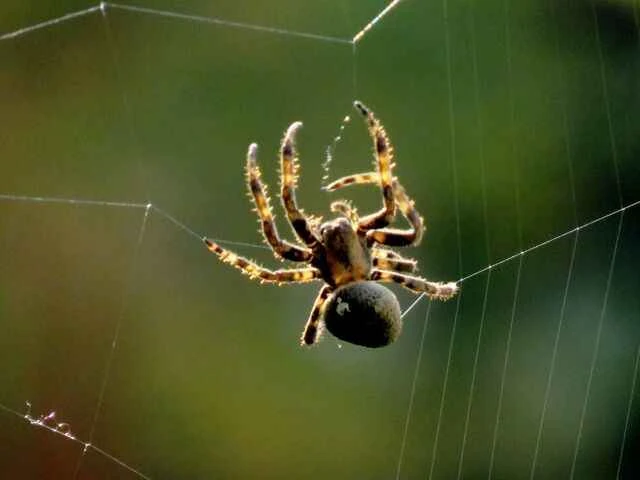
Morphological characteristics
Spiders vary in body length from 0.05 mm to 60 mm depending on the species. The body is divided into a cephalothorax and an abdomen. Some species have a thoracic plate on the dorsal side of the cephalothorax (some do not). The anterior end of the cephalothorax usually has eight simple eyes (though some have six, four, two, or none), arranged in two to four rows. The ventral side has a large sternum, with a labium between the two frontal lobes in front of the sternum. The abdomen is unsegmented; the peduncle evolved from the first abdominal segment (the seventh somatic segment). The abdomen is mostly round or oval, sometimes with various protrusions and unique shapes. The spinnerets on the ventral side of the abdomen evolved from appendages. A few primitive species have eight spinnerets, positioned slightly anteriorly; most species have six, located anterior to the anus at the posterior end of the body; some species have four spinnerets, each with numerous spindles connected to various silk glands, from which silk is spun. Sensory organs include eyes, various sensory hairs, auditory hairs, lyre-shaped organs, and tarsi.
Spiders are covered by a chitinous exoskeleton, and their bodies are clearly divided into a cephalothorax and an abdomen, which are often connected by a stalk formed from the first abdominal segment. They lack a telson or tail whip. Spiders have no compound eyes. The cephalothorax has six pairs of appendages. The first and second pairs are head appendages. The first pair consists of chelicerae, usually with two segments. The swollen base is the chelicerae, and the pointed tip is the fang. The fangs are tubular, and venom glands are located within the chelicerae or cephalothorax, through which the secreted venom is released. The second pair of appendages are called pedipalps, resembling walking legs but with only six segments. The base of the pedipalp forms a jaw-like projection near the mouth, aiding in feeding. The terminal segment of the female spider's pedipalp remains largely unchanged, while the terminal segment of the male spider's pedipalp is specialized as a reproductive accessory, possessing structures for storing and transferring sperm, called pedipalps. The third to sixth pairs of appendages are walking legs, composed of seven segments, ending in claws. Below the claws is a tuft of stiff hairs, making them suitable for crawling on smooth surfaces.
Spiders belong to the phylum Arthropoda. They have a pair of chelicerae at the front of their heads, with venomous fangs at the ends of their chelicerae; they also have four pairs of legs on both sides of their thorax, with hard claws at the tips of their legs; spiders have simple eyes, but some have eight, six, or four eyes.
Spider mouthparts, consisting of chelicerae, palpebrae stem segments, labrum, and labium, are used to poison, capture, crush food, and suck sap.
Some spiders have tufts of sticky hairs under their tarsal claws, which enable them to climb on smooth, vertical surfaces. Web-building spiders have several claw-like spines near the tip of their tarsi, called accessory claws.
Most spiders have unsegmented abdomens. The presence or absence of an external female organ (called the genital operculum) is an important characteristic for identifying female species. Specialized spinnerets are located on the ventral surface of the abdomen, either in the middle or at the posterior end. The three pairs of spinnerets are named anterior, median, and posterior spinnerets according to their location. The tips of the spinnerets have membranous spindles surrounded by hairs. Different spiders have different numbers of spindles, and different shapes of spindles produce different types of silk. The sieves of the spindles are also silk-spinning organs; for example, the sieve of the *Scalycanthus lacera* (a spider in the family Elapidae) has 9600 spindles, demonstrating the extremely fine silk it produces. There are eight types of silk glands that are led out of the body through the spindles. The size and number of silk glands increase with the spider's growth and subsequent molts. Spider silk is a type of bone protein, extremely fine, tough, and elastic, hardening upon contact with air after being spun out.
They are dioecious, with males being smaller than females. The tarsal segments of the male's pedipalps develop into pedipal organs, while the female develops external female organs after her last molt.
The walking legs are divided into three pairs: coxae, trochanters, femurs, patellae, tibialis, metatarsals, tarsi, and terminal tarsi (with claws). The legs are covered with bristles and possess several sensory organs, such as long, fine bristles (sensing airflow and vibration). The legs can regenerate after autotomy and during the next molt. There are eight or fewer simple eyes. Some foot muscles and palatine muscles are attached to the sternal bone of the cephalothorax. A thin abdominal manubrium connects the cephalothorax to the abdomen. The presence of the manubrium allows the abdomen to move freely during spinning. The nervous system is entirely concentrated in the cephalothorax; the pharynx contains the brain (superior pharyngeal ganglion) and the inferior esophageal ganglion. Slit sensory organs are scattered throughout the body or near the foot joints, used for vibration or hearing, etc.
The abdomen is unsegmented and contains the digestive system, heart, reproductive organs, and silk glands. When feeding, they first regurgitate digestive juices for external digestion, then inhale the liquefied food. They possess both book lungs and trachea, but the suborder Orthomagnatius only has book lungs, and Syngnathidae only has trachea. Except for spiders in the family Araneidae, all spiders have venom glands located inside the chelicerae or under the carapace. The venom gland ducts open through the chelicerae near the ends of the fangs. The venom glands may originate from an accessory digestive gland. The venom secretions of many spider species are entirely digestive enzymes; in some species, the secretions can subdue prey and even defend against predators (including vertebrates).
Habitat distribution
Spiders are found all over the world, from the tropics to the Arctic, inhabiting eaves, corners, and trees, or living underwater in air-filled silken dwellings, and even on mountaintops. Arachnida, spider-like organisms, possessed plugs for producing silk and appeared during the Devonian period (386 million years ago), but these animals clearly lacked silk sacs. True spiders have been found in Carboniferous rocks, from 318 to 299 million years ago, and are very similar to a still-existing primitive suborder, Messarapidae. The major modern spider species—Protocorhynchus and Neosarapidae—first appeared during the Triassic period, about 200 million years ago. From 130 million years ago onwards, fossil amber has preserved details of spider anatomy and behavior, including mating, hunting prey, producing silk, and possibly caring for their young. In a few rare cases, amber has preserved spider egg sacs and webs, occasionally with prey attached.
Spiders are found all over the world, from tropical to Arctic regions, living underwater in air-filled silken dwellings, and even on mountaintops. In 1973, Skylab 3 took two spiders into space and discovered that they could weave webs similar to those on Earth even in zero gravity.
Habits
Spiders are omnivorous, primarily feeding on insects such as flies, other spiders, and myriapods. Some spiders also prey on small animals and are capable of enduring hunger and satiety. Jumping spiders have excellent eyesight and can stalk and pounce on prey from within 30 centimeters. Crab spiders wait for prey on flowers that blend in with their body color. Burrowing spiders build silk-lined burrows with a hinged opening at night to catch insects passing by. Funnel-web spiders weave funnel-shaped webs; when an insect falls into the web, it causes vibrations. The spider itself resides within a silk tube, the narrow end of which leads into vegetation or crevices in rocks.
Most orb-weaver spiders weave the largest possible web with minimal silk, acting like an aerial filter to trap insects that cannot see the fine threads and have weak flight capabilities. Although complex, the web is typically completed within an hour, usually before dawn. If a web is damaged during predation, a new one is woven. While weaving the orb, the spider releases a single thread that drifts in the wind. If the free end of the thread fails to adhere to something, the spider pulls it back and eats it. If the thread adheres firmly to something (such as a branch), the spider crosses the silk bridge and reinforces it with more silk. The spider attaches a thread in the center of the bridge, hangs down on another thread, and attaches it to the ground or another branch. Returning to the center, the spider pulls out several radial threads radiating from the center. Then, the spider crawls back to the center and pulls temporary spiral threads from the inside out, with relatively large gaps between each spiral. Finally, the spider crawls to the outermost edge and lays out tightly packed, sticky insect-trapping spiral threads from the outside towards the center. As they spin their webs, they eat the dry, non-sticky spiral threads they've already spun. Once the web is complete, some spiders pull a thread (a signal thread) from the center of the web and crawl to a corner where they hide among the leaves.
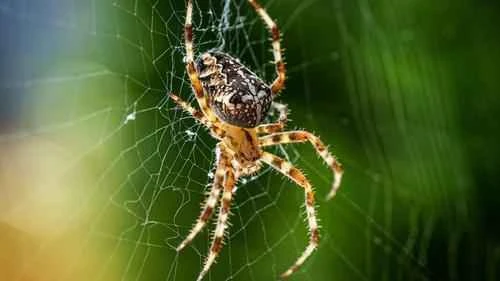
Spiders can be broadly classified into two types based on their lifestyle and hunting methods: web-building spiders and hunting spiders.
Web-building spiders
Web-building spiders employ various methods, including weaving webs, digging burrows, and building nests as permanent dwellings. Their most prominent characteristic is their web-building behavior. Those that live solitary lives maintain a certain distance from each other, avoiding encroachment. Spiders secrete a sticky fluid through protrusions at the tip of their silk sacs; this fluid solidifies into very fine threads upon contact with air. The resulting web is highly adhesive and is the spider's primary means of predation. When insects become entangled in the web, the spider injects a special liquid digestive enzyme. This enzyme causes the insect to become stunned, convulse, and eventually die, liquefying its body. The spider then feeds on this liquefied substance by sucking it up. Spiders are oviparous (egg-laying), and most male spiders are consumed by the female after mating, becoming her food.
hunting spiders
Hunting spiders are spiders that roam freely, hunting and preying without a fixed abode. They do not build webs, burrow, or nest. This includes spiders in the families Triplophysa, Triplophysa, and most Lycaenidae. They wander around or camouflage themselves to hunt prey. For example, the huntsman spider (also known as the white-fronted huntsman spider in Taiwan, or by the Ministry of Education as "蟧蜈") feeds on cockroaches. Small to medium-sized crab spiders also do not build webs; they mimic the colors of flower petals and stamens, catching insects as they approach. Jumping spiders and fly spiders are similar. Jumping spiders have excellent eyesight and generally use their vision to locate prey and hunt using various methods. Lycaenidae have eyesight second only to jumping spiders. Lycaenidae are found in almost every country. Some are burrowing lycaenidae, digging burrows to wait for prey; others are hunting lycaenidae, roaming around and hunting prey like wolves. Tartars are large spiders that build webs, and many genera and species within the Tartaridae family are now kept as pets. For example: Chilean red rose spider, Honduran curly-haired spider, and sapphire gorgeous rainforest spider.
Spiders are omnivorous, mainly feeding on insects such as flies. They are resistant to hunger and thirst, have high reproductive rates, and long lifespans. Small hunting spiders are very fast and agile, so their limbs are more developed than those of web-weaving spiders. Some spiders can use webs to secure themselves and drift with the wind to other places to hunt.
Value: Spiders are not food for humans, and are even feared and avoided, but in some regions such as Sukhun, Cambodia, spiders are sold as a dish.
Spiders are natural enemies of many agricultural and forestry pests and play an important role in biological control. Protecting and utilizing spiders has become an important aspect of biological control. Spiders have extremely high medicinal and economic value. They are a traditional Chinese medicine, and oral liquids made from spiders are remarkably effective in treating neurological diseases. Spiders, when used medicinally, have detoxifying and anti-inflammatory effects, and are effective in treating boils, sores, insect bites, infantile convulsions, impotence and premature ejaculation, cerebral hemorrhage, epilepsy, neurodegeneration, and cerebral arteriosclerosis. They can also be used to make many traditional Chinese medicine preparations, which have good efficacy for certain intractable diseases.
Spider silk is a type of silk protein, tough and elastic, used to make artificial blood vessels and tendons. It is 5 to 6 times stronger than steel and can be used to make bulletproof vests. Spider silk was also once used as a crosshair in the scope tubes of sniper rifles; however, using spider silk to make the crosshair was too expensive for arms manufacturers worldwide. Therefore, after the emergence of cheaper synthetic fibers, spider silk was gradually replaced.
artificial breeding
Spiders are diverse in species and have a varied diet. Grasshoppers, crickets, butterflies, flies, and mealworms are among their best food sources. For in-depth development of spider farming, including large-scale breeding and integrated processing, it would be ideal to also establish a small insect farm. Cage-raising flies or box-raising mealworms could meet the spider's food needs. Developing an effective human diet is no easy task. Here, we introduce an artificial diet suitable for raising red-clawed spiders and wolf spiders. Crab spiders fed a mixture of 4 parts egg yolk and 1 part miscellaneous feed for 6 weeks showed no adverse effects. Spiders prefer to prey on fresh meat and are very effective in controlling flies and mosquitoes in the home.
Spiders are highly territorial and should be kept alone. They eat only one or two meals a month and can fast for up to two months. Their diet consists mainly of insects such as crickets and grasshoppers. Simply place a damp sponge in the cage to provide them with water, and they can be raised to adulthood (around seven years) without needing to be re-enclosed.
Not all spiders are venomous (some spiders in the family Araneidae are non-venomous)! And the potency of their venom varies. Generally, pet tarantulas sold in the market have relatively weak venom and will not attack unless deliberately provoked. Even if bitten, it is not life-threatening. They are very adaptable and do not require much care. Spiders are among the easiest pets to keep.
Because spiders are fierce, carnivorous, and cannibalistic, they are easier to keep successfully in solitary captivity than in groups. However, due to their omnivorous diet, tolerance to hunger, and strong vitality, they can be successfully kept as long as the three basic conditions of food, water, and hiding places are guaranteed. Observations of *Tarantula pseudoringedilum* spiders, about 1 cm in length, kept in a gas lamp shade show that they prey on 7-12 planthoppers, leafhoppers, and flies daily. *Tarantula pseudoringedilum* spiders can survive without food or water for 34-112 days; their high tolerance to hunger is related to their large appetite. Generally, the higher the temperature, the lower their tolerance to hunger.
Individual breeding
Hunting spiders: Since they do not spin webs, they can be kept in smaller containers, such as glass bottles, tubes, lampshades, and petri dishes.
For single-spider rearing using a glass trap, the opening is a cork stopper with a small glass tube. The lower end of the small glass tube is plugged with a small cotton ball. Water, or a 10% honey solution (used for raising spiderlings), can be poured in through the top of the small glass tube to provide a water source. The other end of the trap has a circular bottom protruding into the main tube, with a small hole in the center, plugged with cotton to prevent the spider from escaping. Live insects such as planthoppers, leafhoppers, aphids, and flies, or artificial feed such as egg yolk, can also be introduced through this hole to provide a food source.
Lampshade rearing: Suitable for medium-sized non-web-building spiders. The top of the lampshade is sealed with gauze, with a small hole in the gauze. A glass tube is installed for water and food. A larger white ceramic basin sits atop the lampshade, filled with fertile soil and planted with plants adapted to the spider's living conditions. Both adult and juvenile spiders can be reared in this way.
Wooden box rearing: Suitable for web-building spiders, such as orb-weaver spiders and octopuses. The height of the wooden box should be about 1 meter. The wooden board only needs to be smooth on the outside, while the inside can be rough to facilitate the spider's crawling. There should be a door on each of the lower sides of the box for easy access from inside. The top and four sides of the box should be surrounded by nylon mesh to allow for ventilation and light. The interior of the box can be arranged to simulate natural living conditions, facilitating web-building, resting, and hunting. A water culture dish (filled with cotton balls to hold water without drowning the spider) and another dish containing artificial food can be placed inside.
Group feeding
Larger wooden boxes can be designed to increase the number and species of spiders. The interior of the box should be arranged to simulate the natural ecological conditions of spiders. Another type of rearing box uses wire mesh as the cage wall and can be directly covered with straw. A funnel-shaped insect collector is installed on the top of the cage, using light to attract insects. This method of group rearing is difficult to achieve ideal results and is still under exploration.
Classification
The families marked in bold in the table below contain one or more venomous spiders.
Spider classification table | ||||
Suborder | General Section | division | genus | kind |
Mesothelae | Liphistiidae | 8 | 116 | |
Mygalomorphae | Mecicobothrioidea | Mecicobothriidae | 4 | 9 |
Microstigmatidae | 7 | 15 | ||
Hexatheloidea | Hexathelidae | 11 | 86 | |
Atrazidae (Spiders) | 3 | 35 | ||
Dipluroidea | Dipluridae | twenty four | 177 | |
Nemesioidea | Nemesiidae | 41 | 342 | |
Theraphosoidea | Theraphosidae | 116 | 909 | |
Paratropididae | 4 | 8 | ||
Barycheloidea (superfamily of raccoon spiders) | Barychelidae | 44 | 300 | |
Atypoidea | Atypidae (earth spider family) | 3 | 43 | |
Antrodiaetidae | 2 | 32 | ||
Cyrtauchenioidea | Cyrtaucheniidae | 18 | 134 | |
Idiopoidea | Idiopidae | twenty two | 297 | |
Ctenizoidea (superfamily) | Ctenizidae | 3 | 52 | |
Halonoproctidae | 6 | 82 | ||
Migoidea | Migidae (Four-spining spider family) | 10 | 91 | |
Actinopodidae | 3 | 41 | ||
Classification undetermined incertae sedis | Macrothelidae | 1 | 26 | |
Araneomorphae (New Arachnoidea) | Hypochiloidea | Ancient sieve spiders, family Hypochilidae | 2 | 11 |
Southern spider superfamily Austrochiloidea | Southern spider family (Austrochilidae) | 3 | 9 | |
Gradungulidae | 7 | 16 | ||
Filistatoidea | Filistatidae | 17 | 110 | |
Scytodoidea | Drymusidae | 1 | 15 | |
Periegopidae | 1 | 3 | ||
Scytodidae | 5 | 220 | ||
Sicariidae (Silk Spiders) | 2 | 121 | ||
Leptonetoidea | Leptonetidae | 15 | 199 | |
Ochyroceratidae | 14 | 169 | ||
Telemidae | 7 | twenty two | ||
Pholcoidea | Diguetidae | 2 | 15 | |
Pholcidae (Ghost Spiders) | 80 | 959 | ||
Spider family Plectreuridae | 2 | 30 | ||
Caponioidea | 四气门蛛科Caponiidae | 11 | 70 | |
盔蛛科Tetrablemmidae | 29 | 126 | ||
石蛛总科Dysderoidea | 石蛛科Dysderidae | twenty four | 492 | |
卵蛛科Oonopidae | 68 | 472 | ||
激蛛科Orsolobidae | 28 | 177 | ||
类石蛛科Segestriidae | 3 | 106 | ||
隆头蛛总科Eresoidea | 隆头蛛科Eresidae | 10 | 102 | |
长疣蛛科Hersiliidae | 11 | 145 | ||
埃蛛科Oecobiidae | 6 | 102 | ||
古蛛总科Archaeoidea | 古蛛科Archaeidae | 3 | 25 | |
全古蛛科Holarchaeidae | 1 | 2 | ||
展颈蛛科Mecysmaucheniidae | 7 | 25 | ||
小幽蛛科Micropholcommatidae | 8 | 33 | ||
拟古蛛科Pararchaeidae | 7 | 34 | ||
二纺蛛总科Palpimanoidea | 胡通蛛科Huttoniidae | 1 | 1 | |
二纺蛛科Palpimanidae | 15 | 127 | ||
斯坦蛛科Stenochilidae | 2 | 12 | ||
拟态蛛总科Mimetoidea | 马尔卡蛛科Malkaridae | 4 | 10 | |
拟态蛛科Mimetidae | 12 | 152 | ||
涡蛛总科Uloboroidea | 鬼面蛛科Deinopidae | 4 | 57 | |
涡蛛科Uloboridae | 18 | 262 | ||
金蛛总科Araneoidea | 安蛛科Anapidae | 34 | 144 | |
金蛛科Araneidae | 166 | 2840 | ||
杯蛛科Cyatholipidae | twenty three | 58 | ||
皿网蛛科Linyphiidae | 569 | 4320 | ||
密蛛科Mysmenidae | twenty two | 91 | ||
类球腹蛛科Nesticidae | 9 | 204 | ||
派模蛛科Pimoidae | 3 | 25 | ||
愈螯蛛科Symphytognathidae | 6 | 44 | ||
Synaphridae | 2 | 8 | ||
合蛛科Synotaxidae | 13 | 68 | ||
长脚蛛科Tetragnathidae | 52 | 955 | ||
络新妇科Nephilidae | 4 | 75 | ||
姬蛛科Theridiidae | 87 | 2248 | ||
球体蛛科Theridiosomatidae | 12 | 75 | ||
狼蛛总科Lycosoidea | 栉蛛科Ctenidae | 39 | 458 | |
狼蛛科Lycosidae | 104 | 2304 | ||
Neolanidae | 1 | 3 | ||
猫蛛科Oxyopidae | 9 | 419 | ||
盗蛛科Pisauridae | 53 | 334 | ||
褛网蛛科Psechridae | 2 | twenty four | ||
六眼蛛科Senoculidae | 1 | 31 | ||
斯蒂蛛科Stiphidiidae | 13 | 94 | ||
行蛛科Trechaleidae | 15 | 75 | ||
佐蛛科Zoridae | 13 | 73 | ||
Zorocratidae | 5 | twenty one | ||
逸蛛科Zoropsidae | 12 | 76 | ||
草蛛总科Agelenoidea | 草蛛科Agelenidae | 39 | 503 | |
菲蛛科Amphinectidae | 35 | 184 | ||
暗蛛总科Amaurobioidea | 暗蛛科Amaurobiidae | 71 | 643 | |
叶蛛总科Dictynoidea | 近管蛛科Anyphaenidae | 56 | 508 | |
并齿蛛科Cybaeidae | 12 | 153 | ||
潮蛛科Desidae | 38 | 182 | ||
叶蛛科Dictynidae | 48 | 562 | ||
横疣蛛科Hahniidae | 26 | 235 | ||
尼可蛛科Nicodamidae | 9 | 29 | ||
巨蟹蛛总科Sparassoidea | 巨蟹蛛科Sparassidae | 82 | 1009 | |
拟扁蛛总科Selenopoidea | 拟扁蛛科Selenopidae | 4 | 189 | |
拟平腹蛛总科Zodaroidea | 拟平腹蛛科Zodariidae | 72 | 828 | |
廷盖蛛总科Tengelloidea | 廷盖蛛科Tengellidae | 8 | 36 | |
分类未定incertae sedis | Chummidae | 1 | 2 | |
袋蛛科Clubionidae | 15 | 538 | ||
隐纺蛛科Cryptothelidae | 1 | 10 | ||
圆栉蛛科Cycloctenidae | 5 | 36 | ||
无齿蛛科Homalonychidae | 1 | 3 | ||
米图蛛科Miturgidae | 26 | 351 | ||
崖地蛛总科Titanoecoidea | 菲克蛛科Phyxelididae | 12 | 54 | |
崖地蛛科Titanoecidae | 5 | 46 | ||
鹫蛛总科Gnaphosoidea | 沙蛛科Ammoxenidae | 4 | 18 | |
琴蛛科Cithaeronidae | 2 | 6 | ||
加利蛛科Gallieniellidae | 10 | 48 | ||
鹫蛛科Gnaphosidae | 116 | 1975 | ||
灯蛛科Lamponidae | twenty three | 191 | ||
粗螯蛛科Prodidomidae | 30 | 299 | ||
转蛛科Trochanteriidae | 18 | 149 | ||
蟹蛛总科Thomisoidea | 虾蛛科Philodromidae | 29 | 517 | |
蟹蛛科Thomisidae | 170 | 2026 | ||
蝇虎总科Salticoidea | 蝇虎科Salticidae | 553 | 5025 | |
圆颚蛛总科Corinnoidea | 圆颚蛛科Corinnidae | 76 | 925 | |
辉蛛科Liocranidae | 29 | 160 | ||
3亚目 | 38总科 | 111科 | 3642属 | 39490种 |


