Basic Information
Scientific classification
- Chinese name: Black-billed Mountain Toucan
- Scientific name: Andigena nigrirostris, Black-billed Mountain Toucan
- Classification: Climbing birds
- Family and genus: Toucanidae, order Toucanidae, genus Toucan
Vital signs data
- Body length: No verification information available.
- Weight: No verification information available.
- Lifespan: No verification data available.
Significant features
Distribution and Habitat
The Black-billed Toucan is found in Colombia, Ecuador, and Venezuela.
Appearance
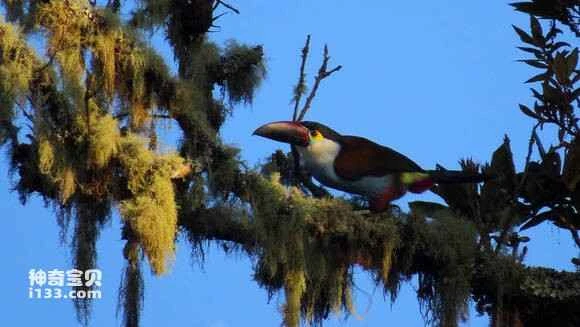
The Black-billed Mountain Toucan is a medium-sized climbing bird, somewhat resembling a hornbill in appearance. It has a very large beak, but is lighter in weight, with serrated edges and vibrant colors. Its plumage is also richly colored. The beak is about one-third the length of its body, resembling a knife. The beak is very beautiful, yellow with a slight greenish tinge on the upper half and dark blue on the lower half. Its vibrant plumage, combined with the semi-circular yellow and semi-circular sky-blue feathers around its eyes, its black crown, white breast, chestnut back, and wings, creates a harmonious and colorfully beautiful picture.
Detailed introduction
The Black-billed Mountain Toucan, scientifically known as *Andigena nigrirostris*, has three subspecies.
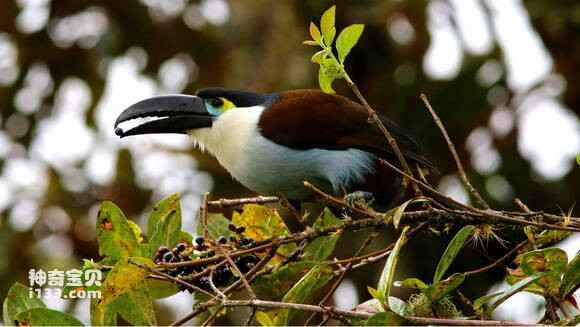
The Black-billed Mountain Toucan is a gregarious bird that prefers to perch in the treetops. It is also one of the noisiest forest birds, capable of producing booming, horn-like, and piercing calls. Its nest is built high in tree cavities. When eating, it first pecks at its food with the tip of its beak, then tilts its neck back, tosses the food upwards, and then opens its large beak to accurately swallow the food, avoiding the time spent swallowing through its long beak. This bird is omnivorous, feeding on fruits, seeds, and insects, and sometimes raids nests of smaller birds, eating the eggs and chicks.
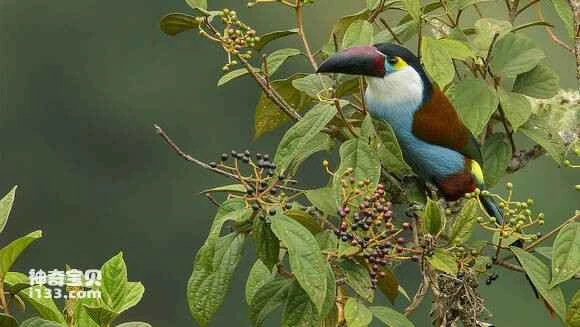
The Black-billed Mountain Toucan nests in tree cavities. It lays 2 to 4 eggs at a time. The smooth, white eggs are laid in an unlined cavity and incubate for about 16 days. The chicks hatch naked and take at least 3 weeks to open their eyes. They begin to live their own lives about 45 days after hatching.
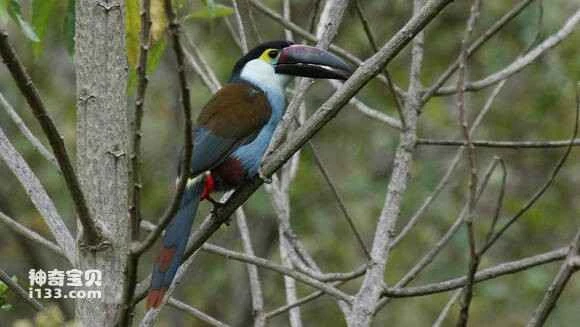
Listed as Least Concern (LC) in the IUCN Red List of Threatened Species (ver 3.1: 2009).
Protect wild animals and ban the consumption of wild game.
Maintaining ecological balance is everyone's responsibility!