
Basic Information
Scientific classification
- Chinese name: Pink-legged Shepherd
- Scientific name: Ardenna creatopus, Pink-footed Shearwater
- Classification: Waterfowl
- Family and genus: Herbiformes
Vital signs data
- Body length: 45-50 cm
- Weight: 576-889g
- Lifespan: No verification data available.
Significant features
It is nicknamed the "tube-nosed bird" because of the pair of bony tubes on its upper beak.
Distribution and Habitat
Non-breeding areas: Colombia, El Salvador, and Nicaragua.
Resident birds: Canada, Chile, Costa Rica, Ecuador, Mexico, Peru, and the United States.
Wandering (outside of breeding grounds): Guatemala.
Wandering: Argentina, Australia, and New Zealand.
They are distributed from Juan Fernández Island and Mocha Island to the Pacific coast of the United States, and occasionally to Alaska. They have been recorded in the coastal areas of Choco Province, Colombia. They are also distributed throughout the Pacific region from southern Forrest Island, Alaska to southern San Carlos, Chile, and occasionally found along the Atlantic coast and in New Zealand and Australia in the Pacific.
In Santa Clara, this species breeds dispersedly in eroded terrain at elevations of 15–300 meters. On Mocha Island, the population is located in forests (primarily *Aextoxicon punctatum*), with the highest density of burrows along ridges and among the roots of old trees up to 390 meters high. This species prefers oceanic waters far from the continental shelf. They nest on oceanic islands, in forested hills, from sea level to approximately 500 meters above sea level. They primarily nest in burrows at elevations of 50–390 meters, scattered in heavily eroded habitats that are typically sparsely vegetated but occasionally forested. After the breeding season, the Pink-footed Shearling inhabits waters including the southern tip of the Alaska Current, the California Current, and the North Equatorial Current. In North America, they still live on oceanic islands, inhabiting hills and cliffs, preferably in forested areas.
Appearance
The Pink-legged Shearling is 45-50 cm in length, with a wingspan of 109-118 cm and a weight of 576-889 g. It is a large seabird. Although smaller than most shearlings, its wingspan is relatively large for a shearling with a long wing-to-wing ratio. In flight, it appears heavy, and flapping its wings is labored. The head and upperparts are greyish-brown. The fine stripes on the head and neck become mottled towards the sides of the chest. The brown spots continue down to the belly, merging into the darker brown underbelly, undertail coverts, and thighs, with slight pale white spots. The rest of the underparts are dull white. Against the pale background, there are dark spots under the wings, especially in the armpits. The feathers vary between lighter and darker variations.
Sexes are similar, but females are generally slightly smaller. This species is highly polymorphic, exhibiting multiple morphologies: dark, light, and intermediate. The face is generally brownish-grey with small brown spots on the lower face, and white on the chin and throat. There is a greyish-brown crown extending below the eyes (occasionally with a narrow, pale localized eye ring). Brown coloration extends along the back to the mantle and scapula, usually in a scaly pattern. The back and upper part of the wings are brownish-grey, while the abdomen and ventral surface of the wings are pale grey with brown mottled patterns. The degree of browning on the belly varies depending on the morphology. The beak is pink or pale yellow with a dark tip. The beak is pink. Sexes are similar. Juveniles are similar to adults, with no difference in age or sex. However, all three morphologies mentioned above exist regardless of sex or age.
The plumage of young birds is similar to that of adults and does not change seasonally. However, young birds have fresh plumage from May to July, while older birds have worn-out plumage or are molting, which can help distinguish them.
Its iris is brown, its legs and feet are pale pink, and its beak is pale yellow with a dark tip.
Detailed introduction
The Pink-footed Shearwater (scientific name: *Ardenna creatopus*) has no subspecies. Prior to 2014, it was classified in the genus *Puffinus*, but in 2014 it was reclassified into the genus *Ardenna*.
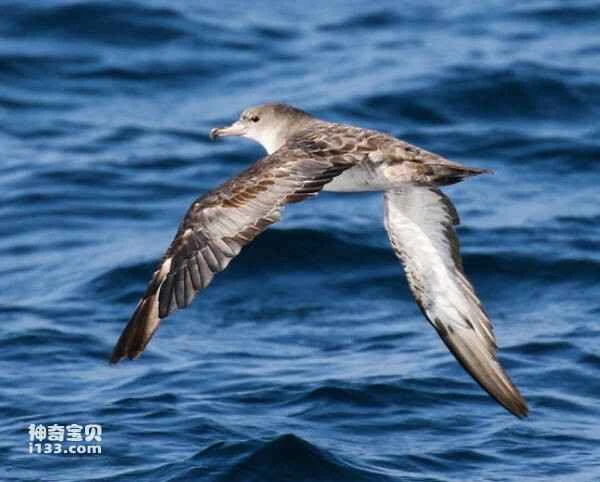
The Pink-legged Shearling's breeding season in the south is summer. After breeding, these birds migrate north along the west coast of South America to North America. From April to early autumn, an increase in the species' numbers observed along the continental shelf from the Gulf of California to British Columbia marks the migration. By the end of October, the numbers begin to decline as the birds return to Chile and their breeding grounds. During the southern winter, after breeding and nesting on the Chilean islands of Robinson Crusoe, Santa Clara, and Morovinilla, the Pink-legged Shearling travels approximately 21,550,000 kilometers to reach the northern part of the Americas. Their migration route crosses the coasts of Ecuador, Peru, Central America, and California.
The Pink-legged Shearling is an oceanic and pelagic bird that prefers waters far from the coast to the continental shelf. During the breeding season, they remain on islands in the ocean, choosing hills and cliffs, preferably forested areas. This bird breeds only on three islands near Chile and spends most of its life at sea.
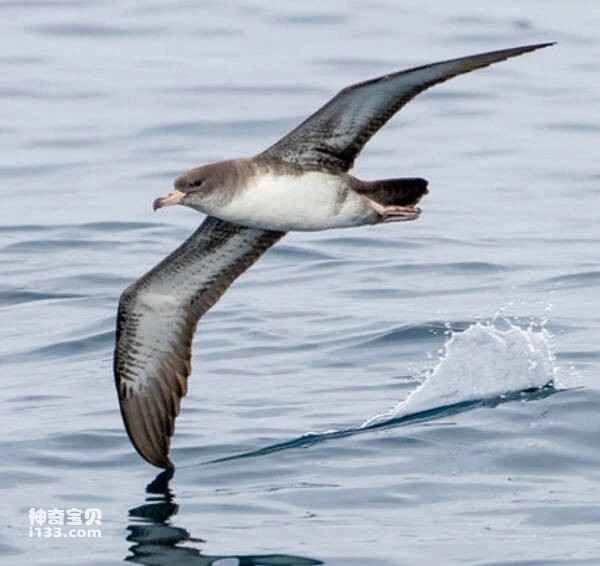
Pink-legged shelducks forage in the open ocean, in temperate deep waters. They can be found alone or in groups and prefer cold water. They spend their non-breeding season in the waters of western North America from April to November. They swim long distances in search of food, their wingbeats are relatively slow, but their flight speed is faster than most other gulls. They can be solitary or gregarious, and are often accompanied by other gull species within their range, especially the Grey Shelduck and Grey-backed Shelduck. They can forage alone or in flocks with other species. Pink-legged shelducks primarily forage in nearshore waters above the continental shelf, but also in deeper open ocean waters. Their main prey includes Far Eastern sardines (Sardinops sagax), Japanese anchovies (Engraulis japonicus), squid, and crustaceans. They hunt on the surface or underwater, and also follow vessels to collect fishery waste. Birds breeding on Santa Clara Island primarily feed on fish, with squid making up a smaller proportion of their diet.
The pink-legged shearling is a member of the order Procellariiformes and is nicknamed the "tube-nosed bird" because of the pair of bony tubes on its upper beak. These specialized tubes are used to filter and excrete salt, enabling them to drink seawater.
The Pink-legged Shearling is a gregarious species, both in its nesting and foraging areas. They nest in groups, practicing monogamy. They arrive at their settlements in early October or November. Nests are built on ocean islands and in natural caves. Eggs are laid in February, and molting and dispersal occur from late April to late May.
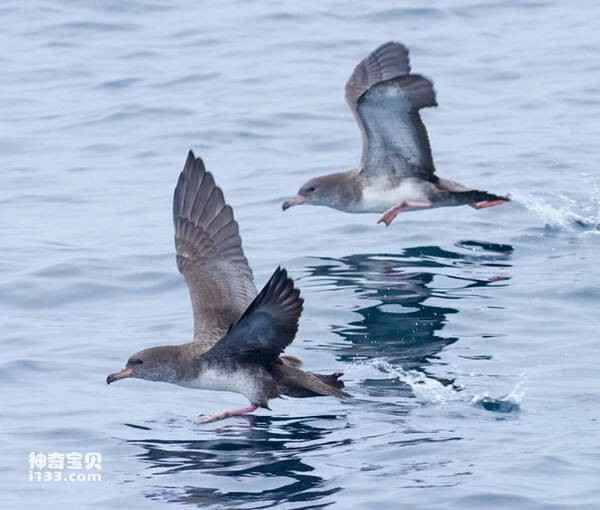
Every November, the Pink-legged Shearling breeds on Robinson Crusoe, Santa Clara, and Morro Vanilla Islands in Chile. It forms colonies and nests in burrows, with each bird laying one egg, which is incubated by both parents for 48-56 days. Like most seabirds, two adults take turns incubating, caring for, and feeding one chick. This relay in the nest can last up to two weeks. Compared to other species, its first breeding age is relatively late; the Pink-legged Shearling begins breeding at around 6 years old.
The Pink-legged Shepherd has an average of approximately 29,573 breeding pairs (data for Muñoz and P. Hodum are not publicly available), which translates to approximately 150,000 individuals. Trends are unknown, but long-term breeding season monitoring on Robinson Crusoe, Santa Clara (2002–present), and Mocha (2010–2016) indicates stable population numbers. Furthermore, a comparison of burrow counts at all breeding sites in the Juan Fernández Islands in 2003 and 2016 suggests that burrow numbers remained stable during this period. Further research is needed to determine if the introduction of predators and herbivores, rodents (Rattus spp.), dogs, and wildcats on Robinson Crusoe, as well as chick breeding and fishery by-products on Mocha, have any impact. Throughout its wintering range in North America, the Pink-legged Shearling preferentially inhabits the waters at the outer edge of the continental shelf, an area also frequently used for longline fishing. Therefore, interactions between the species and fisheries are likely present across the entire range. Furthermore, the Pink-legged Shearling's tendency to follow vessels increases the likelihood of such interactions. Additionally, the species' abundance in the seaward half of its wintering range due to illegal discharges of water from oil tankers and oil spills makes it particularly vulnerable to contamination by petroleum products. These final threats are the most significant to the conservation of species in Canada.
In addition, the greatest threats to the terrestrial Pink-legged Shearling are invasive predators, human disturbance, human predation, and habitat destruction. The importance of each of these factors varies depending on the breeding location. On Robinson Crusoe Island in the Juan Fernández archipelago, the introduction of South American raccoons to control roof rats is likely the greatest threat to the Pink-legged Shearling population in the area. Furthermore, although capturing chicks is illegal, it is estimated that about 100 chicks born annually on Mocha Island are captured by humans. Furthermore, burrow destruction frequently leads to chick deaths. The interaction between seabirds and fisheries also represents a significant potential risk. During the breeding season, Mocha Island Pink-legged Shearlings exhibit a strong preference for foraging in areas where fishing is important.
Listed as Vulnerable (VU) in the IUCN Red List of Threatened Species 2018 ver3.1.
Protect wild animals and ban the consumption of wild game.
Maintaining ecological balance is everyone's responsibility!


