Basic Information
Scientific classification
- Chinese name: Grey Shepherd
- Scientific name: Black Shearling, Grey Waterbird, Grey-striped Water Shearling, Grey Water Grub, *Puffinus griseus*, Sooty Shearwater
- Classification: Waterfowl
- Family and genus: Herbiformes
Vital signs data
- Body length: 41-51 cm
- Weight: No verification information available.
- Lifespan: No verification data available.
Significant features
Its narrow, long wings, spindle-shaped body, and black plumage make it easy to spot in the wild.
Distribution and Habitat
They breed in the South Pacific and South Atlantic Oceans of the Southern Hemisphere, including the coast of New Zealand and its neighboring islands, Chatham, Auckland, Campbell, Macquarie Island, Norfolk Island, Kapiti Island, the Bounti Islands, as well as the Strait of Magellan, the Falkland Islands, and the east coast of South America and its neighboring islands, extending as far north as Chile.
Outside of the breeding season, they can be found along the Pacific and Atlantic coasts, extending south to 60 degrees south latitude, and north to the Far East, the Kuril Islands, the Sea of Okhotsk, the Kamchatka Peninsula, Sakhalin Island, the east and west coasts of North America, the Aleutian Islands, the west coast of the Labrador Peninsula, the southern tip of Greenland, as well as Western Europe, Northern Europe, the Scandinavian Peninsula, southeastern Iceland, and the Atlantic coast of Africa. The species *Cephalotaxus sinensis* is only found along the coast of Fujian, Taiwan, and the Penghu Islands.
During the breeding season, grey shelducks mainly inhabit remote and desolate rocky coastlines and adjacent sea areas and coastal islands. Outside the breeding season, they inhabit the open ocean. Except for the breeding season, they do not venture onto land and spend the entire year at sea for activities, foraging, and resting.
Appearance
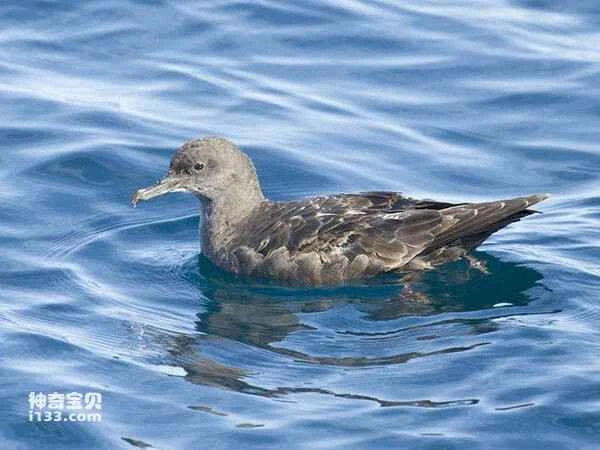
The Grey Shearling is a medium-sized seabird. It has a slender, laterally compressed bill with a hooked tip on the upper mandible. Its nasal tubes are short, located at the base of the bill along the midline of the bill's apex, and are fused into one, separated by a thick septum on the inner surface. Its wings are narrow and long with pointed tips, and it has 11 primary flight feathers. Its tail is rounded, of medium length, and has 12 tail feathers. The upperparts are dark brown, the underparts are greyish-brown, and the underwing coverts and bases of the flight feathers are silvery-grey and glossy with dark brown edges. The chin and throat are greyish-white.
The iris is dark brown, the mouth is black, the inner tarsal, middle and inner toes are pale blue, and the outer and outer toes are dark brown or black.
Size measurements: Body length 410-510 mm; bill 38-42 mm; wings 286-320 mm, wingspan about 100 cm; tail 86-97 mm; tarsus 45-56 mm.
Detailed introduction
The Sooty Shearwater (scientific name: *Puffinus griseus*) is a medium-sized seabird with no subspecies. Some scholars believe that populations breeding along the South American coast should belong to different subspecies, thus dividing them into two subspecies: the nominate subspecies *P. g. griseus* and the South American subspecies *P. g. chilensis*. However, this view lacks sufficient evidence and has not been supported.
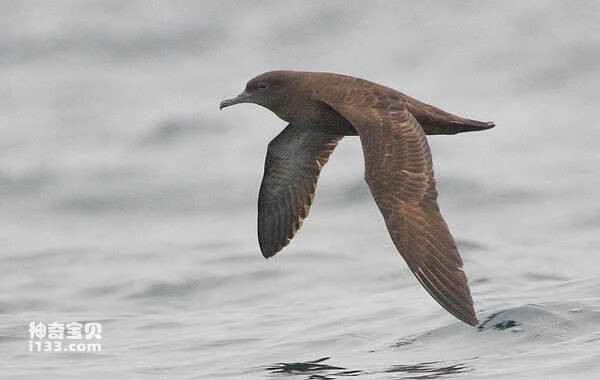
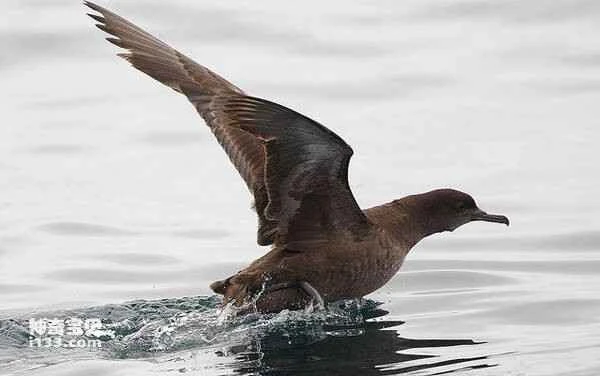
Grey shelducks are gregarious, active in flocks both during and outside the breeding season, primarily at night. They are excellent fliers, often soaring in flocks over the sea for extended periods, sometimes rapidly flapping their wings, sometimes gliding close to the waves. They are good swimmers and can also dive, but not very deep or for long. Taking off from the water is easy and agile for them, but walking on land is difficult and clumsy; they need to climb to a high place to take off and cannot fly from flat ground.
Grey shelducks primarily feed on various small fish, shrimp, crustaceans, mollusks, and other zooplankton. They forage mainly in open water, often alongside whales, especially grey whales, catching insects and squid that the whales regurgitate. When whales surface, the disturbance they cause often brings small fish and crustaceans to the surface, providing opportunities for the shelducks to feed. They also peck at small insects and fish from whale dung.
The most unique characteristic of the Grey Shearling is its long-distance migration. In search of a meal, it will fly around the globe, first heading north to the Bering Sea, then south to Antarctica, east to Chile, and finally west to Japan and New Zealand. According to electronic tags tracking its movements, the Grey Shearling can fly over 997.8 kilometers a day, covering approximately 64,000 kilometers annually. It makes full use of wind direction, flying in a figure-eight pattern over the Pacific Ocean, catching prey such as squid and krill along the way. Normally quiet, it becomes quite noisy, especially at its nest and while feeding its chicks at night, occasionally emitting a muffled cawing sound.
They breed in temperate oceanic coasts and on islands in the open ocean of the Southern Hemisphere, often in flocks. The breeding season varies by location, generally from September to April of the following year. They nest on the coast or in low vegetation along the coast or on the ground in forests. The nest is usually a depression dug by the parents in soft ground, lined with a few dry leaves and grass.
After building the nest, both parents fly to the nearby sea and return several days later to lay eggs. Each clutch contains one egg, which is oval or pointed oval, white, measuring 58.5-81.7 mm × 42-53.4 mm, with an average of 74 mm × 48 mm, and weighing 69.1-77.75 grams. Both parents take turns incubating the egg, which incubates for 30-35 days.
After hatching, the chicks are covered in long, thick down feathers. It takes about five months of arduous feeding by their parents for them to grow full plumage and molt their down feathers, usually around the end of April. At this time, the parents stop feeding them and use hunger as a stimulus to encourage them to leave the nest and come to sea. Around May, almost all of them leave their breeding grounds to live a nomadic life at sea.
Although the Grey Shearling is an extremely numerous species, its population is declining steadily due to the impact of fishing, predation of young birds, and climate change, and it is listed as a Near Threatened species by the International Union for Conservation of Nature (IUCN). In its largest population area on New Zealand's Snails Islands, the Grey Shearling population declined by 37% between 1969-1971 and 1996-2000, and the number of burrowing Grey Shearlings may also have decreased.
It has been included in the China Species Red List (2004) and is assessed as Least Concern (LC).
It has been included in the "List of Terrestrial Wild Animals of Beneficial or Important Economic and Scientific Research Value under State Protection" (Item 8) issued by the State Forestry Administration of China on August 1, 2000.
It is listed as Near Threatened (NT) in the IUCN Red List of Threatened Species 2019 ver 3.1.
Protect wild animals and ban the consumption of wild game.
Maintaining ecological balance is everyone's responsibility!