
Basic Information
Scientific classification
- Chinese name: Huangyao Xiangmi Pi
- Scientific name: Yellow-rumped Honeyguide (Indicator xanthonotus)
- Classification: Climbing birds
- Family and genus: Erythriformes, Rhythmia family, Rhythmia family
Vital signs data
- Body length: Approximately 15 centimeters
- Weight: No verification information available.
- Lifespan: No verification data available.
Significant features
It is the only vertebrate that can feed on beeswax.
Distribution and Habitat
The Yellow-rumped Honeybee is historically found in Pakistan, northern and northeastern India, and northeastern Myanmar. It is rare in temperate forests at altitudes of 1450–3500 meters along the southern slopes of the Himalayas. Recently, researchers from the Kunming Institute of Zoology recorded this bird in southeastern Tibet.
The Yellow-rumped Honeybee inhabits the vicinity of its frequent hives.
Appearance
The Yellow-rumped Honeybee is a small (15 cm) dark brownish-grey finch-like bird. The male is distinguished by its yellow eyebrows, crown, and cheeks, bright golden-yellow rump, and white stripes on its tertiaries. Its underparts are nearly white with dark longitudinal stripes. The female is darker in color, with less yellow on her head. Her iris is brown; her bill is yellowish-brown; and her legs are green.
Detailed introduction
The scientific name of the Yellow-rumped Honeyguide is Indicator xanthonotus, and it has two subspecies (Indicator xanthonotus fulvus and Indicator xanthonotus xanthonotus).
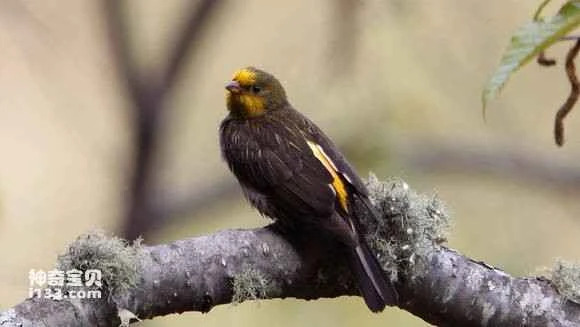
The Yellow-rumped Honeybee's favorite food is beeswax, honey, and bee larvae. It is the only vertebrate that can feed on beeswax. The Yellow-rumped Honeybee has keen eyesight and is particularly adept at finding beehives, but it is not suited to foraging inside beehives and is easily stung. Therefore, it has developed a special relationship with honey badgers, baboons, and humans. When it finds a beehive, it flies towards its "friend's" dwelling, circling in the air and emitting a piercing scream, leading the way to the beehive. Upon reaching the destination, it calls out for a while above the beehive, then silently hides in a nearby tree. Only after its "friend" destroys the beehive, takes the honey, and the bees scatter does it fly to the beehive to enjoy its meal. It emits a soft, sweet call while flying and a piercing scream while guiding.
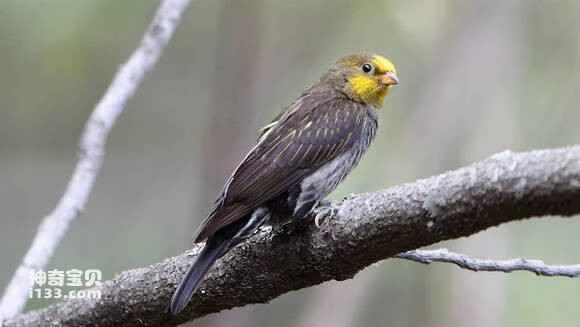
The Yellow-rumped Honeybird is a parasitic bird, similar to the cuckoo. It waits patiently outside a chosen nest, and when the nest owner is away, it sneaks in to lay its eggs. The honeybird hatches faster than its adoptive parents. The newborn chicks have sharp "egg teeth" on their beaks, which, when closed, form a deadly pincer. As soon as their adoptive siblings hatch, the honeybird uses the hooks on its beak to kill them. Of course, the adoptive parents don't understand why their offspring died; they quickly carry the carcasses out of the nest and then shower the baby honeybirds with even more affection. About ten days after hatching, the honeybird's beak hooks fall off on their own. Under the careful care of its adoptive parents, the baby honeybird grows quickly, and once its feathers are fully developed, it leaves the nest.
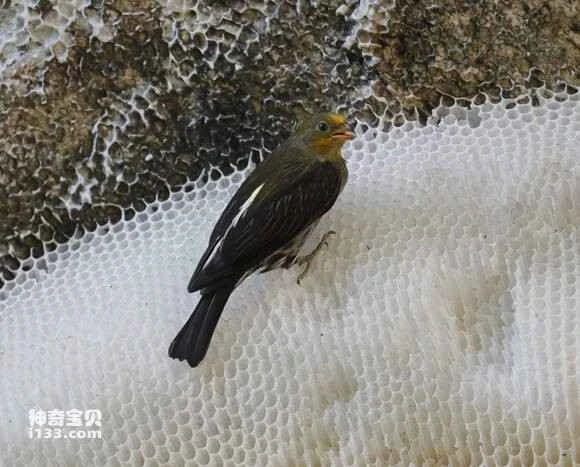
In May 2022, a yellow-rumped honey loach was discovered in the general control area of the Yingjing County Management Station of the Giant Panda National Park in Sichuan Province.
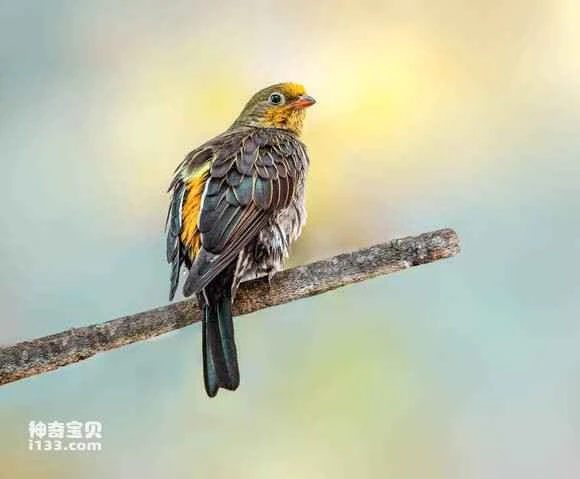
Due to the gradual decline in the population of this species, it has been listed as a near-threatened species by the International Union for Conservation of Nature (IUCN).
Protect wild animals and ban the consumption of wild game.
Maintaining ecological balance is everyone's responsibility!


