Basic Information
Scientific classification
- Chinese name: Black-throated Honeybee
- Scientific name: Black-throated Honeybird, Greater Honeybird, Indicator indicator, Greater Honeyguide
- Classification: Climbing birds
- Family and genus: Erythriformes, Rhythmia family, Rhythmia family
Vital signs data
- Body length: Approximately 20 centimeters
- Weight: about 50g
- Lifespan: No verification data available.
Significant features
They lay eggs and parasitize other birds' nests.
Distribution and Habitat
The black-throated honeybee is distributed in south-central Africa, including the southern Arabian Peninsula and the entire African continent south of the Sahara Desert (Tropic of Cancer).
Appearance
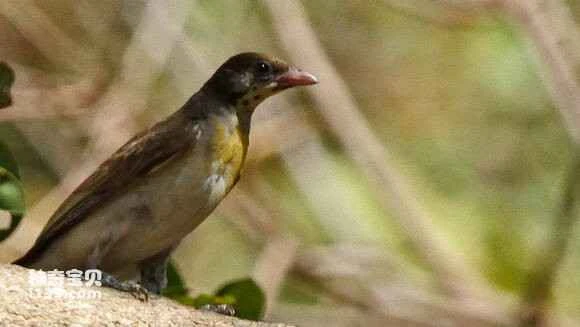
The Black-throated Honeybee is about 20 cm long and weighs about 50 grams. It is a small climbing bird. Its body color is relatively plain, with a large head and a relatively hard beak. Its paired toes are advantageous for climbing. There are white markings on the sides of its tail. The male has a dark greyish-brown upper body, a white lower breast and abdomen, and a black throat. Its wings have white stripes, and there is a yellow patch on its shoulder. Its beak is pink. The female lacks the black throat and has a green beak. Juveniles are quite distinctive, with a white throat, yellow rump, and olive-brown upper body and breast.
Detailed introduction
The Black-throated Honeyguide, scientifically known as *Indicator indicator* or Greater Honeyguide, is a peculiar bird.
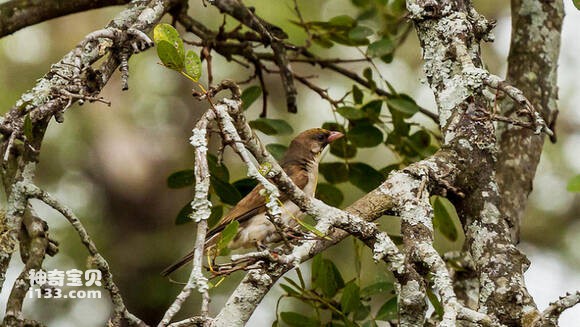
The black-throated honeyguide is known for guiding honey badgers and humans to beehives in the forest, hence its name. Once the beehive is broken open, the honeyguide eats the honey and beeswax inside, as well as bee larvae and other insects.
The Black-throated Honeyguide lays its eggs in the nests of other birds. Sometimes, more than one female honeyguide visits a nest, so when laying its own eggs, it will first try to destroy the other eggs already in the nest, whether they are from the same species or other birds. Any chicks that manage to survive and hatch will then use their superior abilities to quickly kill the original "foster mother's" offspring. These chicks are born with sharp beaks, a dagger-like structure that can easily pierce the exposed bodies of other chicks, even before their eyes are open, the slaughter is done at will, and they thus comfortably enjoy all the food they will have later.
Listed in the International Union for Conservation of Nature (IUCN) Red List of Birds, 2009 ver 3.1.
Protect wild animals and ban the consumption of wild game.
Maintaining ecological balance is everyone's responsibility!