
Basic Information
Scientific classification
- Chinese name: Wedge-tailed Shepherd
- Scientific name: Ardenna pacifica, Wedge-tailed Shearwater, Puffin du Pacifique
- Classification: Waterfowl
- Family and genus: Herbiformes
Vital signs data
- Body length: Approximately 46 cm
- Weight: 390-570g
- Lifespan: Approximately 29 years
Significant features
It has a relatively long and thin beak, a short snout, long pointed wings, and a wedge-shaped, also relatively long tail.
Distribution and Habitat
The wedge-tailed shelduck is distributed in the tropical, subtropical, and temperate waters of the Pacific and Indian Oceans between 35 degrees north and south latitude, from the Ogasawara Islands, Iwo Jima, Hawaiian Islands, Revilla Hihedo Islands, and the Penghu Islands in China, southward to the coast and islands of Australia, including Cape Nachura, the Cocos Islands, the Kermadec Islands, the Seychelles, Norfolk Island, and Lord Howe Island. Outside of the breeding season, it also migrates to the Izu Islands, the Arabian Sea, the Red Sea, and occasionally New Zealand. In China, it is only found in Taiwan and the Penghu Islands.
Origin: Australia, British Indian Ocean Territory, China, Cocos Islands, Colombia, Ecuador, Fiji, French Polynesia, Guam, Guatemala, Honduras, India, Indonesia, Japan, Kenya, Kiribati, Madagascar, Malaysia, Maldives, Marshall Islands, Mauritius, Mexico, Micronesia, Mozambique, New Caledonia, Nicaragua, Norfolk Island, Northern Mariana Islands, Oman, Palau, Papua New Guinea, Philippines, Reunion Island, Samoa, Seychelles, Solomon Islands, Somalia, Sri Lanka, Tonga, United States, Hawaii, Vanuatu, Yemen.
Migratory birds are distributed in Christmas Island, Costa Rica, Egypt, Iran, New Zealand, and Panama.
Undetermined distribution: American Samoa, Chile, Comoros, Cook Islands, El Salvador, French Southern Hemisphere Territories, Mayotte, Nauru, Niue, Pakistan, Peru, Pitcairn Island, South Africa, Tanzania, Tokelau, Tuvalu, Wallis and Futuna Islands.
The wedge-tailed petrel is a typical marine bird, inhabiting tropical and subtropical oceans. During the breeding season, it inhabits small, grassy, and rocky islands or coastlines. In eastern Australia, they are frequently found in inland waters. These birds primarily nest on sandy offshore islands, flat-surfaced atolls, slopes, plateaus, and cliff tops. They also breed in wooded areas and grasslands.
Appearance
The Wedge-tailed Shearling has a body length of 46 cm, a wingspan of 97-105 cm, and a weight of 390-570 g. Sexes are similar in size and medium in stature. It has a relatively slender bill, a short nasal tube, long and pointed wings, and a relatively long, wedge-shaped tail. There are two plumage types: the pale type has a blackish-brown forehead, crown, nape, and upperparts; black primary flight feathers and tail; and blackish-brown wing coverts and flight feathers. The chin, throat, foreneck, and underparts are white. The underwing coverts are also white with blackish-brown spots, the axillaries are pure white, the iris is dark brown, the bill is pale pink with a black tip, and the legs are pale red. The dark type is entirely blackish-brown, with black flight feathers and tail feathers, brown wing coverts, a brown iris, a lead-grey bill, and pink legs.
Among these medium to large seabirds, plumage displays a variety of colors and patterns. However, in many regions, the dark morph tends to be the majority or dominant, such as in the North Pacific, where it approaches 100% in Japan. In the Revillagiedo Islands, the number of dark morphs is twice that of the light morphs. In the South Pacific and Indian Oceans, the number of dark morphs far exceeds the number of light morphs in the community. Intermediate forms are also found in this species.
In the dark phenological type, the plumage is entirely black, with deeper shadows on the primary feathers, flight feathers, and upper tail feathers. There is a concealed M-shaped spot on the upper wing. The pale edges of the feathers create a scaly appearance, especially on the scapula. The undertail coverts are uniformly dark brown, but there is a lighter, grayer stripe in the center of the larger coverts. The underparts are pale, especially the chin and throat.
In paler phenotypes, the plumage is slightly paler, but the upperparts are the same. The flight feathers on the underside of the wings have black trailing edges. The undercoverts are mostly white or whitish. The wrists are darker, decorated with dark spots and stripes. The dark color on the head becomes lighter at the throat and chin. Except for the thighs, vent, and undertail coverts, the rest of the underparts are brown.
The iris is black, and the beak is triangular. Sexes are identical, and juveniles are similar to adults. Some regional differences exist; individuals from the Kermadec population are larger, while those from the Indian Ocean are smaller. Dark-colored individuals often resemble pale-footed shearlings or grey shearlings.
Detailed introduction
The Wedge-tailed Shearwater (scientific name: *Ardenna pacifica*), also known as Puffin du Pacifique, has no subspecies. Prior to 2014, it was classified in the genus *Puffinus*, with the scientific name *Puffinus pacificus*. In 2014, it was reclassified into the genus *Ardenna*.
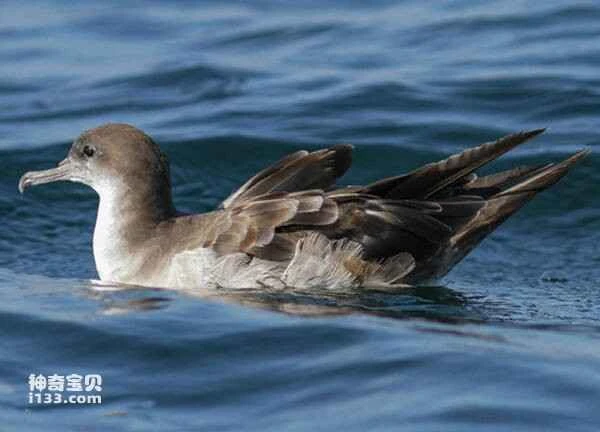
Wedge-tailed shearlings are resident birds, but often wander aimlessly after the breeding season. In tropical regions, they are usually resident. On the other hand, at the northern and southern ends of their range, these birds exhibit greater mobility, tending to migrate to the warmer waters of the Pacific and Indian Oceans.
Wedge-tailed shelducks are primarily active at night and dusk, often flying in flocks low over the sea. They glide across the surface with varying angles, sometimes rapidly flapping their wings to weave between wave crests, displaying a swift and powerful flight. They are also adept swimmers and divers. Around schools of fish, wedge-tailed shelducks congregate with black terns and red-footed boobies. They benefit from the cooperation of dolphins and sea turtles; on the other hand, near the Hawaiian Islands, they also benefit from the parasitic activities of little frigatebirds.
Wedge-tailed shearlings most often hunt fish in flight, then dive by making a brief contact with the water's surface. They catch flying fish in mid-air. In the Seychelles, wedge-tailed shearlings are capable of diving to depths of up to 66 meters. In Australia, these birds undertake long journeys to bring food for their offspring. Females dive to lower depths than males. The amount of food varies primarily depending on the bird's physical condition and the length of the journey. Stronger wedge-tailed shearlings receive better quality and larger portions of food. Weaker shearlings perform poorly and eat lighter portions. The former bring back a mixed menu of fish and cephalopods, while the latter consume only lower-quality cephalopods.
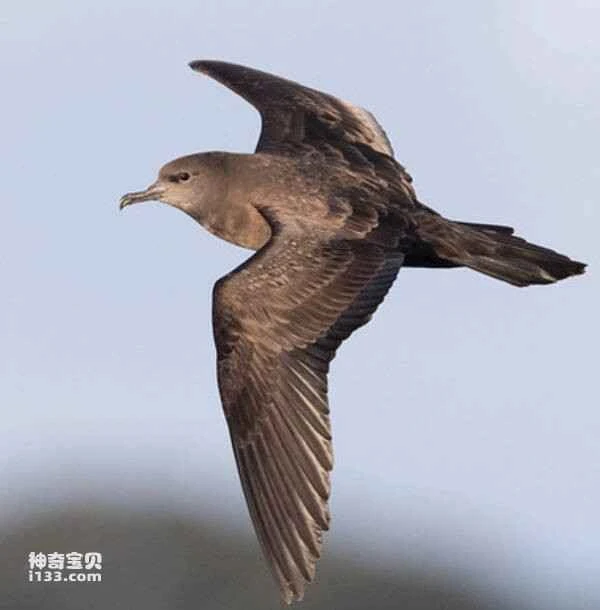
Wedge-tailed shearlings are generally silent at sea and rarely call out in flight. However, they become very noisy when on land or near burrows, producing a sound that can be transcribed as oooooo-err. Wedge-tailed shearlings primarily feed on small fish and cephalopods. They forage mainly by swimming and diving, often swimming while feeding on surface prey, and can also descent suddenly from flight to the water to hunt for prey spotted in the air. They also follow ships in search of food. Their main prey consists of small fish of the genus *Mullidae* and cephalopods. They also consume small amounts of insects and crustaceans. Studies of the stomachs of some wedge-tailed shearlings in Hawaii revealed that fish comprised 67%, cephalopods 29%, and crustaceans 1%.
The breeding season for wedge-tailed shelducks varies by region, typically from September to April of the following year. In the Hawaiian Islands, it's from early March to November, and in southern Australia, from August to late May. They breed on small islands or coastlines in warm ocean, especially those with abundant grass, rocks, and sand. They nest in rocky caves or on the ground, or under rocks and bushes. Some wedge-tailed shelducks also nest on bare sand or in low vegetation. In Australia, they have even been found nesting on the ground in island forests. They usually nest in groups.
Each clutch contains one white egg, measuring 63 mm x 41 mm and weighing approximately 60 grams. Incubation lasts 48-63 days. The chick's down is brownish-grey to pale yellow. The parents bring back approximately 20 to 72 grams of food per meal. The chicks are ready to fly in about 105 days, when they weigh between 392 and 440 grams. However, the chicks reach their maximum weight at around 77 days old, at which point they weigh 500-575 grams.

When food is scarce, wedge-tailed petrels engage in infanticide. Most nests become vulnerable and collapse in the first year, leading to the repair of 75% of the tunnels. Burrows with entrances surrounded by tree roots are more robust and can withstand years of hardening. The species reaches sexual maturity at age 4 and has a maximum lifespan of 29 years, allowing parents to have up to 25 offspring in their lifetime.
In 2004, the global population of the wedge-tailed shearling was estimated to exceed 5.2 million. In 2009, population estimates in some countries were as follows: 50-10,000 wedge-tailed shearlings migrated to Taiwan, China; 10,000-100,000 pairs of adult wedge-tailed shearlings and 1,000-10,000 individual wedge-tailed shearlings migrated to Japan.
Listed as Least Concern (LC) in the IUCN Red List of Threatened Species 2018 ver3.1.
Protect wild animals and ban the consumption of wild game.
Maintaining ecological balance is everyone's responsibility!


