Basic Information
Scientific classification
- Chinese name: Pale-footed Butterfly
- Scientific name: *Ardenna carneipes*, Flesh-footed Shearwater, *Puffin à pieds pâles*, *Pardela negruzca*, *Pardela paticlara*, جلم لحمي القدمين
- Classification: Waterfowl
- Family and genus: Herbiformes
Vital signs data
- Body length: Approximately 45 cm
- Weight: 580-765g
- Lifespan: Approximately 30 years
Significant features
The Pale-legged Shepherd can be confused with the Pink-legged Shepherd, but its belly is darker.
Distribution and Habitat
The White-footed Shearling inhabits the Indian and Pacific Oceans, with its southern range bounded by the southern coast of Australia and the North Island of New Zealand. In the Pacific, its northern range is defined by a relatively straight line, starting from Sakhalin Island, passing through the tip of the Kamchatka Peninsula, and connecting the Aleutian Islands and the Alaskan Peninsula. Major nesting sites include: St. Paul (southern Indian Ocean), southwestern Australia, Lord Howe Island (eastern Australia), small islands near the North Island of New Zealand, and the Cook Strait separating New Zealand's two main islands.
The White-footed Shearling is a unique marine species that inhabits open marine and island environments. It is primarily found on subtropical continental shelves and slopes, and occasionally in nearshore waters. These birds nest on wooded hills, especially those covered with shrubs and forests. They also breed on slopes or grassy slopes facing the sea.
When migrating to the North Pacific and Indian Oceans, some individuals also cross tropical and deeper waters. Individuals have been recorded in waters of 13-23°C in the Southwest Pacific and 11-16°C in the North Pacific.
Appearance
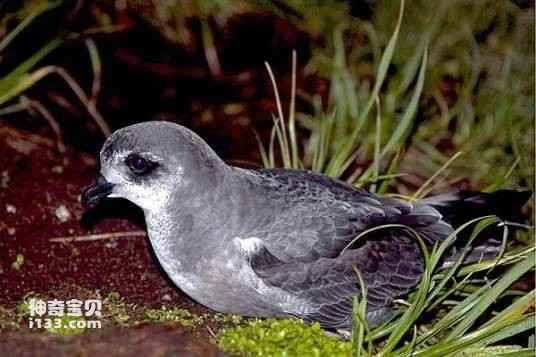
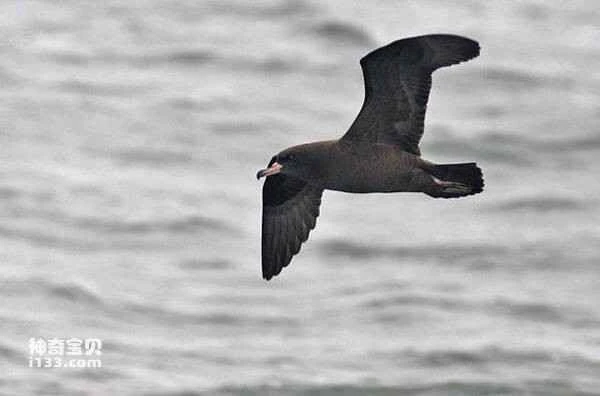
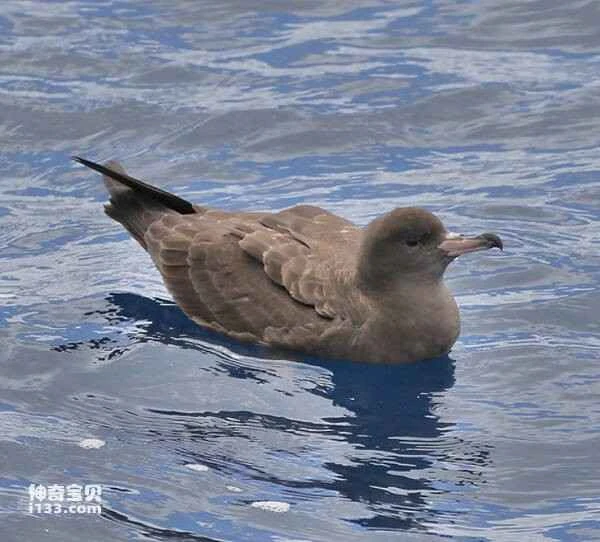
The Pale-footed Warbler is 45 cm in length, with a wingspan of 99-107 cm and a weight of 580-765 g. It is a large, broad-winged seabird. Its entire body is covered in dark plumage, with a strong, pale white beak. The plumage is dark brown, typically darker on the head, neck, upper flight feathers, and tail. The coverts and upper tail coverts have brown edges and a slight scaly appearance, more pronounced at the shoulder angles. The underside of the flight feathers is grayer and paler. In some spectra, the larger camouflage may appear more or less silvery. The belly is paler and has paler spots than the rest of the underparts.
The iris is black, and the beak ranges from pink to dark red with a black spot at the tip. The legs are pinkish-white, and part of the toes are grey. Males and females have the same plumage, but the male is slightly larger.
Young birds resemble adults, but the feathers of young birds from April to July are newly grown, while those of older birds are worn or molted.
The pale-footed shearlings that nest in South Australia and New Zealand are larger than those in Western Australia. The pale-footed shearling can be confused with the pink-footed shearling, but their darker bellies distinguish the two species. Many dark-footed shearlings congregate in the same area, but their size and beak structure typically differ.
Detailed introduction
The Flesh-footed Shearwater (scientific name: *Ardenna carneipes*), also known as Puffin à pieds pâles, Pardela negruzca, Pardela paticlara, جلم لحمي القدمين, has no subspecies. Prior to 2014, it was classified under the genus *Puffinus*.
The White-footed Shearling is a highly migratory species, a migratory bird. Each year from March to September, breeders from Lord Pride Island winter in South Korea. Populations in New Zealand range north to the Sea of Okhotsk. Some migrate to the west coast of the United States in warmer years. Populations in Western Australia migrate to the Indian Ocean and the Arabian Sea. They arrive there at the end of May and stay until August. During migration, in the northwestern Pacific, White-footed Shearlings descend to depths slightly deeper than 2.50 meters, while at the start of breeding season they can reach depths of 8.70 meters.
The pale-footed shearling is not very sociable, but they form loose flocks and sometimes mix with other species of gulls. These birds often follow trawlers on sweeping operations, catching debris thrown into the sea. This species is primarily diurnal.
The pale-footed warbler mostly calls from its burrow at night. It also calls on land and in flight; occasionally, it calls during the day. It emits a "gug gug gug" sound, which then transitions into a melodious three-syllable "ku-kooo-ah". The second part of the sound is repeated five or six times. It ends with a slowly fading gurgling or crackling sound. The three parts combine to form a call performance lasting about 10 seconds.
The pale-footed shearling primarily hunts by diving and chasing prey, but it will also dive to depths of up to 5 meters below the surface. Its diet consists mainly of squid and fish, especially during the breeding season. However, long-term studies in stable environments have shown that these birds also consume mollusc-like non-cephalopod invertebrates. At this time (outside the breeding season), the animals found in their digestive tract are mainly lanternfish or saury. Other species of fish, such as snapper and flying squid, have also been found.
The pale-footed shearlings breed in pairs on islands in burrows on sloping ground in coastal forests, scrublands, or grasslands. The nest consists of an enlarged chamber (1-3 meters long) located at the end of the burrow, and the entrance is usually covered with plant material.
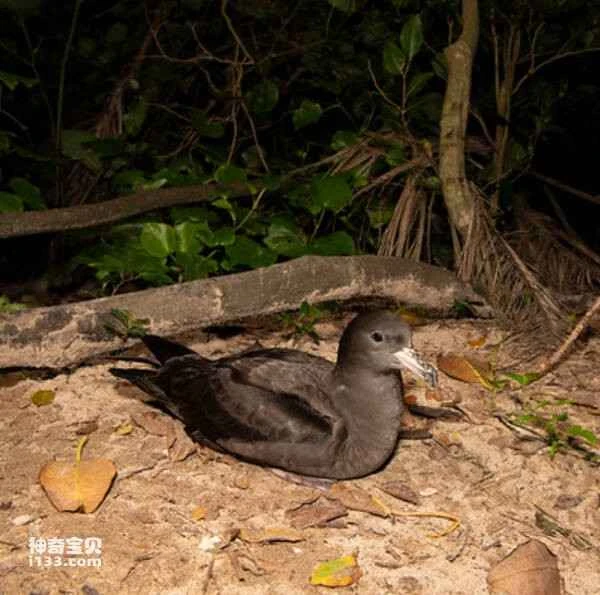
The Palefoot Shearling is entirely nocturnal, arriving at its breeding grounds about 30 minutes after sunset. Nesting begins in late September or early October as the birds return to their roosts. The first egg is laid between November 20 and December 12, and the chicks hatch in late April or early May. The Palefoot Shearling is a colony, using the same burrows as the Grey-faced Roundtail Shearling, which is the winter nester. They lay their eggs in tunnels 1 to 2 meters long. Each clutch contains one white egg, averaging 7 centimeters in size. The incubation period is approximately 53 days, shortened by 9 days on Lord Howe Island.
Newborn chicks have grey downy feathers and are kept warm for two days before being fed daily by their parents. As they grow older, the amount and frequency of their meals increase, but decrease. The chicks gain weight rapidly; when they weigh 545 grams, they will take flight and leave the nest after 92 days.
During the breeding season, populations in Western Australia undertake expeditions in search of food, flying to locations nearly 300 kilometers from their birthplace. The species on Lord Howe Island undertakes two types of journeys, the shortest lasting less than three days and the longest estimated to exceed three days. The chick-rearing success rate on Lord Howe Island is estimated at 60%. The life expectancy of the palefoot shearling is 30 years.
Listed as Near Threatened (NT) in the IUCN Red List of Threatened Species 2018 ver3.1.
Protect wild animals and ban the consumption of wild game.
Maintaining ecological balance is everyone's responsibility!