
Basic Information
Scientific classification
- Chinese name: Grey-backed Shepherd
- Scientific name: Ardenna bulleri, Buller's Shearwater, Pardela Dorsigrís
- Classification: Waterfowl
- Family and genus: Herbiformes
Vital signs data
- Body length: Approximately 46 cm
- Weight: 340-420g
- Lifespan: No verification data available.
Significant features
The head and neck are dark brown, the wings are gray, and there is a large, dark "M" across the back of the wings.
Distribution and Habitat
Resident bird: Peru.
Breeding grounds: New Zealand.
Non-breeding grounds: American Samoa, Australia, Canada, Chile, Cook Islands, French Polynesia, Marshall Islands, Mexico, New Caledonia, Niue, Norfolk Island, Russia (East Asia), United States, small islands outside the continental United States, Wallis Islands and Futuna Islands.
Wandering (non-breeding grounds): Fiji.
Wandering: Japan.
Origin uncertain (seasonal uncertainty): Costa Rica, French Southern Territories, Kiribati, Micronesia, Nauru, Samoa, Solomon Islands, Tokelau, Tonga, Tuvalu, and Vanuatu.
Origin unknown: Ecuador.
The Grey-backed Shearling is a species of oceanic seabird. It typically forages on the continental shelf near New Zealand's North and South Islands, sometimes flying as far as the Chatham Islands. They spend most of their time at sea but return to land to breed. The species nests in caves, rock crevices, and ledges along the coast and island shores, usually hidden under dense vegetation. They inhabit altitudes up to 200 meters.
Appearance
The pattern consists of dark brown feathers. The wedge-shaped tail is darker in color, contrasting sharply with the greyish-brown rump. The underparts and lower wings are white, with a narrow, dark grey trailing edge visible on the lower wing, which generally widens towards the wingtip. The leading edge is narrower and extends only to the distal part. The rump and undertail coverts are white. The head is dark brown or blackish-brown. The nape is lighter in color where it connects to the greyish-brown back feathers. The dark brown crown contrasts sharply with the white cheeks. The chin and throat are pure white.
The slender, hooked beak is blackish-gray, with a darker tip. The iris is dark brown. The inner sides of the legs and webbed feet are pink, while the outer sides of the tarsi and outer toe are dark brown.
The male and female birds have the same plumage, but the female has a shorter beak and is slightly smaller than the male. Juvenile birds resemble adults.
Detailed introduction
The Grey-backed Shearwater (scientific name: *Ardenna bulleri*), also known as the Pardela Dorsigrís, has no subspecies. Prior to 2014, it was classified under the genus *Puffinus*.
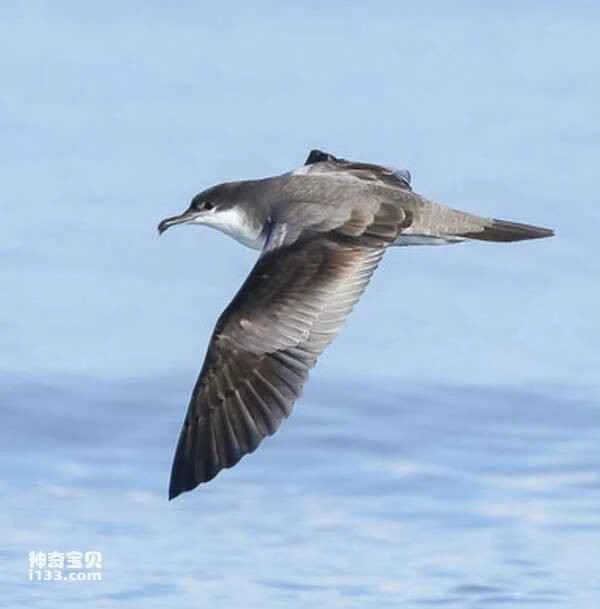
The Grey-backed Shearling breeds in the Purnets Islands near Tutukaka, north of New Zealand. After breeding, they migrate north to the Pacific Ocean, wintering in the subarctic waters, and then migrate south along the west coast of North America. Large numbers of birds can be seen near Southern California in August. Immature juveniles spend the breeding season in their wintering grounds as far south as Chile.
After breeding in the North Pacific, they migrate south along the west coast of North America, displaying powerful flight with long glides interspersed with powerful wingbeats. Sometimes, to stay close to flocks, they perch in trees for easier takeoff. In strong winds, they soar and skim over water, rarely flapping their wings.
Grey-backed shelducks emit groans, coos, and wailing sounds in their colonies, but are generally quiet at sea. During breeding season, a variety of sounds can be heard, including rapid croaking, clucking, trills, and meows. They feed on krill, squid, small fish, salps, and jellyfish.
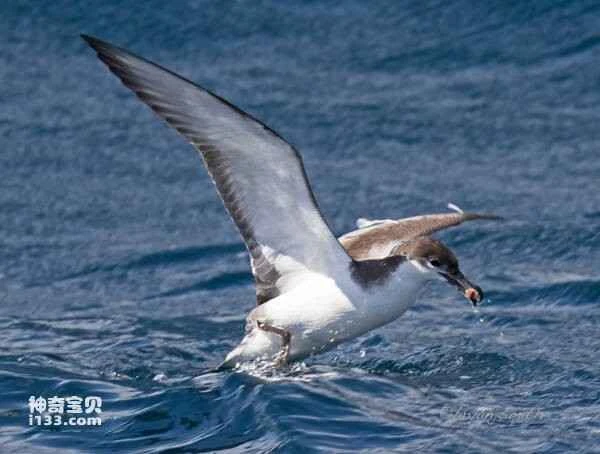
The Grey-backed Shearling feeds at night to avoid attacks from larger seabirds and to protect itself from predators when returning to land. They take flight after sunset. They are quite noisy when hunting in flocks on the water. They typically catch prey underwater with their beaks, but also forage in flight, descend to near the water's surface, and may even submerge their entire head while swimming. This species does not dive. They sometimes feed in mixed flocks with other shearlings.
Grey-backed petrels nest in dense colonies. When they return to their breeding grounds, the males clean the nests before laying eggs to attract females. As night falls, the flocks become very active, and the birds are noisy as they fly overhead. Each grey-backed petrel calls loudly as it passes its own burrow, hoping for a response from its mate. Individual differences in their calls and the melodies they employ help them find their burrows.
Grey-backed petrels use various calls and open beaks to threaten and defend against intruders in their nests. Some territorial disputes may occur, but these are neither intense nor violent. They are monogamous. Mating takes place inside the nest and mainly involves the two partners pecking at each other's beaks and preening each other's feathers. Both sexes emit long calls.
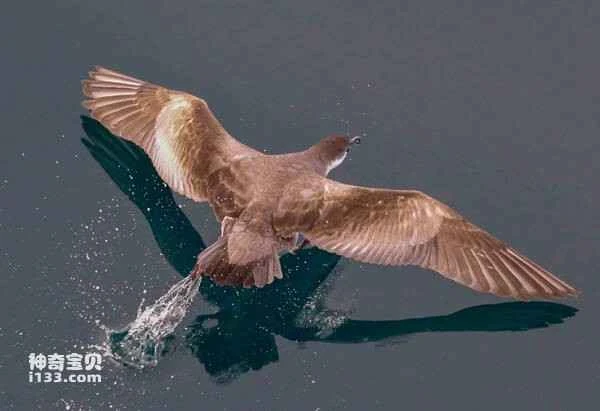
The breeding season occurs between September and May of the following year. They breed in colonies. Burrows are dug into well-drained slopes or in clay among rocks. These breeding colonies are established under tall trees in forests or under lower coastal scrub. The burrow floor is covered with a fine carpet of leaves, twigs, and gravel. The incubation chamber, located at the far end of the burrow, can range from 60 cm to 3 meters in length. The female lays a large, white egg in late November. Both parents incubate for 49-51 days, spawning every 4 days. Newly hatched chicks are covered in grey down. Adults feed the chicks via the current. The chicks leave the colony after 14 weeks to reach the sea.
The total population of Grey-backed Shearlings was estimated at 2.5 million (Marchant and Higgins, 1990), though this estimate may be too high (2013). The Grey-backed Shearlings of Orange became extinct in 1936, and while the population has increased since then, it appears to have remained stable or even declined (G. Taylorinlitt. 2012; Waugh et al. 2013).
This species faces bycatch risk within its range. The Grey-backed Shearling has previously been caught in North Pacific driftnet fishing and remains potentially threatened by fixed nets. They may be caught by longline fishing, trawls, and by hand and reel fishing, but bycatch levels are not quantified and little evidence is documented. Intensive purse seine fishing for pelagic fish in the Hauraki Gulf over the past few decades up to 2012 has disrupted important feeding areas and may have impacted the species through food depletion. Climate change is expected to have a significant impact on the species, perhaps due to the associated effects of this fisheries, given their limited range, population confined to islands with elevations up to 218 meters, and observed climatic sensitivity, including fluctuations during La Niña years and significantly lower reproductive rates. The poor breeding success recorded on Aorangi Island in 2011 may be related to the intense La Niña event of 2010–2011, but data from some geolocator-equipped birds suggest that the hatching cycle was approximately twice as long as reported in the 1980s (G. Taylorinlitt. 2012). Domestic pigs, formerly present on Aorangi Island, were eradicated after the island was declared a protected area in the 1930s. Vegetation and soil conditions subsequently improved dramatically (Heather and Robertson 1997).
Listed as Vulnerable (VU) in the IUCN Red List of Threatened Species 2018 ver3.1.
Protect wild animals and ban the consumption of wild game.
Maintaining ecological balance is everyone's responsibility!


