
Basic Information
Scientific classification
- Chinese name: Hornbill
- Scientific name: Bycanistes bucinator, Trumpeter Hornbill
- Classification: Climbing birds
- Classification and genus: Order Coraciiformes, Family Hornbills, Genus Hornbills
Vital signs data
- Body length: 58-65 cm
- Weight: 452-941g
- Lifespan: 30-50 years
Significant features
It has a long, curved, large helmet on its mouth.
Distribution and Habitat
It is distributed in eastern, central and southern Africa.
Appearance
Males are 65cm long, and females are 58cm long. Females weigh 452–670g, with an average of 565g; males weigh 607–941g, with an average of 720g.
A robust woodland hornbill. It has a long, curved, large hood on its beak. Its plumage is somewhat similar to that of the Chinese Great Hornbill, mainly black, with white on the belly, leg feathers, flight feather tips, and outer tail feathers. Males and females have similar plumage, but the male has a larger hood.
Detailed introduction
The hornbill, scientifically known as *Bycanistes bucinator*, is a bird belonging to the genus *Bycanistes* in the family Hornbillidae.
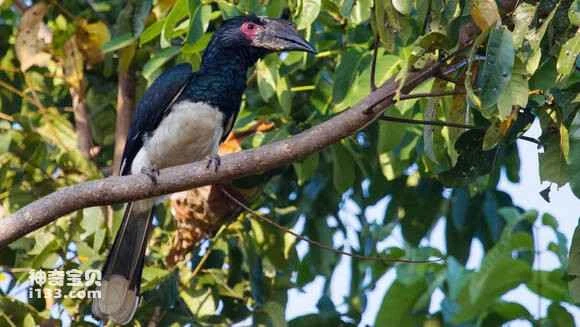
The hornbill feeds on tree fruits (especially figs), which make up 89% of its total intake. It is the largest obligate fruit eater in South Africa, but also eats insects, bird eggs, and chicks.
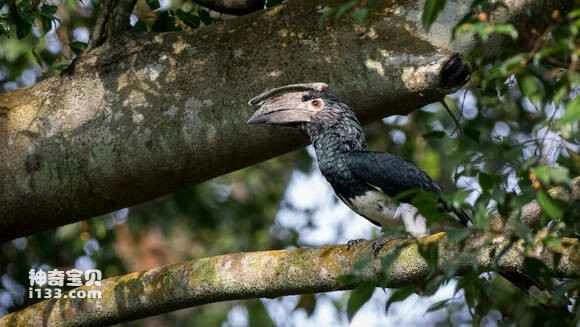
Hornbills typically live in small groups and are noisy. Outside of the breeding season, they form large flocks containing both juveniles and adults.
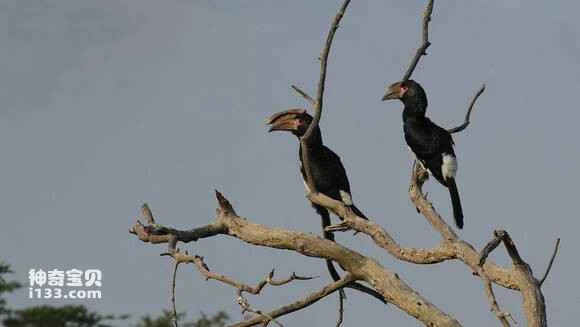
Like most hornbills, the Great Hornbill breeds in natural hollow tree cavities. The female is sealed in the cavity with mud, leaving only a small hole for feeding, while the male feeds her. The chicks become independent six months after hatching.
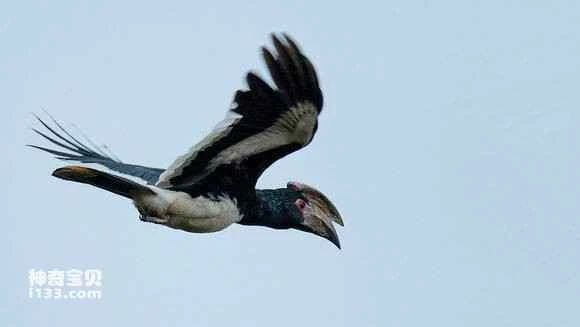
Listed as Least Concern (LC) on the IUCN Red List.
Protect wild animals and ban the consumption of wild game.
Maintaining ecological balance is everyone's responsibility!


