Basic Information
Scientific classification
- Chinese name: Southern Ground Hornbill
- Scientific name: Great-billed Hornbill, Red-faced Ground Hornbill, *Bucorvus leadbeateri*, Southern Ground Hornbill
- Classification: Climbing birds
- Genus and species: Order Coraciiformes, Family Terrestrial Hornbillidae, Genus Terrestrial Hornbill
Vital signs data
- Body length: Approximately 127 cm
- Weight: Approximately 6.2kg
- Lifespan: Approximately 70 years
Significant features
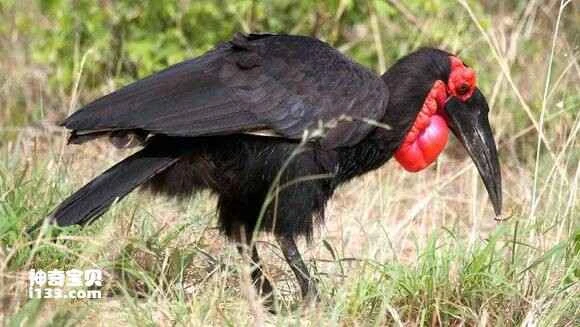
The exposed skin of the face, throat, and throat sac is vermilion, while the rest is black.
Distribution and Habitat
The Southern Ground Hornbill is found in southeastern Africa, ranging from Kenya to South Africa.
Appearance
The Southern Ground Hornbill, measuring approximately 127 cm in length, is the largest bird in the hornbill family. Its entire body is black, including its beak and feet. The bare skin on its face, throat, and throat pouch is vermilion.
Southern ground hornbills typically live in savannas.
Detailed introduction
The Southern Ground Hornbill, scientifically known as Bucorvus leadbeateri, is an important scavenger among carrion predators.
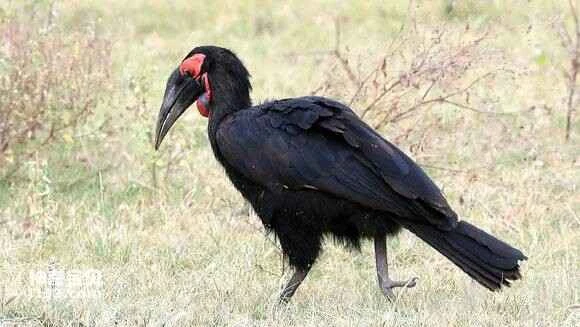
Unlike other arboreal hornbills, the Southern Ground Hornbill lacks large wings but possesses a pair of strong, powerful legs and feet. It primarily lives on the ground, feeding in small flocks on insects, worms, and small reptiles, only roosting in trees at night. They are very cautious and timid, and the flock includes helpers who assist breeding mates in building nests in tree cavities lined with dry leaves.
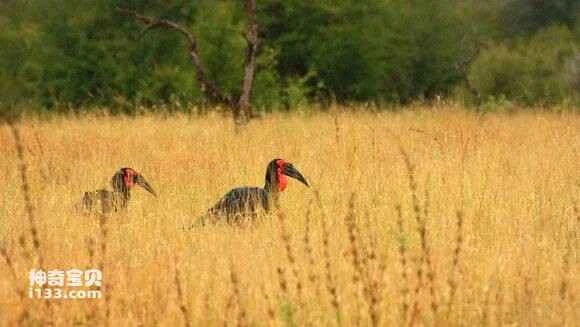
The Southern Ground Hornbill is very timid, which is completely disproportionate to its size and weight. Due to its diet, it mainly stays on the ground during the day, usually hunting in small family groups, and roosts in trees at night.
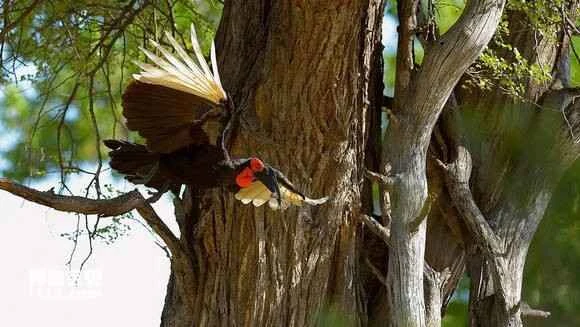
Due to their size and weight, the Southern Ground Hornbill is not a fast flyer and cannot fly very far. Generally speaking, it does not like to fly.
The population of Southern Ground Hornbills has been declining, and they are listed as "Vulnerable" by the IUCN and "Endangered" in South Africa, Lesotho, Namibia and Swaziland.
Protect wild animals and ban the consumption of wild game.
Maintaining ecological balance is everyone's responsibility!