Basic Information
Scientific classification
- Chinese name: Northern Ground Hornbill
- Scientific name: Ground Hornbill, Bucorvus abyssinicus, Abyssinian Ground Hornbill
- Classification: Climbing birds
- Genus and family: Coraciiformes, Hornbillidae, Earth Hornbill
Vital signs data
- Body length: 120-124 cm
- Weight: Approximately 6.2kg
- Lifespan: Approximately 50 years
Significant features
It has a high tendency to live on land.
Distribution and Habitat
It is distributed in south-central Africa (including the southern Arabian Peninsula and the entire African continent south of the Sahara Desert (Tropic of Cancer)).
Appearance
Male ground hornbills can reach 129 cm in length and weigh up to 6.2 kg, while females are slightly smaller.
Detailed introduction
The Northern Ground Hornbill, scientifically known as Bucorvus abyssinicus, has no subspecies.
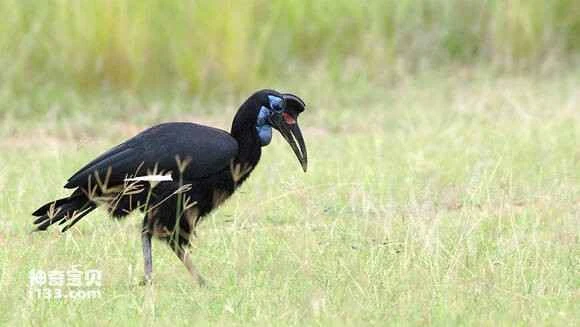
In the wild, ground hornbills are very cautious and timid, but they can be exceptionally fierce when hunting. Compared to other members of the hornbill family, ground hornbills spend most of their time on the ground, rarely flying or climbing trees. Their legs have evolved to be long and robust, and their foot structure is better suited for running on flat ground than for grasping branches. In terms of diet, ground hornbills also differ greatly from most omnivorous hornbills; they are almost exclusively carnivorous.
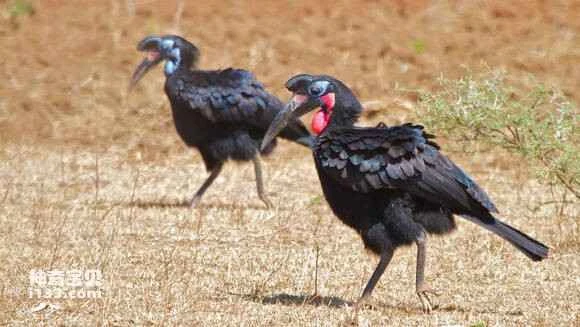
Like other hornbills, the ground hornbill has an exceptionally well-developed and strong beak, enabling it to efficiently kill and dismember various animals. Besides easily caught targets like toads and rabbits, its prey includes more troublesome venomous snakes, monitor lizards, and heavily armored tortoises. In addition to actively hunting, the ground hornbill is also an opportunist that doesn't mind scavenging carcasses, a behavior that sometimes leads to violent conflicts with other professional scavengers.
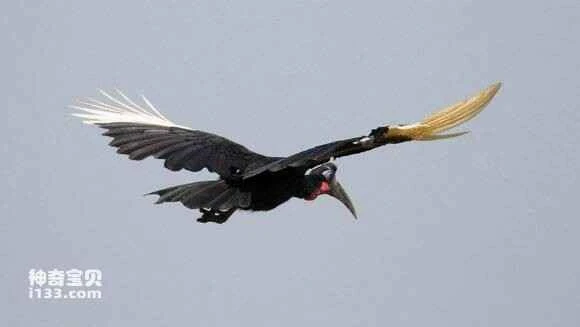
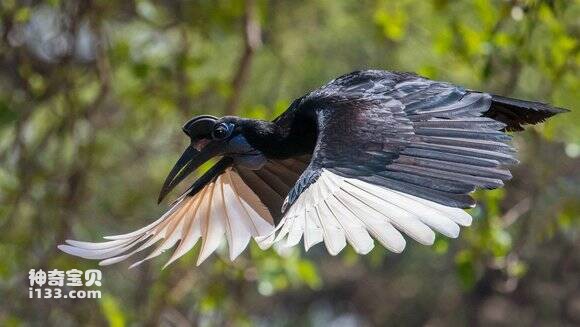
Despite preferring to hunt on the ground, the ground hornbill still possesses considerable flying ability.
Protect wild animals and ban the consumption of wild game.
Maintaining ecological balance is everyone's responsibility!