
Basic Information
Scientific classification
- Chinese name: Little Kingfisher
- Scientific name: Alcedo pusilla, Little Kingfisher
- Classification: Climbing birds
- Classification and genus: Order Coraciiformes, Family Kingfisher, Genus Kingfisher
Vital signs data
- Body length: Approximately 11 centimeters
- Weight: 10-14g
- Lifespan: No verification data available.
Significant features
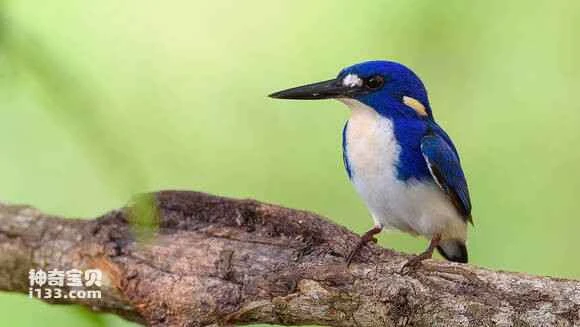
It is composed of two colors: the head, upper body, and wings are dark blue, while the lower body is pure white.
Distribution and Habitat
The little kingfisher is found in Australia, Indonesia, Papua New Guinea, and the Solomon Islands.
They mainly live in coastal areas and coastal plains, and their habitats vary greatly, including coastal woodlands, ponds, streams, forests, mangroves, and swamps. In New Guinea at altitudes up to 540 meters and Mount Atherton at 850 meters, the Australian Kingfisher in Queensland, Hammarhera, is almost entirely found in mangroves and numerous small islands, with its habitat strictly coastal.
Appearance
The little kingfisher is 11 cm long, with males weighing 10-14 grams and females 10-12 grams. They are composed of two colors: a dark blue head, upper body, and wings, and a pure white underparts. There is a white patch at the base of the beak and markings on both sides of the neck. The sides of the breast and wings are also blue, hidden at the wingtips. The iris is brownish-black, encircling the black eye. The legs are grayish-brown. There are black spots on the forehead and cheeks. The sides of the breast have black feather markings.
The beak is thick, straight, long, and strong, with a rounded ridge; the nasal groove is indistinct; the wingtips are long, with the first primary flight feather slightly shorter and the third and fourth longest; the tail is short and rounded; the body plumage is bright and glossy, often with blue or green hues. The head is large, the neck short, the wings short and rounded, and the tail mostly short as well; the beak is large and pointed with a blunt culmen; the legs are very short, the toes slender and weak, the fourth toe mostly fused with the third, and only fused with the second toe at the base. The preen gland is covered with (unidentified feathers). Coracoid bones are present on both sides, and there are four notches on the posterior margin of the sternum; the manubrium of the sternum is simply formed by external spines.
Detailed introduction
The little kingfisher, scientifically known as *Alcedo pusilla*, has nine subspecies.

Kingfishers are solitary birds, usually perching alone on branches or rocks near water, waiting to hunt. Their diet consists mainly of small fish, supplemented by crustaceans, various aquatic insects and their larvae, as well as small frogs and a small amount of aquatic plants. Kingfishers maintain excellent vision even when submerged, as their eyes can quickly adjust to the visual contrast caused by light changes underwater. Therefore, they are highly skilled at catching fish.
Kingfishers typically nest in mangroves, in trees hollowed out by termites, or on termite mounds. They dig tunnel-like burrows with their beaks to create their nests, which are 10 cm high, 13 cm wide, 3 cm in diameter, and 15 cm long. The chicks leave the nest after nine days. The egg-laying period varies slightly by region: in Queensland, it is November and February; in New Guinea and Papua New Guinea, it is February. Each clutch contains 6-7 eggs. The eggs are pure white, glossy, and slightly spotted, measuring approximately 28 mm × 18 mm. There are 1-2 clutches per year; the incubation period is about 21 days. Both parents incubate the eggs, but only the female feeds the chicks.

Listed as Least Concern (LC) on the IUCN Red List of Threatened Species 2013 ver 3.1.
Protect wild animals and ban the consumption of wild game.
Maintaining ecological balance is everyone's responsibility!


