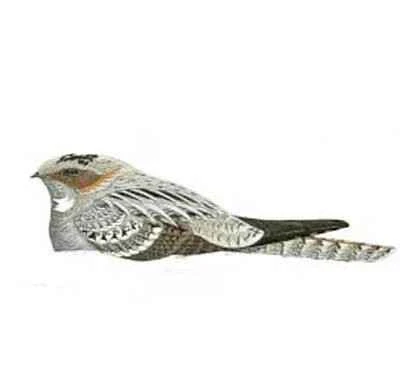
Basic Information
Scientific classification
- Chinese name: Mediterranean shelduck
- Scientific name: Puffinus yelkouan, Yelkouan Shearwater, Pardela mediterránea
- Classification: Waterfowl
- Family and genus: Procellariiformes, Procellariiidae, Procellarii
Vital signs data
- Body length: Approximately 40 centimeters
- Weight: 330-480g
- Lifespan: No verification data available.
Significant features
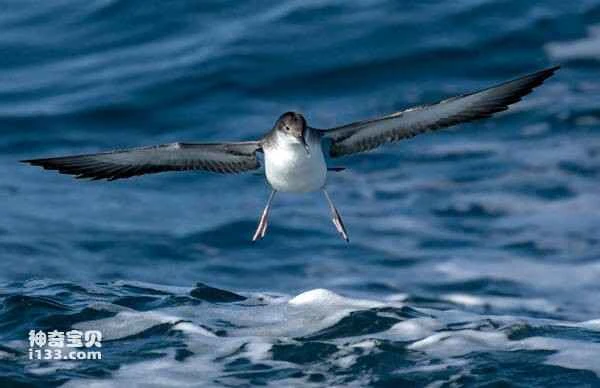
The upper body feathers are dark gray, the underparts are white, and some have dark patterns under the armpits and tail.
Distribution and Habitat
Resident birds: Algeria, Bosnia and Herzegovina, Bulgaria, Croatia, Egypt, France, Georgia, Greece, Israel, Italy, Lebanon, Libya, Malta, Morocco, Palestine, Spain, Tunisia and Turkey.
Breeding grounds: Albania. Non-breeding grounds: Romania, Syria, and Ukraine.
Migratory birds: Cyprus and Slovenia.
Wandering (seasonally uncertain): United Kingdom.
Wandering: Austria, Gibraltar, North Macedonia and the Russian Federation.
Origin uncertain (seasonal uncertainty): Monaco and Montenegro.
The Mediterranean petrel lives on islands or rocky islets perched on steep cliffs. This species is endemic to the Mediterranean and also winters there. They are found on the French islands of Hyères, Marseille, and Corsica. Other breeding grounds include Sardinia, Malta, Tunisia, Greece, Italy, and the Turkish archipelago. They nest in caves or rock crevices (caves, rubble at the foot of cliffs) or in dug burrows. In most cases, the burrow consists of a corridor that more or less ends in a brooding chamber.
Appearance
The Mediterranean petrel is 40 cm in length, with a wingspan of 76-93 cm and a weight of 330-480 grams. This species is smaller than the similar Corylus shelduck, very close to the Balearic petrel, but with slightly higher contrast. The upperparts are dark grey, and the underparts are white. Some have dark markings in the armpits and undertail. The beak is black with a slightly curved tip. In this family, the tubular nostrils are very well-developed. Sexes are similar, but easily distinguishable by their calls.
The base of the beak has tubular nostrils. The wings are typically long and narrow, with a streamlined design, allowing for long-distance travel on the high seas, utilizing the wind and air currents generated by the waves to minimize physical and energy consumption. The bird resembles a flying cross, its wings perpendicular to its body. When flying low over the sea, it changes from dark brown to white as its dark upper body and light lower body are alternately exposed. Webbed feet allow them to swim and dive on the water.
Detailed introduction
The Mediterranean shearling (scientific name: *Puffinus yelkouan*, also known as *Yelkouan Shearwater*, *Pardela mediterránea*) has no subspecies. Previously considered a subspecies of the Atlantic shearling, it was classified as the "Mediterranean shearling" subspecies of the Atlantic shearling, also known as the nominate subspecies; however, it is now considered a single species because the Balearic form "mauretanicus" has also diverged into the Balearic shearling. The Mediterranean shearling was formally described in 1827 by the Italian biologist Giuseppe Acerbi based on specimens collected in the Bosphorus Strait in Turkey. He classified the species in the genus *Procellaria* and coined the binomial name "Procellaria yelkouan". In 1760, French zoologist Mathurin Jacques Brisson classified the Mediterranean shearling into the genus *Puffinus*. The genus name *Puffinus* is based on the neo-Latin word for "puffin." The specific name "yelkouan" is Turkish for "wind chaser," meaning seagull. The Mediterranean shearling is considered monotypic, with no identifiable subspecies.
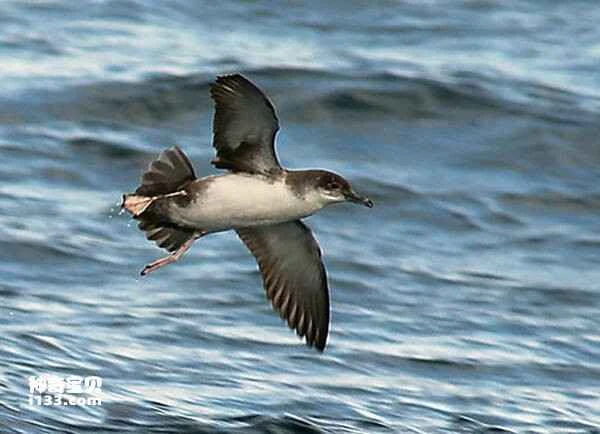
The Mediterranean petrel is an oceanic seabird that waits for nightfall to return to its roosts. Therefore, they spend most of the year on the high seas, arriving at the islands in November to explore breeding grounds. Mating only occurs at the end of February. They nest at their breeding grounds. They fish collectively and form raft-like gatherings near the shore. Their massive sunset migrations are known as the Gull River on the Hyères islands.
Mediterranean shearlings fly over the water. If the sea is calm, they will flap their wings alternately a few times while gliding. In this case, their flight is straight. In windy weather with good sea surface conditions, they can move without flapping their wings, taking advantage of the air currents created by the movement of the sea surface. The species' flight is powerful, effortless, and often spectacular. Mediterranean shearlings have the typical "shear" flight of their genus, using their strong wings to tilt from one side to the other with almost no flapping, the wingtips almost touching the water surface. The species' flight is similar to that of an albatross.

The Mediterranean petrel primarily feeds on fish, cephalopods, shrimp, and fish spoil. It can dive to depths of up to 40 meters to hunt prey. The petrel uses flipper-like wings and webbed feet to swim. It expels excess salt along with seawater and prey through its nostrils; salt glands in its brain allow it to filter saltwater. The male's call differs from the female's: it actually consists of two parts. The second part of the male's call is shorter and sharper.
Mediterranean shearlings do not build nests; instead, they lay their eggs in burrows. During the 55-day incubation period, both males and females take turns incubating the eggs. Individuals seeking nesting sites or mates begin arriving at the breeding islands in November; already paired Mediterranean shearlings seeking the same burrow and mate each year may arrive slightly later. The female lays one egg per year. This species is not capable of re-laying eggs in case of failure. The breeding season lasts about a month and a half, from mid-March to early May. The incubation and feeding period for the chicks is from mid-May to the end of July. Parents take turns feeding the chicks approximately every 3-4 days. They fly hundreds of kilometers daily to hunt for food. The adult birds then return to the sea. At four months old, the chicks must leave the burrow and learn to fly to the high seas. On average, at four years old, they return to their birthplace to find mates and reproduce there.
Based on population assessments covering the species' entire distribution range, figures indicate a total of 15,337–30,519 pairs, roughly equivalent to 46,000–92,000 individuals (Derhé 2012). However, this figure is inconsistent with preliminary counts conducted in early February, which were averages. Records show 75,000–90,000 birds migrating through the Bosphorus (2015), by which time most breeding birds were already near their breeding grounds in Malta, France, and Italy. Further investigation is urgently needed to confirm the size of the breeding population, particularly in the Aegean and Turkey.
Listed as Vulnerable (VU) in the IUCN Red List of Threatened Species 2018 ver3.1.
Protect wild animals and ban the consumption of wild game.
Maintaining ecological balance is everyone's responsibility!