Basic Information
Scientific classification
- Chinese name: Arabian woodpecker
- Scientific name: Picoides dorae, Arabian Woodpecker
- Classification: Climbing birds
- Family and genus: Order Vulpetiformes, Family Woodpeckers, Genus *Woodpecker*
Vital signs data
- Body length: Approximately 15 centimeters
- weight:
- life:
Significant features
Distribution and Habitat
The Arabian woodpecker is distributed throughout Europe, Africa north of the Tropic of Cancer, the Arabian Peninsula, and Asia north of the Himalayas-Hengduan Mountains-Minshan Mountains-Qinling Mountains-Huaihe River. Its distribution also includes south-central Africa, encompassing the southern Arabian Peninsula and the entire African continent south of the Sahara Desert (Tropic of Cancer).
Appearance
The Arabian woodpecker is about 15 centimeters long.
Detailed introduction
The Arabian woodpecker, scientifically known as Picoides dorae, is also called Arabian Woodpecker.
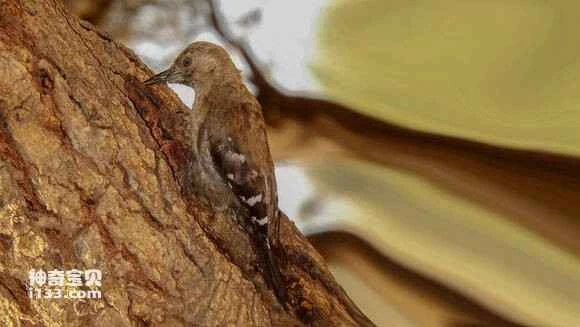
Arabian woodpeckers are resident birds, with a few species exhibiting migratory habits. They are generally silent. Most Arabian woodpeckers are not social, often living alone or in pairs. They can leap with astonishing speed and agility between tree trunks and branches. Their ability to stand firmly on vertical tree trunks is related to the structure of their feet. Each foot has two toes pointing forward, one to the side, and one backward, with sharp claws at the tips. The Arabian woodpecker's tail feathers are stiff and can be used to brace against the tree trunk, providing additional support for its body. They typically use their beaks to rapidly tap on tree trunks to find insects hidden within the bark. Once located, their strong beaks can quickly peck a deep hole in the bark, and they swiftly extend their long tongues to capture the insect.
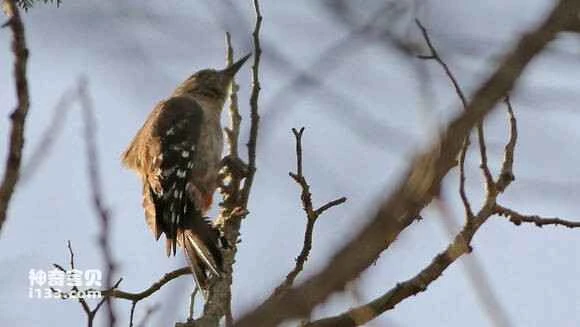
Listed as Vulnerable (VU) in the IUCN Red List of Threatened Species (ver 3.1: 2009).
Protect wild animals and ban the consumption of wild game.
Maintaining ecological balance is everyone's responsibility!