Basic Information
Scientific classification
- Chinese name: Blue-winged Laughing Kingfisher
- Scientific name: Dacelo leachii, Blue-winged kookaburra
- Classification: Climbing birds
- Genus and species: Order Coraciiformes, Family Kingfisher, Genus *Laughing Kookaburra*
Vital signs data
- Body length: 38-45 cm
- Weight: No verification information available.
- Lifespan: No verification data available.
Significant features
The head is disproportionate to the rest of the body, with a thick neck and a powerful, dagger-shaped mouth.
Distribution and Habitat
The Blue-winged Kookaburra is found in Australia and New Zealand (including Australia, New Zealand, Tasmania, and nearby islands).
The Blue-winged Kookaburra's range is much smaller than that of the Kookaburra, also located in Queensland, Australia. However, it is confined to a range of about 100 kilometers along the long northern coast of Australia, not venturing into the interior of the continent. Its preferred habitats include open eucalyptus forests, as well as large farms or suburban parks located in cities. Family territories range from 1 to 4 acres, or 0.4 to 1.6 hectares.
Appearance
The Blue-winged Kookaburra is slightly smaller than the Kookaburra, measuring 38-45 cm in length, and its habits are largely similar. Like all kingfishers, the Blue-winged Kookaburra's name is a key identifying feature. It has a disproportionately large head, a thick neck, and a powerful, dagger-shaped beak. It has a short tail. Its upperparts are brown, and its underparts are greyish-white. It has blue wings with a prominent bluish-grey eye stripe. Its eyes and eyebrows are white. Furthermore, its rump and tail are different shades of blue. The tips of its wing feathers are covered in dark blue, which is the most important distinguishing feature of the Blue-winged Kookaburra.
The beak is thick, straight, long, and strong, with a rounded ridge; the nasal groove is indistinct; the wingtips are long, with the first primary flight feather slightly shorter and the third and fourth longest; the tail is short and rounded; the body plumage is bright and glossy, often with blue or green hues. The head is large, the neck short, the wings short and rounded, and the tail mostly short as well; the beak is large and pointed with a blunt culmen; the legs are very short, the toes slender and weak, the fourth toe mostly fused with the third, and only fused with the second toe at the base. The preen gland is covered with (unidentified feathers). Coracoid bones are present on both sides, and there are four notches on the posterior margin of the sternum; the manubrium of the sternum is simply formed by external spines.
Detailed introduction
The Blue-winged Kookaburra, scientifically known as *Dacelo leachii*, has four subspecies.
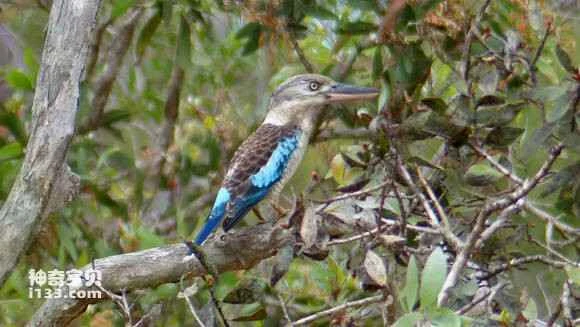
Although the Blue-winged Kookaburra is classified as a fish-eating bird, its diet is actually quite varied. It feeds on a wide variety of small land animals, including insects (grasshoppers, beetles, cockroaches), snails, lizards, snakes, and small mice. Of course, its favorite food is small fish, but it also includes amphibians such as Australian shrimp and crabs. When food is scarce, Blue-winged Kookaburras often attack other birds, capturing and preying on eggs and chicks. Their food is not fully digested; their stomachs contain the membranous wings of insects, shells, fur, and bones.
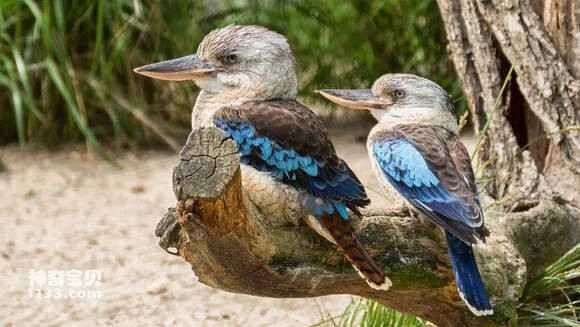
Every August, the Blue-winged Kookaburra, which is active in New South Wales, returns to Queensland to breed, first searching for nesting sites. They typically choose large trees hollowed out by termites, using their powerful beaks to pry open a burrow. They may also choose a nest used in previous years, some for as long as 15 years. Blue-winged Kookaburras are monogamous and live together. During the breeding season, sub-adult females live in the family group, while males are excluded from the family after the first year. In September or early October in Queensland, the female lays 3 or 4 white eggs, with an incubation period of 25 days.
Listed as Least Concern (LC) on the IUCN Red List.
Protect wild animals and ban the consumption of wild game.
Maintaining ecological balance is everyone's responsibility!