Basic Information
Scientific classification
- Chinese name: Yellow-browed Penguin (also known as Fiordland Crested Penguin, Flying Crested Penguin, or Maori Penguin)
- Scientific name: Eudyptes pachyrhynchus
- Classification: Wading birds
- Genus and family: Penguinidae (family Penguinidae)
Vital signs data
- Body length: Approximately 40–60 cm
- Weight: 3–4 kg
- Lifespan: Approximately 10–20 years in the wild
Significant features
The most "forest-dwelling" of the crested penguin species: they often build their nests under bushes/tree roots, in well-hidden locations.
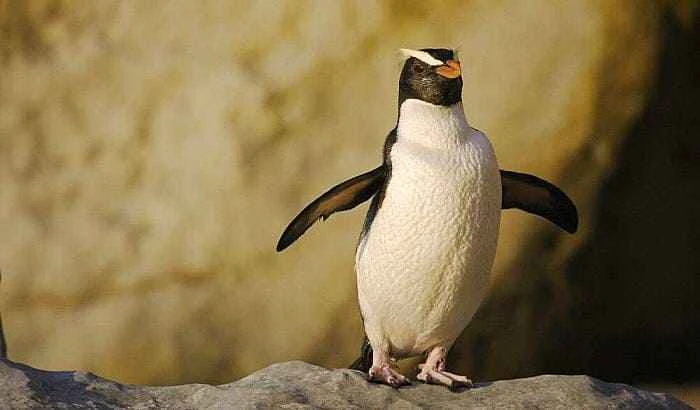
With golden eyebrows, black cheeks, and a white belly, his distinctive look is that of a Maori man named Tawaki.
Diving to feed on squid has a high proportion of its weight, and the depth at which it feeds varies depending on sea conditions and location.
Small and scattered breeding colonies are sensitive to disturbance, and leaving the nest can expose chicks to predation.
Distribution and Habitat
Breeding grounds in temperate oceans and coastal woodlands/rocky shores of the southwestern South Island of New Zealand, such as Fiordland and Stewart Island; foraging in nearshore to offshore waters.
Distribution: Southwest coast of New Zealand's South Island and its offshore islands (occasionally to Australia).
Appearance
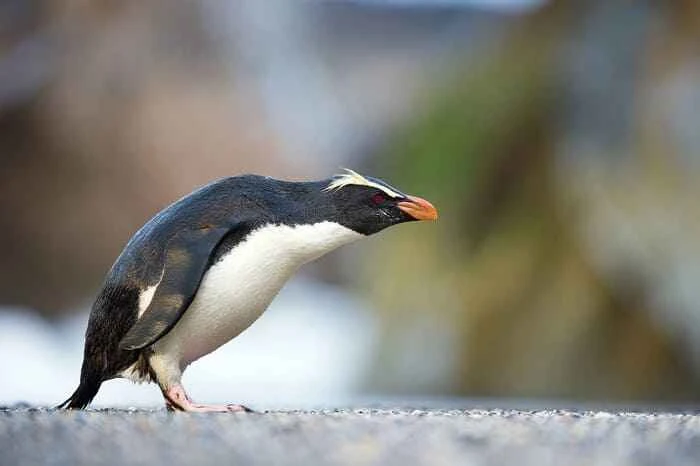
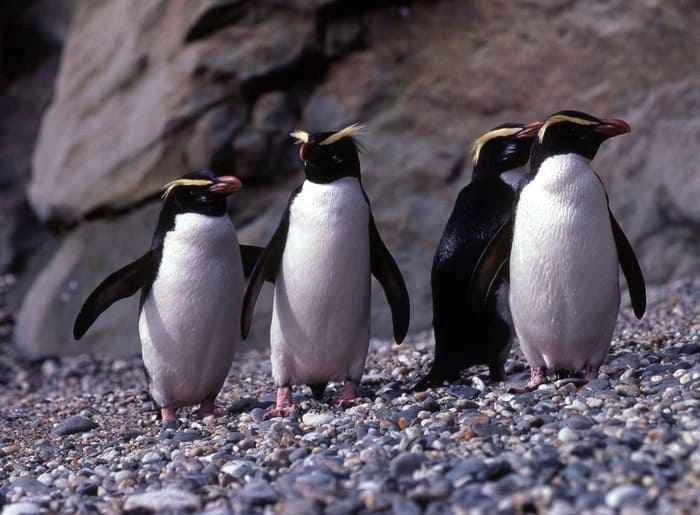
A bright yellow crest grows from behind the eyes on the top of its head, extending backward and outward; the mask and upper body are black, the belly is white, and the beak is short and thick.
Much smaller than the Emperor/King penguin, and similar in size to the Rockhopper/Macaroni; they walk steadily and are well-adapted to rock climbing and traversing woodlands.
Adult birds have dark irises; males and females look similar, but males are slightly larger and have thicker beaks.
Detailed introduction
I. Species Overview
Yellow-browed penguins belong to the genus Eudyptes and are endemic to the Fiordland and Stewart Island region of southwestern New Zealand. Due to their tendency to breed in dense forests and rocky crevices , their well-hidden nesting sites, and their long periods of time spent at sea, population monitoring is challenging , and historical estimates are considered likely to be underestimated.
II. Distribution and Habitat
They primarily breed along the southwest coast of New Zealand's South Island and its offshore islands, with a small number drifting to the Tasman Sea or even the Australian coast after foraging in the open ocean. Breeding grounds are often located on rocky shores or in caves or under fallen trees near humid temperate rainforests/shrublands to reduce the risk of high temperatures and predation.
III. Behavior and Ecology
Breeding season typically begins in late winter to early spring , with nests scattered and sensitive to disturbance . Their diet consists mainly of squid , supplemented by krill and small fish . Significant differences exist between different populations in diving depth and feeding layer , reflecting the spatial heterogeneity of the nearshore marine environment.
IV. Current Status and Threats to Conservation
The IUCN currently classifies it as Near Threat (NT) , but the New Zealand DOC lists it as a threat at the national level in its domestic assessment. Key threats include:
Invasive predators (ferret badgers/rats/wildcats/dogs) invade the nesting area, leading to the loss of eggs/chicks;
Human disturbance and tourism pressure cause adult birds to leave their nests, making chicks vulnerable to predation.
Fishery interactions (bycatch/food competition) and changes in sea conditions affect foraging success rates.
Priority measures : predator control/fencing in key breeding grounds, visitor management in nesting areas, marine management (reducing bycatch), and long-term tagging/acoustic and satellite tracking monitoring.
Frequently Asked Questions
Q1: How to distinguish between yellow-browed penguins and macaroni/rockhopper penguins?
A: All three are crested penguins with yellow crests . Yellow-browed penguins have shorter crests and often nest in secluded woodlands/caves ; Macaroni penguins ( E. chrysolophus ) breed more on sub-Antarctic islands and form larger groups; Southern Rockhoppers ( E. chrysocome ) are slightly smaller and mostly breed on exposed rocky shores.
Q2: Is the IUCN "Near Threatened" or "Vulnerable"?
A: In 2020, the IUCN updated the classification to Near Threatened (NT) ; many websites still use the old "Vulnerable (VU)" designation. Please check the latest IUCN/BirdLife page before publishing.
Q3: Why is it so difficult to conduct surveys?
A: Breeding sites are hidden and scattered , and mostly in steep woodlands/caves ; coupled with the long periods of activity at sea, it makes ground surveys and synchronous counting difficult, and historical estimates may be underestimated .


