Basic Information
Scientific classification
- Chinese name: African forest elephant
- Scientific name: Loxodonta cyclotis
- Classification: Proboscidea
- Family and Genus:
Vital signs data
- Body length: Males approximately 2.4–3.0 m at the shoulder; females 2.1–2.5 m.
- Weight: Males approximately 2,000–4,000 kg (major regional variation); females slightly less.
- Lifespan: 50–60 years (in the wild)
Significant features
The largest living terrestrial mammal, it acts as an "ecological engineer" in the savanna.
The matrilineal family group is at the core, and migration relies on traditional water sources and passageways.
Infrasound enables long-distance communication and superior memory, facilitating the intergenerational transmission of routes and resource information.
Distribution and Habitat
It inhabits tropical rainforests and swamp forests and secondary forests in Central and West Africa, and occasionally extends to forest edges/savanna mosaic zones.
Distribution: Congo Basin and West African rainforest (Congo (Kinshasa), Congo (Brazzaville), Gabon, Cameroon, Equatorial Guinea, Sierra Leone, Ivory Coast, Ghana, etc.)
Appearance
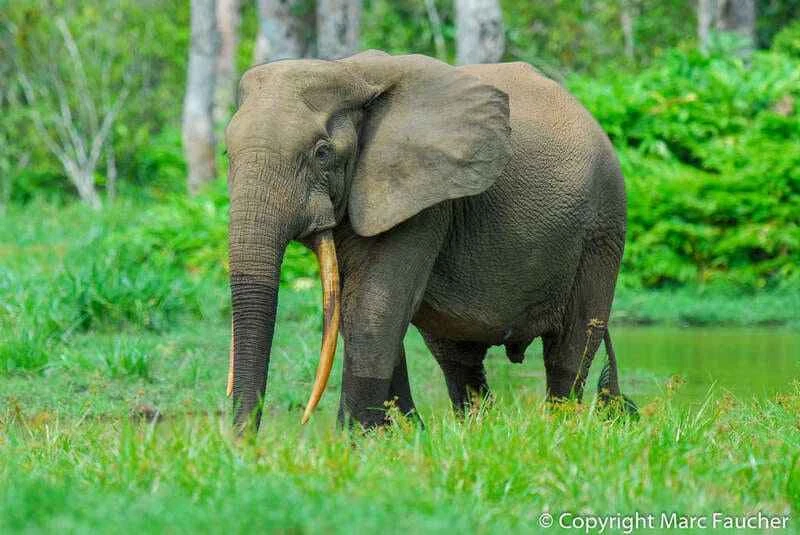
They are large in size, with broad, triangular, fan-shaped ears and slightly arched shoulders and backs; males are even more imposing, with a shoulder height of up to 4 meters.
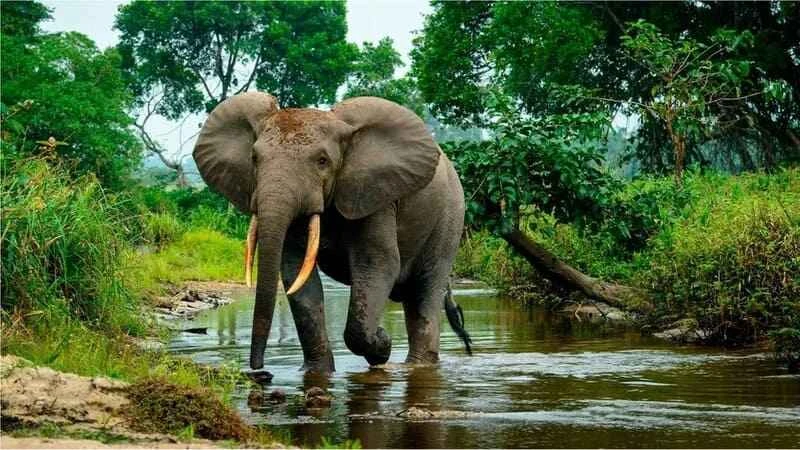
The tusks are thick and curved outwards, and the tip of the nose has two "fingers" that make it easy to grasp; the limbs are thick and columnar with prominent toenails.
The skin is thick and grayish-brown with deep wrinkles to facilitate heat dissipation and sun protection, while the auricle has a well-developed vascular network that acts as a "radiator".
Detailed introduction
I. External Features
African forest elephants are smaller and more compact than savanna elephants , with rounder ears and a relatively straight back. Their tusks are thinner and straighter, often pale pink (due to variations in ivory quality), with more pronounced differences in appearance between males. Their footpads are better adapted to the damp, muddy environment of the forest floor, facilitating movement through dense forests.
II. Distribution and Habitat
They primarily inhabit contiguous rainforests in Central and West Africa , including the Congo Basin and coastal and mountainous rainforests of West Africa. Forest elephants prefer closed canopies and swamp-riparian forests , but during the fruit season they may move towards forest edges and come into contact with agricultural landscapes, increasing the risk of conflict with humans.
III. Ecological Roles and Behaviors
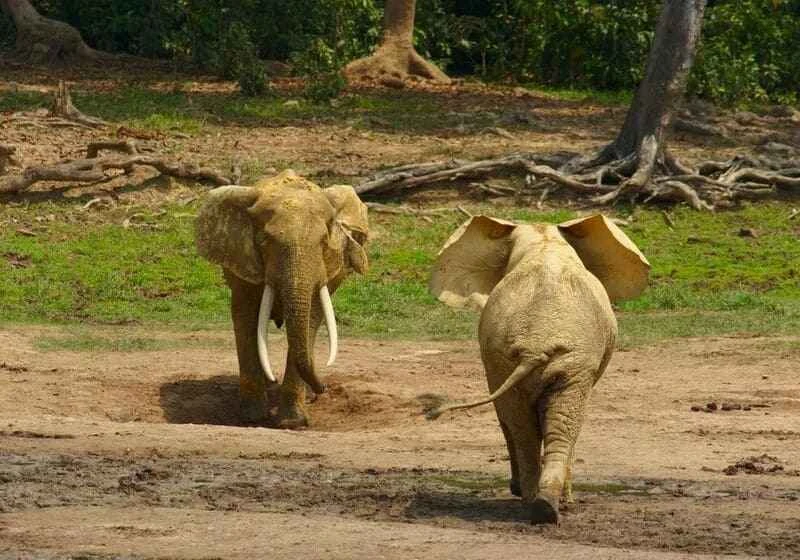
Forest elephants are the most important large frugivores and "seed carriers" in tropical rainforests. They can ingest and disperse the seeds of large fruit trees over long distances, playing a vital role in maintaining the forest's species composition and structure . Their social structure is centered on matrilineal families , and their groups are usually smaller than those of savanna elephants. They are secretive and rely on traditional saline-alkali lands and mineral springs as "check-in points."
IV. Reproduction and Life Cycle
Female elephants reach sexual maturity around 10–12 years of age ; the gestation period is about 22 months , and most births are single ; calves are nursed for more than 2 years. Because forest elephants have longer breeding intervals and their survival rate is sensitive to habitat quality , once adult individuals are poached in large numbers, the population recovers very slowly .
V. Population Status and Trends
Over the past few decades, poaching and deforestation have led to density collapse and habitat fragmentation in many historical distribution areas. Even within protected areas, poaching pressure can increase if adjacent to roads or mining operations . Some countries have shown signs of localized stabilization through patrols, community co-management , and the construction of connectivity corridors , but the overall risk remains high .
VI. Major Threats
Ivory poaching and illegal trade : especially targeting adult male elephants for ivory, leading to an imbalance in the sex age structure .
Deforestation and infrastructure : Roads, logging and mining lead to fragmentation and increased accessibility , making it easier for poachers to enter core forest areas.
Human-elephant conflict : crop losses and property security trigger retaliatory culling.
Insufficient cross-border protection coordination : Gaps in information sharing and law enforcement cooperation hinder efforts to combat smuggling.
Climate and disease risks : Extreme weather or disease may exacerbate local stress.
VII. Protection and Management
Core protected areas + connectivity : Expand/strengthen the protected area network and create forest corridors connecting habitat patches.
Technological monitoring : collar positioning, fecal DNA , camera traps, and acoustic monitoring to assess density and activity paths.
Demand-side governance : Continuously reduce demand in the ivory market; strengthen deterrence through laws and the judiciary .
Community solutions include : sharing profits from ecotourism, using beehive fences/chili fences to mitigate conflict, and providing compensation and livelihood alternatives.
VIII. Interesting Facts
Forest elephants' "path-clearing" behavior creates animal corridors in dense forests, benefiting a variety of mammals.
There is a seasonal dependence on rich mineral saline sites (saline/baï), and these sites are key to monitoring and protection.
Compared to grassland elephants, forest elephants are more secretive and nocturnal , which is a major reason why their numbers are difficult to accurately assess.
References and data sources
IUCN Red List: Loxodonta cyclotis (Forest Elephant Assessment Page)
IUCN SSC African Elephant Specialist Group (AfESG) Technical Report / African Elephant Status Report
Related National Park Service, CITES documents and peer-reviewed papers
Frequently Asked Questions
Q1: What is the biggest difference between forest elephants and grassland elephants?
A: Forest elephants are smaller, with rounder ears and finer, straighter tusks that are often pale pink . They mostly live in tropical rainforests ; steppe elephants are larger, with wider ears, and live in savannas . In the IUCN classification: Forest elephant CR , Steppe elephant EN (subject to the latest list).
Q2: Why are forest elephants more susceptible to poaching?
A: Although the dense forest environment provides cover, once roads/mining enters, accessibility increases and law enforcement becomes more difficult ; at the same time, forest elephants have long breeding intervals and slow population recovery .
Q3: Can forest elephants really "plant trees"?
A: Yes. Forest elephants eat large fruits and excrete them over long distances, enabling the regeneration and spread of large fruit trees ; they are known as key seed dispersers .
Q4: What are some effective methods for mitigating human-image conflict?
A: Beehive fencing, chili fencing , community patrols and compensation mechanisms , combined with joint patrols and early warnings, can significantly reduce agricultural damage and conflict.