Basic Information
Scientific classification
- Chinese name: ladybug
- Scientific names: Fat Little, Matchmaker, Flower Sister, Heavenly Way Insect, Golden Beetle, Pearl Turtle, Dr. Mai, Stinky Turtle
- Classification: Arthropoda
- Family: Coleoptera; Order: Coleoptera; Class: Insecta; Phylum: Arthropoda; Suborder: Polyphagous
Vital signs data
- Body length: 1.26 to 11.2 mm
- Weight: 5.2~7mm
- Lifespan: 1-3 years
Significant features
The body is hemispherical, usually only the size of a soybean, and the wings are hard and have a metallic sheen. Ladybugs are brightly colored, often with red, black, or yellow spots, and the number and arrangement of these spots are important characteristics that distinguish different species of ladybugs.
Distribution and Habitat
Widely distributed throughout the world, primarily in Asia, Europe, North America, and South America, with the highest prevalence in Asian countries such as China, Japan, and South Korea. The fauna of mainland China belongs to two kingdoms: the southern kingdom, roughly south of the middle and lower reaches of the Yangtze River, belongs to the Oriental Kingdom along with the Indian Peninsula, the Malay Peninsula, and their surrounding islands, forming the central region for tropical animal distribution in East Asia; the northern kingdom extends from the northeast through North China and Inner Mongolia and Xinjiang north of the Qinling Mountains to the Qinghai-Tibet Plateau. Based on this characteristic, China is further divided into three major natural regions: the Monsoon Region, the Mongolian-Xinjiang Plateau Region, and the Qinghai-Tibet Plateau Region.
Ladybugs inhabit both natural and man-made environments. In natural environments, common habitats include grasslands, gardens, orchards, fields, among trees, crawling on flower stems, or resting under leaves. They can survive in warm, humid environments and are also adapted to urban environments, commonly found in parks and street greenbelts. Furthermore, ladybugs can survive in urban environments, especially in parks and street greenbelts, where these areas provide refuge and food sources, allowing them to survive and reproduce in human-inhabited environments.
Appearance
Ladybugs are typically short-ovate to round in shape, with a strongly arched back and a usually flattened ventral surface. Adult ladybugs are generally 1.0–16.0 mm in length. Their bodies are hemispherical, only about the size of a soybean; their wings are stiff and have a metallic sheen. The pronotum and elytra base are often closely connected, usually with similar widths. The head is often embedded in the pronotum, sometimes completely covered by the pronotum. The pronotum and elytra are smooth, or often have sparse or dense fine short hairs. Ladybugs are numerous and brightly colored, often with red, black, or yellow spots distributed on the elytra. Based on the number and distribution of these spots, ladybugs can be classified into different species.
Detailed introduction
Ladybugs (scientific name: *Coccinellidae*, binomial nomenclature: *Coccinella septempunctata*), commonly known as ladybugs, are small insects with brightly colored bodies, often with red, black, or yellow spots. The "lady" in their English name is generally believed to allude to the Virgin Mary in Catholicism. They are also called "fat beetles," "matchmakers," "flower sisters," "heavenly beetles," "golden beetles," "pearl beetles," and "McDonald's beetles" due to the foul odor of their secretions (though this is also a general term).
There are over 6,900 species of ladybugs worldwide. China has recorded 1,072 species belonging to 22 tribes and 83 genera across 10 subfamilies, while North America has over 450 species. Adult ladybugs range in length from a few millimeters to 1 cm, with a hemispherical body shape and short legs and antennae. Their body colors include vibrant hues such as black, blue, red, orange, yellow, and brown, and the patterns on their bodies vary greatly depending on the species.
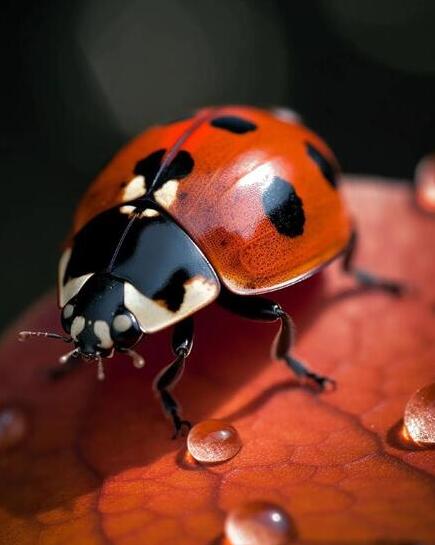
Ladybugs can be categorized into several types, including: seven-spotted ladybug, two-spotted ladybug, four-spotted ladybug, six-spotted ladybug, double seven-spotted ladybug, nine-spotted ladybug, ten-spotted ladybug, eleven-spotted ladybug, twelve-spotted ladybug, thirteen-spotted ladybug, fourteen-spotted ladybug, twenty-eight-spotted ladybug, horned ladybug, large red ladybug, red-ringed ladybug, striped ladybug, six-spotted shield ladybug, brightly colored shield ladybug, and so on.
brief
Ladybugs are typical natural enemies of Hemiptera, with carnivorous ladybugs feeding on aphids and scale insects. Herbivorous ladybugs belonging to the subfamily Epilacninae are highly destructive agricultural pests, such as the Mexican bean beetle (Epilachna varivestis). However, ladybugs are frequently used as biological control agents; introducing new ladybug species can repel and replace existing ladybug populations.
When some ladybugs are subjected to strong physical stimulation, they will appear to be in a state of suspended animation and secrete a yellow, sticky, irritating body fluid from their joints and spines. The body fluid of ladybugs has a strong odor and bitter taste, which can help them avoid attacks from external enemies[3]. The bright body color of ladybugs can be regarded as a warning color to warn external enemies. Therefore, birds and other creatures rarely catch ladybugs, but there are still natural enemies such as parasitic wasps, parasitic flies, and fungi. In addition, mantises will prey on the larvae of potato ladybugs.
Depending on the species, insects exhibit vastly different diets, primarily falling into three categories: carnivorous insects that prey on aphids and scale insects; fungi-eating insects that feed on powdery mildew fungi; and herbivorous insects that feed on plants in the nightshade family (Solanaceae). Therefore, they can be categorized as beneficial or harmful insects to crops. In recent years, carnivorous species have been utilized as biopesticides in organic farming, replacing traditional pesticides.
External features
Ladybugs are typically short-ovate to round in shape, with a strongly arched back and a usually flattened ventral surface. Adult ladybugs are generally between 1.0 and 16.0 mm in length. Their bodies are hemispherical, only about the size of a soybean; their wings are stiff and have a metallic sheen. The pronotum and elytra base are often closely connected, usually with similar widths. The head is often embedded in the pronotum, sometimes completely covered by the pronotum. The pronotum and elytra are smooth, or often have sparse or dense fine short hairs. Ladybugs are numerous and brightly colored, often with red, black, or yellow spots distributed on the elytra. Based on the number and distribution of spots, ladybugs can be divided into different species. For example, the seven-spotted ladybug has seven black spots on its elytra, while the twenty-eight-spotted ladybug has even more.
The seven-spotted ladybug is a type of ladybug with an oval body, measuring 5.2–7 mm in length and 4.0–5.6 mm in width. Its head is black, its antennae are dark brown, and each of the two anterior corners of the head has a pale yellow quadrilateral spot. The scutellum is black, and the elytra have seven black spots, with a triangular yellowish-white spot at the base of each side; the abdomen and legs are black.
Most ladybugs possess three distinctive features: axe-shaped terminal segments of the maxillary palps, a cryptosquamous four-segmented tarsi, and a posterior basal line on the first sternum. These features distinguish them from other closely related species. The relatively short (usually indistinct) legs and antennae, along with the absence of prominent punctures on the dorsal surface of the elytra, also help differentiate them from other closely related families. These characteristics collectively contribute to the ladybug's unique appearance, making it stand out in the insect world.
Distribution and Habitat
Ladybugs are widely distributed throughout the world, primarily in Asia, Europe, North America, and South America. They are most common in Asian countries such as China, Japan, and South Korea. The fauna of mainland China belongs to two kingdoms: the southern kingdom, roughly south of the middle and lower reaches of the Yangtze River, belongs to the Oriental Kingdom along with the Indian Peninsula, the Malay Peninsula, and nearby islands, and is the central region for tropical animal distribution in eastern Asia; the northern kingdom extends from the northeast through North China and Inner Mongolia and Xinjiang north of the Qinling Mountains to the Qinghai-Tibet Plateau. Based on this characteristic, China is further divided into three major natural regions—the Monsoon Region, the Mongolian-Xinjiang Plateau Region, and the Qinghai-Tibet Plateau Region. In addition, ladybugs have been introduced to other regions. For example, from 1951 to 1971, seven-spotted ladybugs were introduced to North America. These regions provided abundant food sources and suitable living environments, allowing ladybugs to thrive. They adapt to various environments, including both natural and artificial ones. In natural environments, grasslands, gardens, orchards, fields, and among trees, or crawling on flower stems or resting under leaves are common habitats for them. Ladybugs can survive in warm, humid environments and are also adapted to urban environments, commonly found in parks and street greenbelts. Furthermore, ladybugs can survive in urban environments, especially in parks and street greenbelts, where these areas provide them with refuge and food sources, allowing them to survive and reproduce in human-inhabited environments.
Biological life cycle
Ladybugs are holometabolous insects. Their life cycle consists of four stages: egg, larva, pupa, and adult. The larvae and adults share similar habits, grow rapidly, have a large appetite, and go through four instars. Adults reproduce 1-2 times per year, laying up to 400 eggs, with an incubation period of approximately 7 days. Their lifespan is generally only 3 years.
Eggs: After mating, the adult insect's eggs are usually oblong or spindle-shaped, pointed at both ends, and range in color from light yellow to reddish-yellow, including yellow, white, orange-yellow, and pink. Different species have different oviposition habits. Eggs vary in length from 0.25 to 2.00 mm, and can be laid singly or in clusters standing upright. Fertilization occurs when the egg passes through the opening of the female's sperm reservoir. At this time, the sperm enters the egg through many small pores (egg pores) at one end and attaches itself near food to lay eggs for the newly hatched larvae to feed on.
Larvae: After hatching, the larvae are wingless, with their abdomens extending backward. They vary greatly in size. The newly emerged larvae will remain on the eggshell for several hours, at most a day, waiting for their body surface, mouthparts, and other organs to harden. Afterward, the larvae disperse to forage. Generally, their heads and mouthparts face downward, and they have three pairs of well-developed thoracic legs. A leg-like projection forms at the end of the abdomen, which helps to anchor the body during movement and pupation. Ladybugs often have a spindle-shaped body, but some have an arched back. Some groups have spiny tubercles or hairy tubercles on their backs, while others are flattened without spiny tubercles or hairy tubercles on their backs. Some even have a waxy coating on their backs, with protrusions and spines on their bodies, making them quite different from adults. They typically molt three times, dividing the larvae into four instars. Before molting, they stop feeding and use their anal organs at the end of their abdomen to anchor themselves to the substrate, molting head down. Before pupation, the fourth-instar larvae do not eat or move.
Pupae: Among beetles, there are cases where the larvae and adults have different diets, while ladybugs mostly have larvae and adults that feed on the same food. Furthermore, carnivorous ladybugs may occasionally engage in cannibalism when food is scarce. After reaching a certain stage of development, the larvae pupate on the undersides of leaves or other plant surfaces. Ladybug pupae are naked pupae, securing their bodies to the substrate with the protuberances at the end of their abdomens before pupation. They are oval-shaped with short wings, but at this stage, they are already close to the adult form. During the growing season, the egg stage for most ladybugs is 2-4 days, the larval stage is 9-15 days, and the pupa stage is 4-8 days, with the emergence of adults taking 16-25 days. Some ladybugs retain their molted exoskeleton at the tail end of the pupa, leaving the pupa completely exposed. Others retain their molted exoskeleton at the tail end, with only the front or center of the back splitting open. The abdomen attaches to branches to prevent falling to the ground, and the hardened portion surrounding the pupa becomes its protective covering.
Adults: Newly emerged adult ladybugs have yellow wings and very soft, light-colored elytra without markings. Markings gradually appear on the elytra, sometimes within minutes, hours, or even days or weeks. As the wings harden, characteristic patterns emerge. Adult ladybugs are commonly seen from spring to autumn. Most ladybugs hibernate in their adult form, hiding in groups under rocks and fallen trees during winter. These groups range in size from a few to hundreds, or even tens of thousands.
Ladybugs have varying lifespans. Some species with longer dormancy periods can live for about a year as adults, and living for two years is also common. Some adults can survive a second winter without laying eggs if suitable egg-laying conditions are not available.
Lifestyle
Ladybugs are swarming and migratory, without fixed habitats. They can tolerate various harsh climates and are capable of swimming and diving, further enhancing their adaptability and predation abilities in the natural environment. Ladybugs primarily feed on pests that damage crops, such as aphids and scale insects.
Foraging
Ladybugs can be divided into two main categories based on their diet: herbivorous and carnivorous. Carnivorous ladybugs constitute the vast majority of ladybugs, primarily preying on agricultural pests, including various aphids, scale insects, whiteflies, spider mites, and other arthropods. Among carnivorous ladybugs, the seven-spotted ladybug (Coccinella septempunctata) is one of the most well-known species. It is named for its bright red or orange-yellow elytra and the seven black spots (three on each side and one in the center). The seven-spotted ladybug particularly favors cotton aphids and peach aphids, consuming hundreds of aphids daily, thus being considered a beneficial insect in farmland, vegetable gardens, and orchards. Ladybugs primarily prey on various agricultural pests through their carnivorous behavior. They seek out suitable habitats—the parasitic plants of their prey—and then hunt and consume them. Clearly, vision plays an important role in the search for habitat; however, there are exceptions. Some plant volatiles affect the foraging of ladybugs. For example, the volatiles of pine trees are more attractive to the gray-eyed ladybug.
In summary, ladybugs primarily prey on agricultural pests through their carnivorous behavior, making them a vital part of the ecosystem. Their presence helps maintain ecological balance and promotes the health and stability of the ecosystem. Ladybugs' diet includes a variety of agricultural and forestry pests, making them a strong candidate for biological control "natural enemies" (a technical term referring to animals that prey on or harm another animal in nature). They can effectively control the populations of harmful insects such as aphids, scale insects, whiteflies, and mites, reducing reliance on pesticides and protecting plant health and yield.
Species hazards
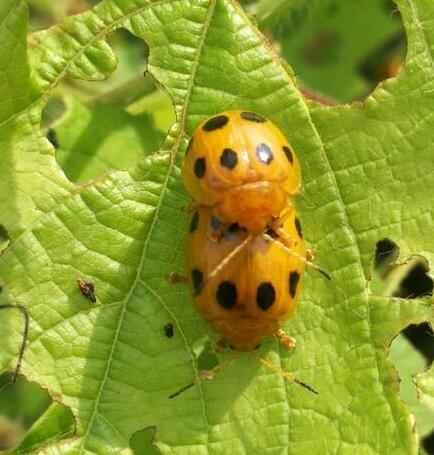
Not every ladybug is beneficial. The 28-spotted ladybug is a typical harmful ladybug that damages vegetables, mainly eggplants and potatoes.
Types
Classified by diet
[Predatory]: Exhibits a certain degree of specialization.
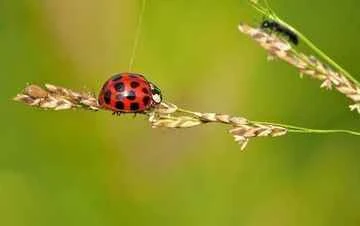
The seven-spotted ladybug (Coccinella septempunctata) is a representative ladybug widely distributed in Africa, Europe, and Asia. It is about 8 mm in length, with red wings and, as its Chinese name suggests, seven black markings. There is no variation in the markings between individuals. It feeds on aphids and spider mites; when food is scarce, cannibalism among larvae occurs.
The multicolored ladybug (Harmonia axyridis) is widely distributed in Asia and other regions, and is considered a representative species along with the seven-spotted ladybug. It is approximately 7 mm in length. Unlike the seven-spotted ladybug, its body color varies greatly, including black with two red spots, black with four red spots, and patterns of red and yellow. It preys on aphids.
The six-striped ladybug (Menochilus sexmaculatus) is about 5mm long, slightly smaller than the multicolored ladybug. Its wings are black with four red spots, and it is difficult to distinguish from other species that resemble the multicolored ladybug. It feeds on aphids.
The large ladybug (Aiolocaria hexaspilota), also known as the six-spotted ladybug, is a large ladybug about 12 mm in length. Its wings have black and orange patterns, hence its name due to their resemblance to a tortoise shell. It preys on the larvae of the walnut leaf beetle.
The Japanese ladybug (Propylaea japonica) resembles the large ladybug in appearance, but is only about 4 mm long. Its food source is aphids.
The large-shouldered ladybug (Synonycha grandis) is a rare, large ladybug about 12 mm in length. It preys on scale insects.
The Australian ladybug (Rodolia cardinalis) is a small ladybug about 4mm in length. Its wings are red with black markings. It feeds on cushion scale insects (Icerya purchasi). Native to Australia, it was introduced to other regions to control cushion scale insects.
The black-edged red ladybug (Chilocorus rubidus) feeds on scale insects. It is often found attached to plum trees. The "rubidus" in its scientific name (meaning "red" in Latin) comes from its red markings, which resemble those of a ruby.
[Fungal diet]
The Koebelei ladybug (Illeis koebelei), also known as the yellow ladybug, is about 5 mm in length. It has two black spots on a white background on its thorax, and its entire wing is yellow. It feeds on powdery mildew and other pathogens.
The twelve-spotted brown ladybug (Vibidia duodecimguttata), also known as the white ladybug, is about 4 mm in length. Its body is yellowish-brown with pale white spots. It feeds on powdery mildew fungi and other pathogens.
[Herbivorous]: Only the Herbivorous Ladybugs subfamily are herbivorous. Herbivorous ladybugs are characterized by their wings lacking luster compared to carnivorous ladybugs.
Ladybug with twenty-eight spots (Henosepilachna vigintioctopunctata)
The potato ladybug (Henosepilachna vigintioctomaculata) and its two species are about 7 mm long, with 28 black spots on a light brown body. The potato ladybug, also known as the large 28-spotted ladybug, is slightly larger in body and spots than the eggplant 28-spotted ladybug. They are considered pests because they collectively feed on eggplant and potato leaves. Within the herbivorous ladybug subfamily, the potato ladybug has the highest latitude distribution, reaching as far north as Primorsky Krai. The eggplant 28-spotted ladybug, on the other hand, is distributed from south of Hokkaido to Southeast Asia.
The Boisduvali ladybug (Henosepilachna boisduvali) is found in the Okinawa Islands of Japan and Orchid Island in Taiwan. It feeds on the leaves of cucurbitaceous plants.
The leaf-splitter ladybug (Henosepilachna pusillanima) is found in Yonaguni Island and other areas of the Yaeyama Islands in Japan, as well as Orchid Island in Taiwan.