Basic Information
Scientific classification
- Chinese name: Feather-tailed possum
- Scientific name: Acrobates pygmaeus
- Classification: Mammals
- Family: Tree-tailed Marmosetidae; Genus: Feathertail Marmoset
Vital signs data
- Body length: The head and body length is usually about 6.5–8 cm, and the tail length is about 7–8 cm; the wingspan appears even wider when the gliding membrane is deployed.
- Weight: Weight is mostly in the range of about 10–14 grams, and may fluctuate depending on the season and food conditions.
- Lifespan: In the wild, lifespan is mostly several years, with a common lifespan of about 3–5 years; under stable resource conditions, some records show that it can be longer.
Significant features
One of the world's smallest gliding mammals, it has "feather-like" bristles on both sides of its tail; it feeds on nectar and pollen at night and also eats insects, thus acting as a nocturnal pollinator.
Distribution and Habitat
Widely distributed in eastern and southeastern Australia, found in various forests, sparse woodlands and riparian forests, and also in well-treed urban green spaces; it relies on tree cavities/nest boxes and connected canopies.
Appearance
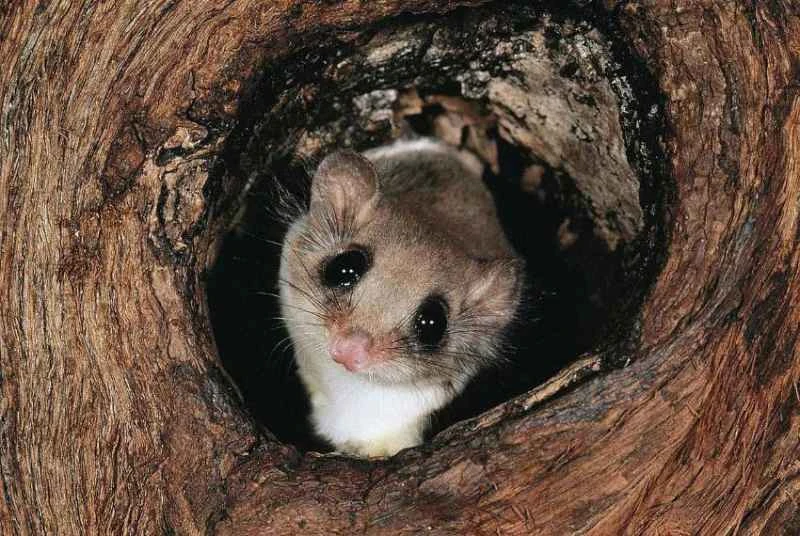
The mouse is about the size of a mouse, with a grayish-brown back and a light-colored belly. It has large eyes and thin ears; there is a gliding membrane between its fore and hind limbs; its tail is flat and has long, feathery hairs on both sides, which act like a rudder when gliding.
Detailed introduction
The feathertail glover ( Acrobates pygmaeus ) is one of the smallest gliding marsupials native to Australia and the smallest gliding mammal in the world. Only the size of a mouse, it can deploy a gliding membrane from its wrists to its ankles between trees, gliding like a miniature parachute from one tree to another. Its most distinctive feature is its flat, feather-like tail with stiff, long hairs on both sides—which helps stabilize its direction while gliding and aids in balance when climbing.
The feathered possum is primarily nocturnal, resting in tree cavities or nest boxes during the day and foraging among flowering plants and the canopy at night. Its diet consists mainly of nectar and pollen, but it also preys on small insects, spiders, and other invertebrates. Due to its frequent movement among flowers, the feathered possum also acts as a "nocturnal pollinator" in some forest and shrub ecosystems. Overall, it is widely distributed and highly adaptable, but remains relatively sensitive to tree cavity resources, continuous canopies, and forest fire patterns.
Classification and nomenclature
The feathertail possum belongs to the class Mammalia, order Diprotodontia, family Acrobatidae, and genus Acrobates . Its English name, "feathertail," comes from the long, feather-like fringe along the sides of its tail; "glider" refers to its ability to glide between trees using a gliding membrane.
Appearance features
The feathered possum is very small, with a head and body length typically around 6.5–8 cm and a tail length around 7–8 cm; its weight usually ranges from 10–14 grams. Its back is mostly greyish-brown or brownish-grey, while its belly and inner sides of the limbs are lighter. It has large, dark eyes and thin, relatively conspicuous ears, making it suitable for nocturnal activity.
Its gliding membrane extends from its forelimbs to its hindlimbs, forming a stable wing surface when unfolded; rows of stiff hairs grow on both sides of its tail, making the tail flat and "feather-like," which helps with steering and deceleration during gliding. Another amazing skill is climbing: the fine ridges on the soles of its feet, combined with secretions, can generate strong adhesion, allowing it to quickly climb relatively smooth tree trunks.
Distribution range and habitat
The feathered possum is widely distributed in eastern and southeastern Australia, from Queensland to New South Wales and Victoria, and extending to parts of southeastern South Australia. It can be found in a variety of tree-lined habitats, including humid forests, dry sclerophyllous forests, open woodlands, riparian forests, and well-treed urban green spaces and gardens.
It relies on tree cavities, crevices in fallen logs, or nest boxes as hiding places for resting and raising young during the day, and also needs relatively connected tree canopies for gliding. Over-clearing of habitats, reduction of old trees (fewer tree cavities), and changes in understory structure caused by frequent high-intensity fires can all reduce its local carrying capacity.
Lifestyle Habits and Behaviors
The feathered possum is primarily nocturnal, becoming active after dusk. It is agile, often quickly climbing to feed on the tips of branches and leaves and among inflorescences. It also glides between trees, with a single glide distance reaching tens of meters (depending on altitude, wind conditions, and canopy structure).
They exhibit a degree of sociality, with several individuals often sharing the same tree hollow or nest box for warmth; this huddling helps conserve energy during the cold season. When disturbed, they typically retreat quickly into tree hollows or other sheltered locations.
feeding habits
Their main food sources are nectar and pollen, but they also feed on tree sap, soft fruits, and small invertebrates such as moths, ants, and termites. Their feeding priorities adjust according to the flowering season: during peak flowering, they prefer "flower sources," while when flower sources are insufficient, they increase the proportion of insects and other animal-based foods.
Reproduction and life cycle
Breeding rhythms are influenced by regional climate and flower availability. Females typically give birth to 2–4 pups per litter, which develop in the brood pouch and then continue to grow in the nest, learning to glide and forage. Due to their small size and rapid energy turnover, the pups are highly dependent on food continuity and a secure nest location during the rearing period.
Their lifespan in the wild is mostly several years (commonly around 3–5 years), with some records showing longer lifespans under conditions of low threat and stable resources.
Relationship with humans
Feathered possums are harmless to humans and are mostly rare "nocturnal creatures." They may quietly visit at night on the outskirts of cities or in gardens with native flowering plants. The main impacts of human activities on them are usually indirect: reduced tree hole resources, altered activity patterns due to roads and lights, and additional mortality risks from invasive predators such as cats.
Protecting the status quo and threats
The feather-tailed possum is generally assessed as Least Concern (LC), but it may still be affected by habitat clearing and fragmentation, a decrease in old trees (tree cavity shortage), frequent high-intensity fires, and predators such as feral cats and foxes. Maintaining canopy connectivity and preserving tree cavity resources (or providing nest boxes), planting native flowering plants, and reducing nocturnal activity of domestic cats are the most direct and effective friendly measures.
Frequently Asked Questions
Q1: Are feathered possums and sugar gliders the same animal?
No. Both can glide, but they belong to different families and genera. The feathered possum is smaller and has a flat, feather-like tail, which is a very distinctive feature.
Q2: What do they mainly eat?
Their diet consists mainly of nectar and pollen, but they also eat insects, spiders, and other invertebrates, and may also consume tree sap and soft fruits. Their diet varies depending on the season.
Q3: Why are they able to climb so quickly on smooth tree trunks?
The fine structures on their soles, combined with secretions, create strong adhesion, helping them grip relatively smooth tree bark and improve climbing efficiency.
Q4: How can we achieve more harmonious coexistence in residential areas?
Preserving large trees and tree cavities, providing nest boxes, planting native flowering plants, and keeping domestic cats indoors at night can significantly reduce the risk of predation and increase their chances of being seen.