
Basic Information
Scientific classification
- Chinese name: Grey-headed Goose
- Scientific name: Ashy-headed Goose, Chloephaga poliocephala
- Classification: Waterfowl
- Family and genus: Anseriformes, Anatidae, Aperturei
Vital signs data
- Body length: 50-55 cm
- Weight: No verification information available.
- Lifespan: No verification data available.
Significant features
It is a short, stout bird with similar plumage in both males and females.
Distribution and Habitat
They are distributed in South America, including Colombia, Venezuela, Guyana, Suriname, Ecuador, Peru, Bolivia, Paraguay, Brazil, Chile, Argentina, Uruguay, and the Falkland Islands (also known as the Malvinas Islands).
Appearance
The Grey-headed Goose, measuring 50-55 cm in length, is a plump and beautiful bird with similar plumage in both males and females, though slightly smaller than the female. It has a grey head, chestnut neck and breast, a white midsection with alternating black and white stripes on the sides, and black primary flight feathers with broad green edges. Juveniles have grey plumage and a brown head.
Detailed introduction
The Ashy-headed Goose (scientific name: Chloephaga poliocephala) is a bird belonging to the family Anatidae in the order Anseriformes.
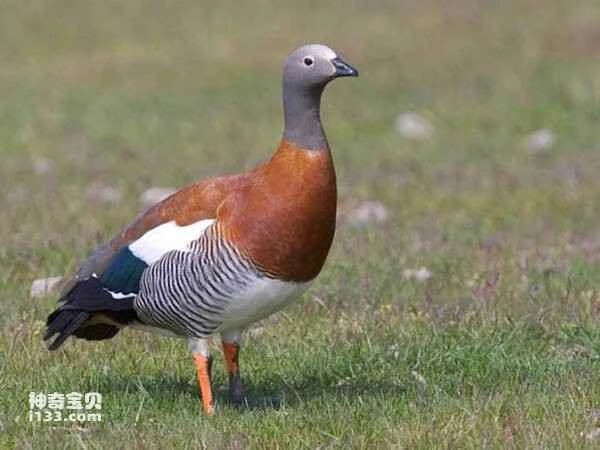
The Grey-headed Goose inhabits the lowlands of the southernmost tip of South America, wintering in the northern mountains. It frequently appears in jungle swamps, wetlands, and beech forests near the southernmost forest regions. Its flight is slow and unpredictable. It is relatively terrestrial, but not a strong swimmer, raising its chest and hindquarters when entering the water. It is wary and timid, and will not tolerate human approach, often flying away or swimming away at a distance upon seeing a person. It forages near water, mainly feeding on grasses, seeds, and various aquatic plants.
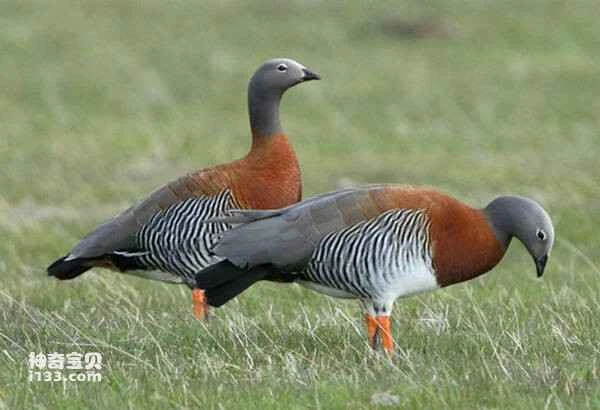
Grey-headed Geese typically breed near the edges of lakes, rivers, ponds, and marshes. Nests are built in grasses and bushes. Male geese are highly territorial. Females line the nest with plants, and after laying eggs, they pluck a large amount of down feathers from their own bodies and place them inside. Each clutch contains 4-6 white eggs, with an incubation period of 30 days. The chicks are precocial, able to swim and move around as early as the second day after hatching, and reach sexual maturity at two years of age.
Listed in the International Union for Conservation of Nature (IUCN) Red List of Birds, 2009 ver 3.1.
Protect wild animals and ban the consumption of wild game.
Maintaining ecological balance is everyone's responsibility!


