Basic Information
Scientific classification
- Chinese name: Spotted-flanked Goose
- Scientific name: Upland Goose, Chloephaga picta
- Classification: Waterfowl
- Family and genus: Anseriformes, Anatidae, Aperturei
Vital signs data
- Body length: 59-72 cm
- Weight: No verification information available.
- Lifespan: No verification data available.
Significant features
It has typical white wing patches and fine black transverse bands on the abdomen.
Distribution and Habitat
They are distributed in South America, including Colombia, Venezuela, Guyana, Suriname, Ecuador, Peru, Bolivia, Paraguay, Brazil, Chile, Argentina, Uruguay, and the Falkland Islands (also known as the Malvinas Islands).
Inhabiting alpine lakes, marshes, grasslands and wetlands, and rocky or pebble areas along coastlines, they graze on grasslands, pastures, and open hillsides. They are active at almost all altitudes. Their flight speed is slow and unpredictable.
Appearance
The Chloephaga picta picta, measuring 59-72 cm in length, possesses relatively long, straight, and powerful legs well-suited for walking, running, and feeding on land. Not only do males and females differ in plumage, but the two subspecies also exhibit slight differences in appearance. One subspecies (Chloephaga picta picta) has a white head, neck, breast, and abdomen, with black wingtips and wingtips. The wings are predominantly black and white with metallic green speckles, and the tail is black. The other subspecies (Chloephaga picta leucoptera) shares the same white plumage, but its underparts are entirely black and white with alternating markings. The central tail feathers are grey with white edges, and the bill and legs are black.
Compared to the two male geese, the female geese have cinnamon brown heads and necks, black sides and sides of the breast and abdomen, black back and tail coverts, black beaks, yellow legs on both sides of the breast, and wings that are almost identical to those of the male geese.
Detailed introduction
The Upland Goose (scientific name: Chloephaga picta) has two subspecies.
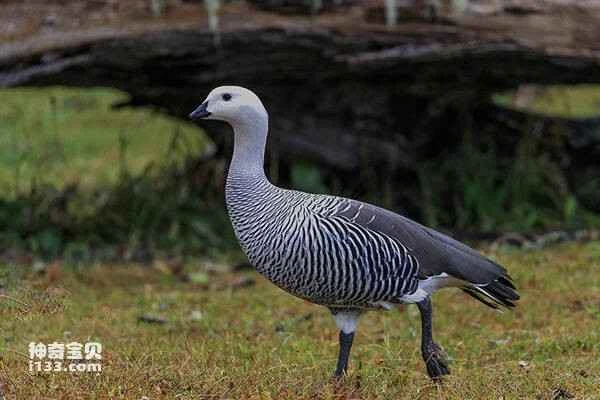
The Barred Grass Goose (frequently inhabits nearby freshwater areas and coastal lagoons; it is primarily terrestrial, a poor swimmer, and raises its chest and hindquarters when entering the water. It is wary and timid, and people cannot approach it; it often flies away or swims away at the sight of humans. It forages near water, mainly feeding on grasses, seeds, berries, green algae, and various aquatic plants.)
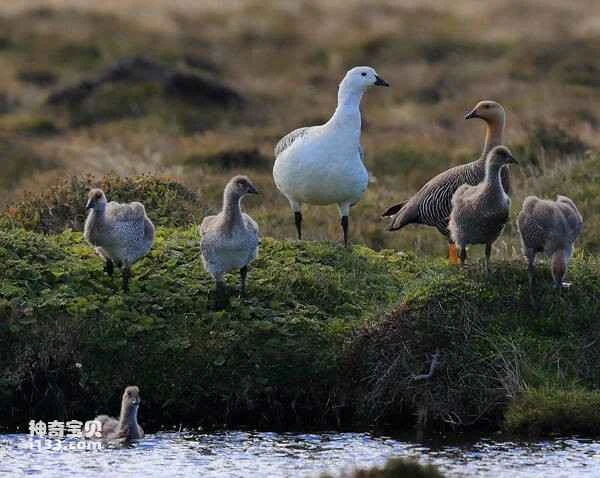
The Barred-sided Goose breeds year-round in the same region of northern mainland China. In the Falkland Islands, egg-laying occurs from September to October. They typically breed near the edges of lakes, rivers, ponds, and marshes. Nests are built in rock crevices or burrows on sandy slopes. Males are highly territorial. Females line the nest with plants, and after laying eggs, they pluck a large amount of down feathers from their own bodies and place them inside. Each clutch contains 5-7 pink eggs, which the female incubates alone for 30 days. Chicks are precocial, leaving the nest shortly after hatching and able to swim and move around by the next day, but still accompanied by their parents to forage for insects and plant matter. They reach sexual maturity at two years of age.
Listed in the International Union for Conservation of Nature (IUCN) Red List of Birds, 2009 ver 3.1.
Protect wild animals and ban the consumption of wild game.
Maintaining ecological balance is everyone's responsibility!