Basic Information
Scientific classification
- Chinese name: Nautilus
- Scientific name: Nautiloidea
- Classification: Molluscs
- Family and genus: Nautiloidea, Nautilidae, Heteronautilus
Vital signs data
- Body length: 16-26.8 cm
- weight:
- Lifespan: Approximately twenty years
Significant features
It is the only extant cephalopod with a complete shell and is also one of the most famous marine mollusks.
Distribution and Habitat
Nautiluses live in the vast tropical waters between the Indian and Pacific Oceans, and are especially common in the deep sea. They can be found as far north as southern Japan, as far south as the Great Barrier Reef, as far west as the Andaman Sea, and as far east as Fiji.
Appearance
The nautilus is brightly colored, beautifully shaped, and highly ornamental. Its shell is thin and light, spiraling in shape. The surface of the shell is white or milky white, with smooth, fine growth lines radiating from the umbilicus, mostly reddish-brown. The entire spiral shell is smooth and disc-shaped, resembling a parrot's beak, hence the name "nautilus."
Detailed introduction
Nautiluses are a family within the order Nautiloidea of the class Cephalopoda. Common characteristics of nautiluses include numerous tentacles, long lifespan, and the use of pinhole-shaped imaging eyes. They are the only extant cephalopods with a complete shell and are among the most well-known marine mollusks. Currently, nautilus populations are relatively small; while not extinct, their habitat requires specific water pressure, making artificial breeding difficult.
Nautiloid species have undergone hundreds of millions of years of evolution on Earth. Their direct ancestors were apex predators in the Ordovician oceans, while the modern nautilus appeared on Earth in the Late Triassic period. Despite this, nautiluses have survived all mass extinction events on Earth thanks to their long lifespan of an average of 20 years and their strategy of small, efficient reproduction. Today, their appearance, habits, and ecology are still very similar to their ancient ancestors. Their survival time is even longer than that of most extinct prehistoric creatures (such as dinosaurs), hence they are called "living fossils." Therefore, nautiluses have high research value in biological evolution and paleontology.
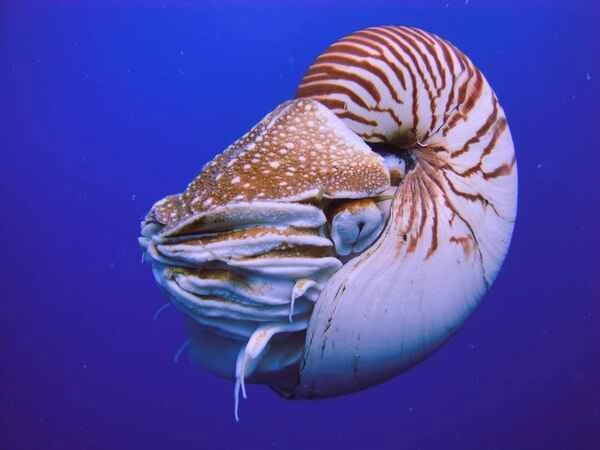
The nautilus shell has a beautiful equiangular spiral cross-section, which is closely related to the golden ratio. This adds a touch of mystery to the nautilus in addition to its beautiful appearance.
Nautiluses resemble other cephalopods in appearance, with a prominent head and tentacles. However, nautiluses have significantly more tentacles, up to 90 in total. Their tentacles lack suckers, so their grasping ability is not as strong as that of their distant relatives like octopuses, cuttlefish, and squid, but there is no fundamental functional difference between them, and they can retract their tentacles. Nautiluses have a large radula with nine teeth and two pairs of gills.
Of the extant cephalopods, only the nautilus has a shell; other cephalopods do not. While octopuses like the ship octopus also have shells, only the female ship octopus produces a white shell to protect the eggs when laying them, and the shell is separable from the body. After laying eggs, the shell is no longer present. However, the nautilus's body and shell are not separated.
The nautilus's shell is divided into more than thirty independent chambers by multiple transverse septa. Except for the last large chamber containing the body, all are filled with gas (mostly nitrogen). As the body grows, the chambers periodically expand outwards, secreting calcium carbonate and organic matter behind the mantle to construct a new septum. A thin tube runs through each chamber, allowing gas to flow into and out. By regulating the gas levels, the nautilus controls its buoyancy and movement. This unique body structure of the nautilus inspired the construction of submarines, and many countries have named their submarines after it.
Nautiluses are warm-water animals, with an optimal water temperature of 19-20℃. They generally live in the ocean at depths of 50 to 300 meters. They are usually active at night and feed mainly on the larvae of small crustaceans such as small crabs and shrimps. During the day, they hide in the crevices of rocks in the shallow waters of coral reefs and rest by holding onto the rocks with their tentacles. When the animals die, their soft bodies shed their shells and sink, while the empty shells drift with the ocean currents. Studying their drift routes is of certain significance for the analysis of ocean currents.
Nautiluses are dioecious and oviparous. Female nautiluses lay eggs once a year, usually on rocks in shallow water. The incubation period is 12 months, and newly hatched nautiluses are about 3 centimeters long.