Basic Information
Scientific classification
- Chinese name: Northern Tree Shredder
- Scientific name: Tree shrew, Central Burmese tree shrew, Tupaia belangeri
- Order: Hedgehogaeformes
- Family and genus: Araneales, Araneidae, Araneidae
Vital signs data
- Body length: 26-41 cm
- Weight: 50-270 grams
- life:
Significant features
They are good climbers and jumpers, agile in movement, timid and easily startled, and have a strong sense of territory. They can emit eight different sounds for alarm, attention, contact, and defense.
Distribution and Habitat
It is mainly distributed in the Malay Peninsula of Southeast Asia. Domestically, it is found in Sichuan, Yunnan, southern Tibet, Guangxi, Guizhou, and Hainan Island. Internationally, it is distributed in southern Nepal, northern India, Bhutan, Bangladesh, Vietnam, Thailand, Laos, Cambodia, and its southernmost point reaches the Kra Isthmus.
A typical arboreal species. It is highly adaptable, distributed from low-altitude areas near sea level to plateaus at around 3000m. It inhabits a variety of habitats, including deciduous forests, evergreen broad-leaved forests, tropical rainforests, and limestone forests, and can also utilize secondary environments such as palm plantations.
Appearance
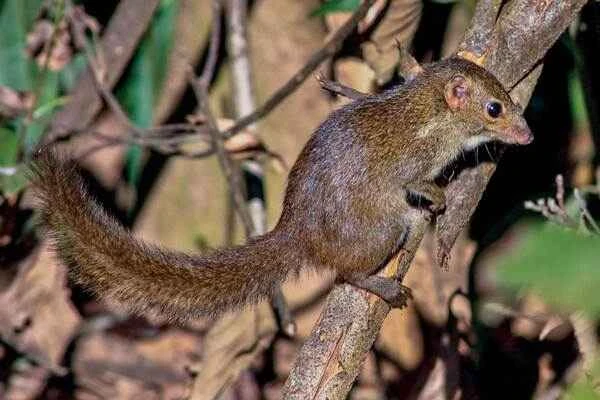
A small mammal resembling a squirrel. Its snout is blunt and rounded, longer than that of rodents like squirrels. The ears are short, 15-20 mm. The head and body length is 160-230 mm. The tail is 150-200 mm long, nearly the same length as the head and body, and is flat, unlike the bushy tail of a squirrel. The fur on the back varies in color, mostly brownish-yellow with black and white hairs, giving the back an overall dirty brown or dirty yellow hue. The belly fur is usually light yellow. There is significant geographical variation in fur color; the Yunnan population has a more olive-brown color, while the Hainan population has a more scarlet color. Females have three pairs of nipples.
Detailed introduction
The Northern Tree Shredder (scientific name: *Tupaia belangeri*) is a tree shrew native to the Indochina Peninsula, northeastern South Asia, and southern China, with its type locality near Yangon, Myanmar. It primarily inhabits tropical and subtropical forests and scrublands. Its diet consists mainly of insects, but it also consumes young birds, eggs, grains, fruits, and leaves. It is mainly distributed in Southeast Asia north of the Kra Isthmus. This species has a wide distribution, large population, stable numbers, strong adaptability, and numerous protected areas; therefore, it is listed as Least Concern by the International Union for Conservation of Nature (IUCN).


subspecies
The Northern Tree Shredder, subspecies *T. b. assamensis*, was named by Wroughton in 1921. In mainland China, it is distributed in Tibet (Abor Mountains) and other areas. The type locality of this species is Assam, India.
*T. b. chinensis*, named by Anderson in 1879, is distributed in southwestern Sichuan and Yunnan provinces in mainland China. The type locality of this species is the Sangda River Valley in Bangxi and Mengla, Yunnan.
The northern tree shrew, *T. b. gaoligongensis*, was named by Wang in 1987. In mainland China, it is distributed in Yunnan Province (central and northern sections of the Gaoligong Mountains). The type locality of this species is Lushui, Yunnan.
The Himalayan subspecies of the Northern Tree Shredder (T. b. lepcha), named by Thomas in 1922, is distributed in southern Tibet and other areas of mainland China. The type locality of this species is India.
The Hainan subspecies of the Northern Tree Shredder (T. b. modesta), named by G. Allen in 1906, is distributed in Hainan and other areas of mainland China. The type locality of this species is Limushan, Hainan Island.
The northern subspecies of the tree shrew (T. b. tonquinia), named by Thomas in 1925, is distributed in southwestern Guangxi and other areas of mainland China. The type locality of this species is Vietnam.
*T. b. yaoshanensis*, named by Wang in 1987, is distributed in Guangxi (Dayao Mountains) and other areas in mainland China. The type locality of this species is Jinxiu, Guangxi.
The Yunnan subspecies of the Northern Tree Shredder (T. b. yunalis), named by Thomas in 1914, is distributed in Yunnan (the Red River basin and areas to its east, and the central Wuliang Mountains), southwestern Guizhou, and Guangxi (Baise area) in mainland China. The type locality of this species is Mengzi, Yunnan.