Basic Information
Scientific classification
- Chinese name: Platypus
- Scientific name: Ornithorhynchus anatinus
- Classification: Monotremes
- Genus and species: Platypus
Vital signs data
- Body length:
- weight:
- life:
Significant features
Distribution and Habitat
Appearance
Detailed introduction
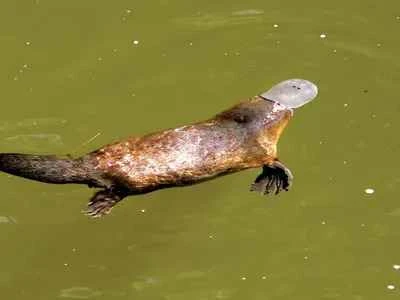
The platypus (Ornithorhynchus anatinus) is a small Australian amphibian mammal known for its strange combination of primitive features and unique adaptations, especially its flat, almost comical beak, which early observers thought was a duck's beak sewn onto a mammal's body. A prominent white patch of fur below its eyes adds to its distinctive appearance. The fur on the rest of its body is dark brown to light brown on the upper body and lighter in color on the lower body.
Platypuses are common in the waterways of eastern Australia, typically feeding on benthic invertebrates, but occasionally preying on surface frogs, fish, or insects. This shy creature is most active foraging from dusk till dawn, hiding in burrows dug into the riverbanks during the day. It is perfectly suited to its aquatic lifestyle, possessing a flat, torpedo-shaped body, thick, waterproof fur, and powerful forelimbs for swimming and digging. Even its head is streamlined, with each ear and a small eye housed in a recess. While feeding underwater, the platypus's vision, smell, and hearing are essentially shut down, but it possesses a unique electromechanical system of electroreceptors and tactile receptors that allow it to navigate perfectly underwater. Similar electroreceptors are found in echidnas, which, along with platypuses, form the order Monotremes, a unique group with an extremely ancient history.
Natural History
Platypuses are typically solitary animals, spending their lives either feeding along the bottoms of rivers, streams, and lakes or resting in burrows dug into the riverbanks. They are energetic, feeding almost continuously in the water, using their flat beaks to shovel through riverbed debris in search of larvae, insects, and freshwater crustaceans (their favorite food). Platypuses utilize their complex electromechanical system to detect minute electrical signals emitted by the muscles of their prey. After feeding, they retreat to their burrows, the entrances of which are large enough to accommodate the platypus and allow them to squeeze out excess water from their fur.
The platypus's range extends from the highlands of Tasmania and the Australian Alps to lowlands near the sea. Although sometimes seen swimming in saltwater, platypuses must feed in freshwater, where their electronic navigation systems function. Platypuses are found in the east- and west-flowing river systems of eastern Australia, but are absent from northern Queensland, and unlike its close relative, the echidna, the platypus does not appear to have settled on New Guinea.
Generally, platypuses are most active at dawn and dusk (twilight), but depending on the season, cloud cover, stream productivity, and even individual preference, they can also be active during the day. Platypuses do not hibernate. However, their body temperature is unusually low for a mammal (around 32 °C [90 °F]). Research has shown that they can maintain a constant body temperature even after prolonged immersion in water as low as 4 °C (39 °F), a fact that contradicts the notion that monotremes cannot regulate their body temperature.
Form and function
Platypuses range in length from 38 to 60 centimeters (15 to 24 inches); males are typically larger than females. Aquatic adaptations include a flat, streamlined body, eyes and nostrils located on the back, and a dense, waterproof coat that provides excellent insulation. Long guard hairs protect the soft undercoat, keeping it dry even after hours in the water. The broad webbing on the forefeet extends far beyond the claws and is crucial for propelling the animal through the water. The paddle-like tail acts as a stabilizer while swimming, while the hind feet function as a rudder and brake.
The platypus's unusual skeletal features include ancient and robust shoulder girdle and a short, broad humerus, providing extensive muscle attachment areas for its exceptionally strong forelimbs. Its outer beak is covered with soft, sensitive skin. Inside the beak, adult platypuses lack real teeth, instead developing flat pads composed of hardened gingival tissue. Male platypuses have a bony spur on the inside of each ankle that connects to a venom gland located above the thigh. This spur can be used for defense; if it pierces the skin, the venom is potent enough to kill small animals and cause excruciating pain in humans.
Life cycle and reproduction
Despite their large numbers, little is known about the life cycle of wild platypuses, and very few have been successfully kept in captivity. Aside from mating, both sexes avoid each other, and they don't mate until they are at least four years old. Males frequently fight during the breeding season, inflicting wounds on each other with sharp ankle spurs. Courtship and mating occur in the water from late winter to spring; the timing of mating varies with latitude, occurring earlier in more northern regions and later in Vietnam. Mating is an exhausting process. In one recorded video, a male was seen tightly gripping a female's tail with his beak, leading her in a relentless chase.
Males do not participate in raising the young. Females construct specialized nursery burrows where they typically lay two small, leathery eggs. Gestation lasts at least two weeks (potentially up to a month), and incubation may take another 6 to 10 days. Females incubate the eggs by curling them around their heads and touching their beaks with their tails. Each platypus hatches from the egg with the aid of an incubator. Egg teeth and fleshy caruncles are remnants of structures from the reptile's past. The young suckle from specialized hairs and are protected in the burrow, suckling for three to four months before becoming independent. Newly hatched platypuses typically gain 20 times their weight in the first 14 weeks after birth, and their teeth fall out shortly after the young platypuses leave the burrow to feed on their own.
Both males and females are fully developed between 12 and 18 months, reaching sexual maturity at around 18 months. For a small mammal, their lifespan is quite long. Some studies have documented individuals living in the wild for over 20 years. Platypuses can survive for nearly 23 years in captivity.
Evolution, Paleontology and Classification
Aquatic, platypus-like monotremes likely evolved from more common terrestrial monotremes. The first fossil record of platypus-like monotremes dates back approximately 110 million years to the Early Cretaceous period, when Australia was still connected to South America via Antarctica. Until recently, this Cretaceous monotremum (Steropodon galmani, known for its striking opaline mandible) was classified in the Platypusidae family, but based partly on molecular studies and some dental structures, it is now classified in its own family, Steropodontidae.
The extant platypus family (Ornithorhynchidae) includes the extinct genus Monotrematum (dating back to the Paleocene approximately 61 million years ago) and Obdurodon (possibly first appearing around 23 million years ago near the Oligocene-Miocene boundary) and the extant Ornithorhynchus. The discovery of M. sudamericanum in 62-million-year-old Patagonian sediments confirms that platypuses once inhabited the geographically contiguous southern continent (Gondwana). The species Monotrematum and Obdurodon retained functional teeth and were 60 cm (24 inches) longer and more robust than the extant platypus (Obdurodon).
Oviparous
Oviparous species lay undeveloped eggs instead of live offspring. The eggs may be fertilized before release, as in birds and some reptiles, or fertilization may occur externally, as in amphibians and many lower animals. Generally, oviparous species produce far more eggs than offspring, but their chances of survival are reduced due to the lack of maternal protection. This is in contrast to viviparous species.


