Basic Information
Scientific classification
- Chinese name: Echidna
- Scientific name: Tachyglossidae, spiny anteater
- Classification: Monotremes
- Family: Echidnae
Vital signs data
- Body length:
- weight:
- life:
Significant features
Distribution and Habitat
Appearance
Detailed introduction
Echidnae (family Tachyglossidae) are one of four peculiar egg-laying mammals found in Australia, Tasmania, and New Guinea. They feed and breathe through a bony, tubular beak covered in spines, extending from their dome-shaped bodies. Echidnae have round eyes and slit-like ears, and their beaks end in two small nostrils and a small mouth. Electroreceptors in the skin of their beaks sense electrical signals generated by the muscles of their invertebrate prey. Echidnae are active both day and night, slowly and cautiously exploring the ground while searching for prey, but they seek refuge in burrows or caves to escape the midday heat. Like their close relative, the platypus, echidnas have an unusually low body temperature, ranging from 29–32 °C (84–90 °F), and cannot tolerate more extreme temperatures. Although echidnas resemble hedgehogs in appearance, the two animals are not related and belong to different orders of mammals. Echidna species can be distinguished by their spines, the number of claws on their feet, and the shape and length of their beaks.
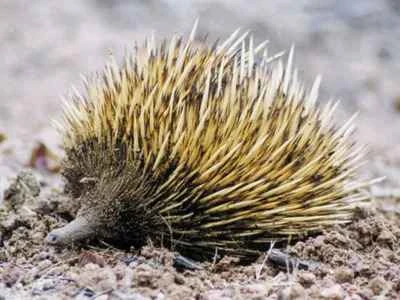
The short-beaked echidna (Tachyglossus aculeatus) has a straight, forward-pointing beak and heavy spines. It is quite common in suitable habitats throughout Australia; it has also been found in New Guinea, although little is known about its distribution and habits. The short-beaked echidna is perhaps the most widespread native mammal in Australia, but it is commonly found only in hollow logs, bushland, and burrows, where it can find shelter and ample food such as ants, termites, and other invertebrates. It captures its prey whole with its long, sticky tongue, but it may use its beak to tear larger soft-bodied prey into smaller pieces. Its small mouth can only open wide enough for its worm-like tongue to extend.
The echidna's head and body length, including its immature tail, is typically 30-45 cm (12-18 inches). Its body is covered by a combination of fur and bristles (modified hair). Echidnas from colder regions like Tasmania have long fur that partially covers their bristles, while those from arid regions appear to be entirely covered in bristles and lack fur. Beneath the bristly skin lies a well-developed layer of subcutaneous muscle, which in part explains the animal's astonishing strength. This layer of muscle allows the echidna to alter the contours of its robust body, wedging itself into crevices and between tree roots. When disturbed, the echidna can also quickly dig itself into the ground. In doing so, they appear to sink directly into the soil, and once burrowed, they are well camouflaged by their bristles. This combination of bristles, strength, and strategy makes the short-beaked echidna difficult to prey on; in fact, it enjoys a relatively predator-free existence—although wild dogs, exotic foxes, and cars occasionally pose a threat.
High temperatures are another danger faced by the short-beaked echidna. They have few sweat glands and cannot dissipate excess heat through panting; therefore, if they cannot find cool shelter, echidnas can die from heat stress. Researchers believe that the short-beaked echidna's habit of blowing mucus bubbles from the nostrils of their beak helps regulate their body temperature: when the bubbles burst, the beak is covered in mucus, which evaporates, helping to cool the body. If the temperature drops too low, it can lead to numbness or hibernation.
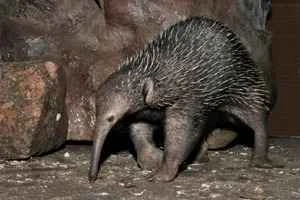
Long-beaked echidna
The western long-beaked echidna (Zaglossus bruijni) inhabits the island of New Guinea in the West Papua province of Indonesia.
The three extant species of the long-beaked echidna (genus Zaglossus) are found only on the island of New Guinea. They are generally described as being about 60 cm (24 inches) long, although one individual has been recorded as 100 cm (39 inches) long. Like the short-beaked echidna, these species exhibit great variation in fur and vertebral covering. Generally, their spines are much shorter and fewer in number than those of the short-beaked echidna, and their fur color ranges from medium brown to dark brown. The beak is also used to probe the leaf litter layer on the forest floor for food. However, its tongue is shorter than that of the short-beaked echidna and is covered with backward-pointing barbs used to hook earthworms.
Long-beaked echidnas inhabit varying altitudes, typically living in forested areas and only in sparsely populated regions. The International Union for Conservation of Nature (IUCN) Red List of Threatened Species considers all three species threatened, listing the Eastern Long-beaked Echidna (Z. bartoni) as Vulnerable, and the Western Long-beaked Echidna (Z. bruijnii) and Sir David's Long-beaked Echidna (Z. attenboroughi) as Critically Endangered due to hunting (echidnas are edible) and habitat loss.
Sir David's long-beaked echidna was first scientifically described in 1999. It is about the same size as the short-beaked echidna. It differs from other long-beaked echidnas in its smaller size and shorter, straighter beak, although it is otherwise similar to echidnas. The western long-beaked echidna inhabits a small patch of highland forest near Jayapura, Papua, Indonesia. Currently, little is known about Sir David's long-beaked echidna, and its habits cannot be described in detail.
The western long-beaked echidna inhabits West Papua province, Indonesia, and has a downward-pointing beak. Compared to the short-beaked echidna, its brown fur is dotted with smaller, fewer spines. The western long-beaked echidna is almost identical to the eastern long-beaked echidna; however, they are generally larger and heavier. Large western long-beaked echidnas typically reach a length of nearly 77.5 cm (about 31 inches) and weigh up to 16.5 kg (about 36 lbs). In comparison, adult eastern long-beaked echidnas weigh between 4.2 and 9.1 kg (about 9 to 20 lbs). The number of claws on each forefoot and hindfoot can also be used to distinguish one species from another. Although the number of claws varies among individuals of the same species, western long-beaked echidnas tend to have three claws on each foot, while eastern long-beaked echidnas tend to have five.
Reproduction and life cycle
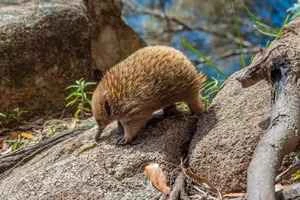
Echidnae appear to congregate only during the breeding season, when a female may follow a group of suitors. After a gestation period of approximately 23 days, the female typically lays a leathery egg in a temporary brood pouch formed by abdominal muscles and subcutaneous mammary gland tissue. The egg incubates for another 10 days before hatching into tiny offspring using egg teeth and fleshy bulbs (structural remnants of the creature's reptilian ancestors). Young echidnas are protected in a special brooding burrow, where they suckle milk from specialized hairs (lacking nipples and teats). Once the young echidna is fully covered in quills and fur and capable of feeding, it leaves the burrow to begin a solitary life. Echidnae have remarkably long lifespans. Reliable records indicate that a wild echidna lived to be 45 years old, while a captive echidna died over 50 years old.
Classification, evolution and paleontology
Echidnae belong to the family Limulidae, and their only extant relative is the platypus. These animals collectively constitute the order Monotremes. Echidnae likely evolved from an unknown monotreman ancestor during the Paleogene period (66 to 23 million years ago). The lack of teeth in echidnas hinders research into their evolutionary history, as teeth are well-preserved fossils and generally help in determining relationships between mammals. The oldest known echidna fossils were found in cave sediments in eastern Australia dating back approximately 17 million years (Early Miocene). Although the material is fragmentary, it shows that basic echidna features, such as a toothless, bird-like skull and strong bones specifically designed for digging, had already evolved by this time. Echidnae were once widespread and diverse, with one species being particularly large, exceeding 1 meter (3.3 feet) in length. Most echidna fossils (belonging to the more recent Megalibgwilia) represent a type between the modern short-beaked and long-beaked families.