
Basic Information
Scientific classification
- Chinese name: Australian Spotted Duck
- Scientific name: Stictonetta naevosa, Freckled Duck, Canvasback, Oatmeal Duck, Speckled Duck, Diamantina Duck
- Classification: Waterfowl
- Family and genus: Anseriformes, Anatidae, Amur Duck
Vital signs data
- Body length: Approximately 54 cm
- Weight: No verification information available.
- Lifespan: No verification data available.
Significant features
The most distinctive feature that differentiates it from other ducks is the high crest on its large head.
Distribution and Habitat
Its distribution is limited to southwestern Australia and inland waters. Inland water conditions in Australia are unstable, and many waterways disappear due to drought, a phenomenon particularly severe since the development of agriculture and animal husbandry, which has significantly impacted the survival of the Australian Spotted Duck.
They inhabit freshwater marshes, streams with dense reeds or tea plantations, and lush forests.
Appearance
The Australian Spotted Duck, measuring 54 cm in length, is a medium-sized water duck. Its most distinctive feature, distinguishing it from other ducks, is the high crest on its large head. Its plumage is dark brown with white or light brown spots. It has an upturned, iron-grey bill. During the breeding season, the base of the male's bill turns red.
Detailed introduction
The Australian Spotted Duck (scientific name: *Stictonetta naevosa*; English names: Freckled Duck, Canvasback, Oatmeal Duck, Speckled Duck, Diamantina Duck) is a type between ducks and geese, and is relatively distantly related to other ducks and geese. It is the only species in the genus.
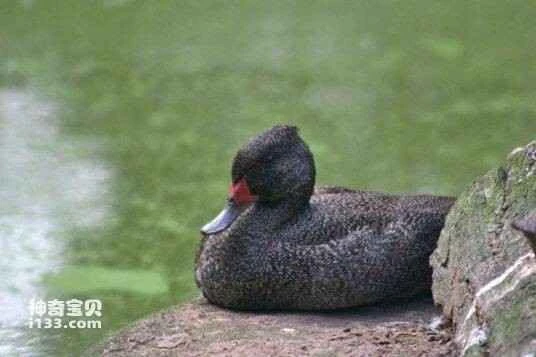
Australian shrews delay breeding during droughts when water is scarce. They feed on algae, seeds, hay, sedges, and small invertebrates.
The Australian Spotted Duck nests near water sources, typically using woven branches as nesting material and lined with duck down. Each nest contains 5 to 15 eggs. The breeding season is common in the Baloo and Lake Eyre basins, and in large, temporary marshlands created by floods in the Murray-Darling System.
Listed in the International Union for Conservation of Nature (IUCN) Red List of Birds, 2009 ver 3.1.
Protect wild animals and ban the consumption of wild game.
Maintaining ecological balance is everyone's responsibility!


