Basic Information
Scientific classification
- Chinese name: Wangrong Duck
- Scientific name: King Eider, Somateria spectabilis
- Classification: Waterfowl
- Family and genus: Anseriformes, Anatidae, Eriocheir
Vital signs data
- Body length: 53-60 cm
- Weight: 1.5-2.01kg
- Lifespan: No verification data available.
Significant features
It is the largest sea duck
Distribution and Habitat
Country of origin: Canada, Denmark, Finland, Greenland, Iceland, Japan, Norway, Russian Federation, Saint Pierre and Miquelon, Svalbard and Jan Mayen, Sweden, USA.
Wandering: Belarus, Belgium, Czech Republic, France, Germany, Hungary, Ireland, Italy, Kazakhstan, Latvia, Lithuania, Netherlands, Poland, Portugal, Spain, United Kingdom.
They reproduce on the Arctic tundra and spend the rest of their time in aquatic environments, but there are exceptions. In winter, they can be found on the ice of bays and fjords.
Appearance
The Royal Egrets are 53-60 cm long, with a wingspan of 94 cm, and weigh 1500-2010 grams. The male has a large, hat-like cap that covers its entire face from head to neck, forming a magnificent mask and helmet of light grey, blue, green, and red. Its orange-red bill has a rectangular scalp. The rear two-thirds of its body is black, contrasting sharply with the white of its wattles, throat, and breast. The back feathers are quite prominent. The female has a uniform darker patch of brown and tan, while its underparts are a mixture of brown and white.
Detailed introduction
King Eider (scientific name: Somateria spectabilis) has no subspecies.
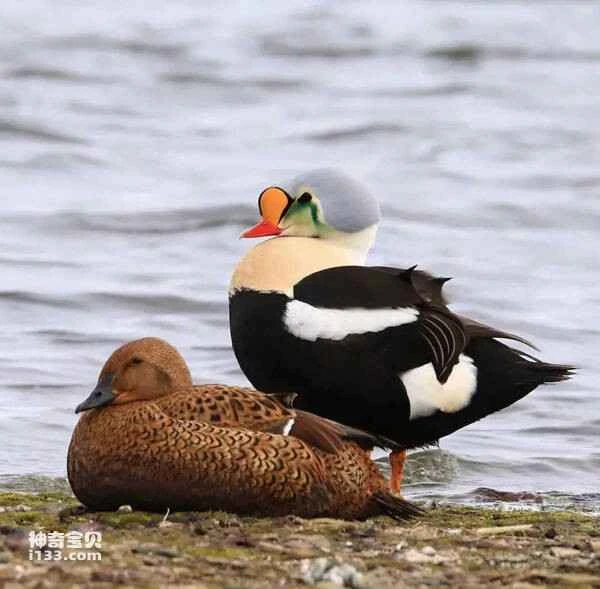
The Royal Eider is the largest sea duck, and some species exhibit migratory behavior. Like other eiders, this species is native to the far north. They breed on frozen coasts, as far south as the Netherlands and the Gulf of St. Lawrence; and winter in waters as far south as France, New England, and the Aleutian Islands.
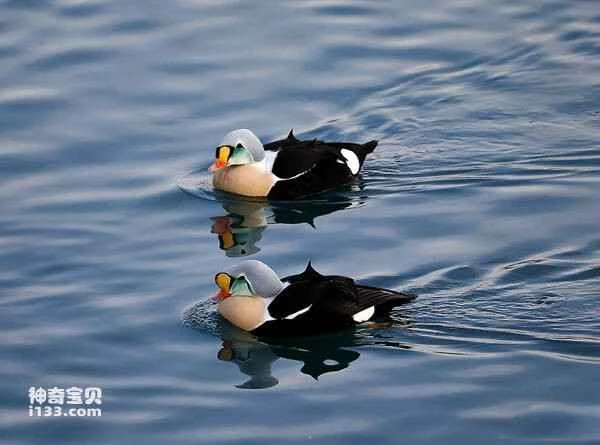
The King Eider obtains most of its food from the seabed, so it prefers to swim in shallow waters along the continental margins. It consumes large quantities of mussels and other shellfish, small fish, crustaceans, squid, and sea urchins. King Eiders are excellent divers, capable of diving to depths of tens of meters to hunt their prey. Due to their primarily terrestrial ecosystem, their diet varies considerably, with insects and other marine organisms also forming an important part of their diet. In winter, they are not entirely carnivorous, and typically also consume algae and marine plants.
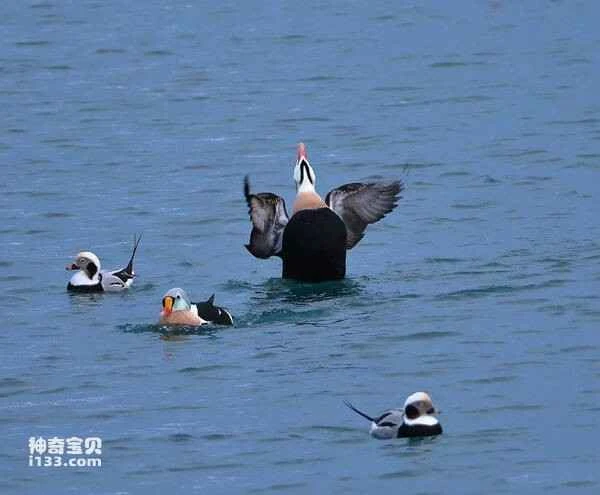
Every late summer, when the Arctic islands are surrounded by water, the Royal Eider begins to nest and breed. Nests are typically built under driftwood or a clump of seaweed for shelter from the wind. The female uses a large amount of branches, leaves, grass, and seaweed to build the nest floor, lining it with down. The nest is chosen in a secluded spot among rocks or vegetation. During the day, they forage at low tide, diving to depths of 10-18 meters, using their wings to paddle underwater and then flying straight out of the water. They can chew and crush the hard shells of seashells and their gizzards. A female Royal Eider lays 3 to 6 eggs per clutch. The eggshells are light olive oil-colored, brownish olive oil-colored, or greyish olive oil-colored, and the eggs are 7.6 cm long. Surprisingly, the King Eider's nesting area is very close to the nest of a type of gull that is not easy to get along with and is a predator of Eider's eggs and chicks. The King Eider likes to make friends with this type of gull precisely because it uses the gull's strength to drive away its more powerful enemies, such as skuas and Arctic foxes. This allows the gull to protect its own nesting area while also protecting the King Eider from harm.
King Eider ducks are monogamous, with the female incubating the eggs for 21 to 24 days. During this time, the female rarely leaves her nesting area, focusing entirely on reproduction. After hatching, the chicks are led by the female to the seashore, where they play and constantly dive into the water to forage for food. Typically, several families of eider ducks will band together, living a communal life, much like a kindergarten. They begin to fly after 56 days, and by September, they are fully capable of taking flight, migrating westward to the Bering Sea and the Gulf of Alaska to overwinter.
Listed as Least Concern (LC) on the IUCN Red List of Threatened Species 2013 ver 3.1.
Protect wild animals and ban the consumption of wild game.
Maintaining ecological balance is everyone's responsibility!