Basic Information
Scientific classification
- Chinese name: Newcastle funnel spider
- Scientific name: Atrax christenseni
- Classification: Arthropoda
- Family: Atrax
Vital signs data
- Body length: Male spiders can have a leg span of about 9.2 cm and a body length of several centimeters; female spiders are larger but less likely to venture out.
- Weight: Specific data is unavailable, but it is estimated to be in the range of several grams, depending on sex and individual size.
- Lifespan: Estimated to be similar to other Atrax funnel-shaped spiders: females can live 10–20 years, while males typically live only a few months to about 1–2 years after reaching maturity.
Significant features
The Australian funnel-web spider is a large, highly venomous species; it has a very small distribution range, found only around Newcastle; males venture out on warm, damp nights.
Distribution and Habitat
Currently, it is only found within a 25-kilometer radius of Newcastle, New South Wales, Australia, where it burrows in damp, shady woodlands, thickets, and green spaces on the outskirts of cities.
Appearance
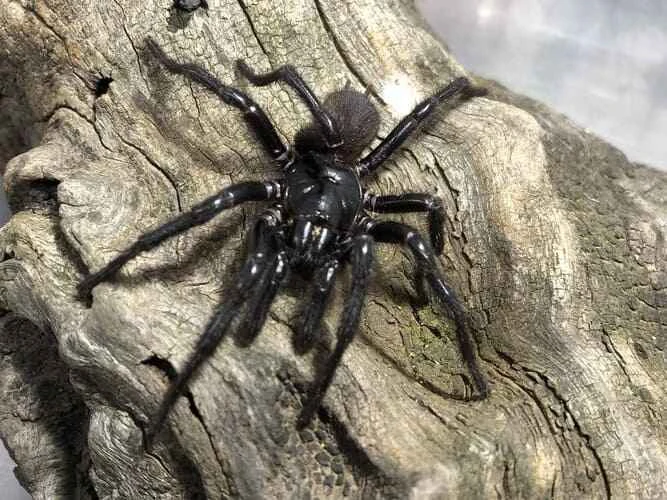
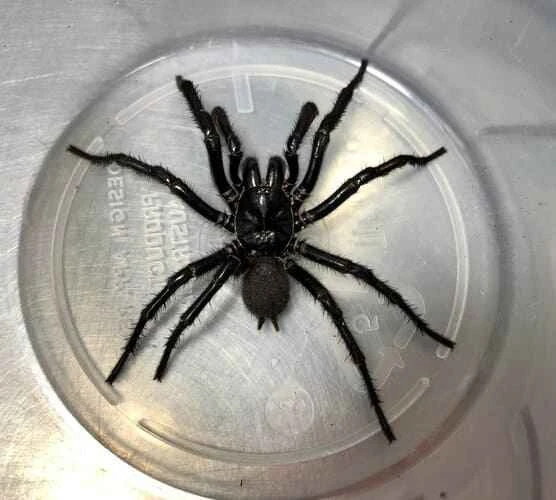
The overall color ranges from dark brown to bluish-black, with a shiny, high-arched head and thorax, thick chelicerae, and long fangs; the male spider is slightly slender, while the female spider is larger and more robust.
Detailed introduction
The Newcastle funnel-web spider (Atrax christenseni) , officially named in 2025, is a large Australian funnel-web spider nicknamed " Big Boy." Belonging to the family Atrazidae and the genus Atraz , it is currently known to be found only in a small area around Newcastle, New South Wales, Australia . It is one of the largest and most venomous funnel-web spiders discovered to date.
Basic Information
Scientific name: Atrax christenseni
Common English name: Newcastle funnel‑web spider / Newcastle Big Boy
Taxonomic classification: Class Arachnida → Order Araneae → Suborder Mygalomorphae → Family Atracidae → Genus Atrax
Size: Male spiders have a leg span of up to 9.2 cm and a body length of several centimeters; female spiders are larger but are less frequently seen.
Lifespan: There is no specific data yet, but it is speculated that it is similar to other Atrax funnel-shaped spiders: females can live for 10–20 years, while males usually only live for a few months to 1–2 years after reaching maturity.
Appearance features
The Newcastle funnel-shaped spider gives an overall impression of being "black, shiny, and heavy."
Its body color is mostly dark brown to bluish-black, and its head, thorax and feet are glossy;
Its foreparts are high-arched, its chelicerae are extremely robust, and its fangs are long and thick, capable of piercing human fingernails;
The abdomen is relatively dark gray, and the body is firm and muscular.
Male spiders are slightly longer and more mobile; female spiders are shorter and thicker and mostly stay in their burrows for life.
Distribution and Habitat
Current research indicates that *Atrax christenseni* is found only within a 25-kilometer radius of Newcastle , making it an extremely limited endemic species. For conservation and safety reasons, research institutions do not disclose specific collection locations.
Similar to the Sydney funnel-web spider, they prefer cool, moist, and secluded microhabitats , such as:
Beneath rocks, fallen logs, and humus layers in woodlands or valleys;
Damp earthen slopes, around tree roots, or moss-covered ground;
Damp corners such as vegetated gardens and the edges of drainage ditches on the outskirts of the city.
Caves and Behavioral Habits
Newcastle funnel-web spiders dig silk-lined burrows in the soil, with several silk tubes extending from the burrow entrance to form a funnel-shaped structure. They use this structure to sense ground vibrations and guide prey. During the day, they mostly rest inside their burrows to avoid high temperatures and dryness. After nightfall, especially on damp spring and summer nights, the male spiders leave their burrows to search for females . This is when humans are most likely to encounter them outdoors or near their homes.
Diet and Ecological Role
Newcastle funnel-web spiders are typical ambush predators , primarily hunting:
Various terrestrial insects (beetles, cockroaches, orthoptera, etc.);
Other arthropods;
Occasionally, they will also attack smaller vertebrates such as amphibians or reptiles.
They occupy a high position among small predators in the local ecosystem, effectively controlling invertebrate populations, but they themselves may also be preyed upon by birds, small mammals, or reptiles.
Toxicity and Medical Significance
Similar to the Sydney funnel-web spider, the venom of the Newcastle funnel-web spider contains potent neurotoxins (such as δ-hexatoxins) , which can interfere with sodium ion channels in the human nervous system, triggering:
Severe localized pain and swelling;
Excessive sweating, nausea, and vomiting;
Muscle spasms, abnormal heart rate and blood pressure, and in severe cases, difficulty breathing may occur.
Experimental studies suggest that its venom may be more potent than that of the classic Sydney funnel-web spider , but to date, there have been no deaths from funnel-web spider bites in Australia since the introduction of antivenom in 1981. Existing Sydney funnel-web spider antivenom is also effective against bites from Atrax christenseni .
Contact with humans and protection
In Newcastle and the surrounding area, people are more likely to encounter male funnel-web spiders during the rainy season or on damp, warm nights. If a suspected funnel-web spider is found near your home, you should:
Avoid touching or patting with bare hands;
Use long-handled tools or glass bottles, plastic boxes, and cardboard to safely contain it;
Contact your local reptile park or relevant agency; in some areas, funnel-web spiders are used for venom collection and antivenom production.
If a bite is confirmed or suspected, seek medical attention immediately . In Australia, follow the local medical facility's procedures for treating funnel-web spider bites, and use antivenom if necessary.
References
Isbister, G, Gray, M, Balit, C, Raven, R, Stokes, B, Porges, K, Tankel, A, Turner, E, White, J, and Fisher, M. 2005. Funnel-web spider bites: a systematic review of clinical case records. Australian Medical Journal 182(8): 407-411.
Gray, M. 2010. Revised edition of the funnel-web spider of Australia (Hexagonal spider family: Funnel-web subfamily). Australian Museum Records 62: 285-392.
Loria, SF, Frank, SC., Dupérré, N., et al. The world’s most venomous spider is a species complex: the systematics of the Sydney funnel-web spider (Funnel-web spiders: *Strong Funnel-web Spider*). BMC Ecology and Evolution 25, 7 (2025). https://doi.org/10.1186/s12862-024-02332-0
Crossman S, Li O. Surface hydrological polygon (national). Geoscience Australia, Canberra. 2015. https://pid.geoscience.gov.au/dataset/ga/83135
Frequently Asked Questions
Q1: How dangerous is the Newcastle funnel spider?
Based on its toxicity and size, it is considered one of the most dangerous funnel-web spiders known.
Venom can rapidly affect the human nervous system. However, with the availability of antivenom serum today, serious consequences are relatively rare if medical attention is sought promptly.
Q2: What is the difference between it and the Sydney funnel-web spider?
Both belong to the genus *Atrax* and have similar toxicity, but the Newcastle funnel-web spider is larger and has a smaller distribution range, found only in the area surrounding Newcastle.
It was independently named a new species, *Atrax christenseni *.
Q3: Is there currently any specific antivenom for the Newcastle funnel spider?
The antivenom currently in use is the Sydney funnel-web spider antivenom, which has been shown in studies to be equally effective against bites from Atrax christenseni.
Q4: What should I do if I see what looks like a funnel-web spider in the wild?
Maintain distance, avoid provocation or attempting to handle with your hands. If removal is necessary, use a long-handled tool or container, handle carefully, and seek professional help.