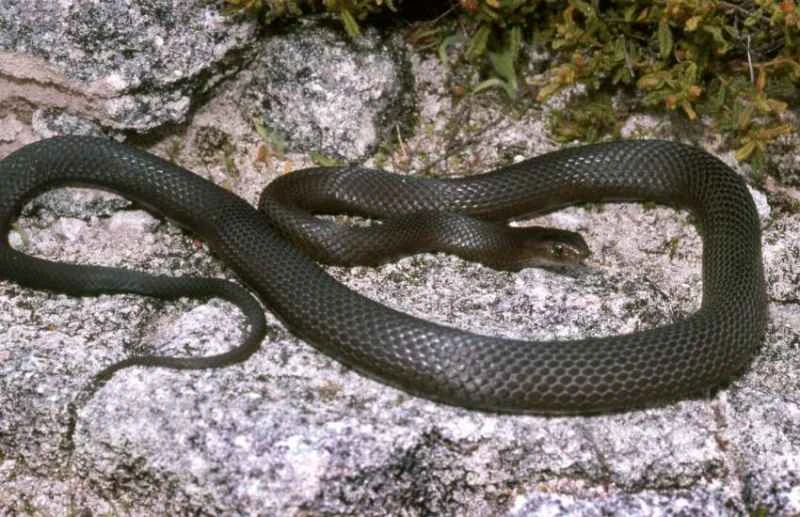
Basic Information
Scientific classification
- Chinese name: Dugart Brown Snake
- Scientific name: Pseudonaja affinis
- Classification: Squamata
- Family and genus: Elapidae, genus *Pseudorascar*
Vital signs data
- Body length: Adults are usually about 1.2–1.8 meters in total length, while larger individuals can approach or exceed 2 meters. Their bodies are slender and relatively delicate.
- Weight: Weight varies depending on individual size and nutritional status, with most adults weighing several hundred grams to about one kilogram.
- Lifespan: There are no precise statistics on lifespan in the wild, but it is generally believed that it can live for about ten years; in areas with less disturbance and abundant food or in good captive conditions, lifespan may be longer.
Significant features
One of the typical highly venomous brown snakes in southwestern Western Australia, it has a slender body and is mostly brown to dark chocolate in color. Its venom has a strong effect on the nervous system and blood clotting function, and it is also an important rodent predator.
Distribution and Habitat
It is almost exclusively found in southwestern Australia, distributed in the southwestern corner of Western Australia and the coastal plains and near-inland hilly areas around Perth. It inhabits a variety of environments, including sclerophyllous forests, shrublands, grasslands, farmlands, pastures, vineyards, and suburban greenbelts, and often uses grass roots, piles of stones, piles of wood, and building crevices as hiding places.
Appearance
The body is slender and relatively delicate, with a slightly elongated coffin-shaped head. The back color ranges from olive brown and grayish brown to dark chocolate brown, with some individuals having small spots or alternating light and dark patterns. The belly is lighter in color, usually cream or pale yellowish-gray. The scales on the body are smooth, giving it an overall "uniform brown snake" appearance, which facilitates camouflage against the backdrop of dry grass and fallen leaves.
Detailed introduction
The Dugite ( Pseudonaja affinis ) is a medium-sized, highly venomous snake with protruding fangs, belonging to the genus Pseudonaja in the family Elapidae. It is one of the most representative brown snakes of southwestern Australia. Widely distributed in the southwestern corner of Western Australia, including Perth and the surrounding coastal plains, it is one of the leading causes of snakebite incidents in the region. Despite this, the Dugite plays an important role as a rodent predator in the ecosystem, helping to control rodent populations.
Classification and nomenclature
The Dugite brown snake belongs to the class Reptilia, order Squamata, suborder Serpentes, family Elapidae, and genus Pseudonaja . The genus Pseudonaja includes several species of "brown snakes," among which the Eastern Brown Snake ( Pseudonaja textilis ) and the Dugite brown snake are known for their neurotoxins and complex venom compositions. Pseudonaja affinis can be further divided into several subspecies based on geographical distribution and coloration, collectively known as the "Dugite brown snake" or "Western brown snake" type. Its common English name, Dugite, is very common in Western Australia and has almost become synonymous with "venomous brown snake" among locals.
Appearance features
The Dugart Brown Snake has a slender and relatively delicate body, with a slightly elongated coffin-shaped head that is not clearly distinguishable from the neck. Its eyes are medium-sized with round pupils. Body color varies considerably, ranging from olive brown and grayish-brown to dark chocolate brown; some individuals have almost black backs. Some subspecies or regional types retain small, alternating dark and light spots or fine markings on their backs and sides, while others have almost no distinct markings, appearing uniformly brown overall. The underside is usually lighter, cream, grayish-white, or pale yellowish-brown, often with small dark spots near the sides. The scales are relatively smooth, giving the snake an overall impression of being "long and thin, with a brownish hue," providing excellent camouflage against backgrounds of dry grass, fallen leaves, and soil.
Distribution range and habitat
The Dugat Brown Snake is almost exclusively found in southwestern Australia, primarily in the southwest corner of Western Australia, the coastal plains around Perth, the near-inland hills, and extending into parts of the semi-arid region. It adapts to a variety of habitats, ranging from natural sclerophyllous forests, low scrub, and rocky slopes to farmland, pastures, vineyards, and suburban greenbelts. Typical microhabitats include grass roots, piles of stones, under stakes and abandoned buildings, rabbit burrows or other mammal dens, and debris piles near fences. Like many culturally adapted snakes, the Dugat Brown Snake maintains high population densities in agricultural and suburban areas with human activity.
Lifestyle Habits and Behaviors
The Dugart Brown Snake is primarily diurnal, more active during bright, warm days, and especially common in spring and summer. They are agile, moving swiftly across open ground in search of prey, and also traversing along fences, hedges, and building edges. This snake is highly alert, often retreating quickly to cover when sensing vibrations or approach; however, when cornered, trampled, or deliberately provoked, it will raise its forebody, flatten its neck, hiss, and bite swiftly. Similar to the Eastern Brown Snake, the Dugart Brown Snake attacks very quickly, and the amount of venom injected is sufficient to cause severe poisoning in a short time; therefore, extreme caution should be exercised when encountering it in the wild.
feeding habits
The Dugart Brown Snake is a carnivorous predator primarily feeding on small mammals, with a particular preference for rodents such as house mice, black rats, and small native marsupials. Near farmland, barns, stockpiles, and residential areas, they act as a natural rodent predator by preying on rodents. They also prey on lizards, other snakes (including small venomous and non-venomous snakes), birds and their chicks, and occasionally frogs. They typically locate their prey through sight and smell, quickly biting and injecting venom, then swallowing the prey whole after it has been weakened or killed by the venom.
Reproduction and life cycle
The Dugat Brown Snake is an oviparous snake. The breeding season typically lasts from spring to early summer. During this period, males increase their activity range to find females in estrus, and sometimes fighting occurs between males. After mating, the female lays her eggs in a secluded location with suitable temperature and humidity, such as under decaying wood, in crevices between rocks, or inside caves. The number of eggs per clutch depends on the female's size and health, but is generally around ten. The eggs incubate in the environment, and the incubation period is greatly affected by temperature. After hatching, the young snakes possess fully functional fangs and venom glands. They resemble adults in appearance but are smaller and quickly begin to independently hunt small lizards and young mice.
Relationship with humans
In Western Australia, the Dugat Brown Snake is one of the most frequently mentioned highly venomous snakes and a significant source of snakebite cases. Adapted to farmland, pastures, and suburban environments, and primarily feeding on rodents, they are often found near homes, barns, and gardens, overlapping with human activity areas. In most cases, the Dugat Brown Snake does not actively attack humans; bites are usually related to accidentally stepping on, attempting to catch, or striking the snake. Symptoms of a bite may include localized pain, discomfort, nausea, dizziness, clotting disorders, internal bleeding, and potential organ damage. It must be treated as a medical emergency, requiring immediate immobilization and hospitalization. Legally, many parts of Australia offer protection for native snakes, prohibiting their hunting or illegal capture without a permit.
Protecting the status quo and threats
In current assessments, the Dugat Brown Snake is generally listed as "Least Concern" on the IUCN Red List, with its overall population considered relatively stable. While its distribution is relatively confined to southwestern Australia, it remains common in many agricultural and pastoral areas and suburbs, demonstrating its adaptability to human-altered landscapes. However, local populations may still be affected by further habitat loss, road traffic fatalities, chemical pesticide pollution, and deliberate killings by humans out of fear. Long-term conservation of the Dugat Brown Snake relies not only on maintaining diverse native vegetation and landforms but also on raising public awareness of the ecological role of venomous snakes, snakebite risk management, and safe coexistence through public education.
Frequently Asked Questions
Q1: How potent is the venom of the Dugat Brown Snake?
The Dugat Brown Snake is a highly venomous snake. Its venom contains various toxins that affect the nervous system and blood clotting function. If left untreated, a severe bite can be life-threatening. If a bite is suspected, apply pressure and bandage immediately and seek medical attention as soon as possible. A professional veterinarian will assess the bite and administer antivenom serum if necessary.
Q2: Will the Dugart Brown Snake attack humans on its own initiative?
Generally, Dugat brown snakes are wary and avoid humans, usually fleeing quickly before they detect a human approaching. Bites are often related to accidentally stepping on the snake, attempting to catch it, or trying to hit it. As long as you maintain distance and do not deliberately provoke it, you will usually not be attacked.
Q3: Why do Dugat brown snakes often appear near farms and suburban homes?
These environments often have abundant rodent resources, such as rats near barns, livestock feed pens, and garbage dumps, making them ideal foraging grounds for the Dugat Brown Snake. Meanwhile, weed beds, woodpile, and building crevices also provide excellent hiding places, hence its high frequency of occurrence in agricultural and suburban areas.
Q4: How can people living in areas where the Dugart brown snake is found reduce their risk of being bitten by snakes?
Practical measures include: keeping the yard clean and reducing clutter and tall grass; properly storing food and feed to reduce rodent populations; wearing closed-toe shoes and long pants when walking outdoors, especially at dusk and night; avoiding directly turning over stones, wood piles, and heavy coverings with your hands; and maintaining a safe distance and contacting professional snake catchers when encountering snakes, rather than handling them yourself.


