
Basic Information
Scientific classification
- Chinese name: Eastern Blue-tongued Skink
- Scientific name: Tiliqua scincoides scincoides
- Classification: Squamata
- Family and genus: Skinkaceae, Bluetongue Skink
Vital signs data
- Body length: Adults typically have a snout-vent length of about 30–35 cm, and the total length including the tail can reach 45–60 cm, making them relatively large skink lizards.
- Weight: Weight varies depending on individual size and nutritional status, with most adults weighing several hundred grams, but can approach 1 kilogram.
- Lifespan: In the wild, the Eastern Blue Tongue Skink has an expected lifespan of about 10 years; under good captive conditions and proper care, it can live for 15–20 years.
Significant features
With a robust body and short, thick limbs, its most distinctive feature is that it opens its mouth wide and sticks out its bright blue tongue to intimidate others when threatened. It is a common "large blue-tongued lizard" in cities and suburbs in eastern Australia and is also one of the important natural enemies of horticultural pests.
Distribution and Habitat
It is mainly distributed along the eastern coast and adjacent inland areas of Australia, including southeastern Queensland, New South Wales, most of Victoria, and parts of South Australia. It inhabits open woodlands, thickets, grasslands, and farmland edges, and is also found in large numbers in gardens, lawns, hedge roots, and roadside greenbelts in cities and suburbs. It often uses fallen logs, piles of stones, and piles of fallen leaves as hiding places.
Appearance
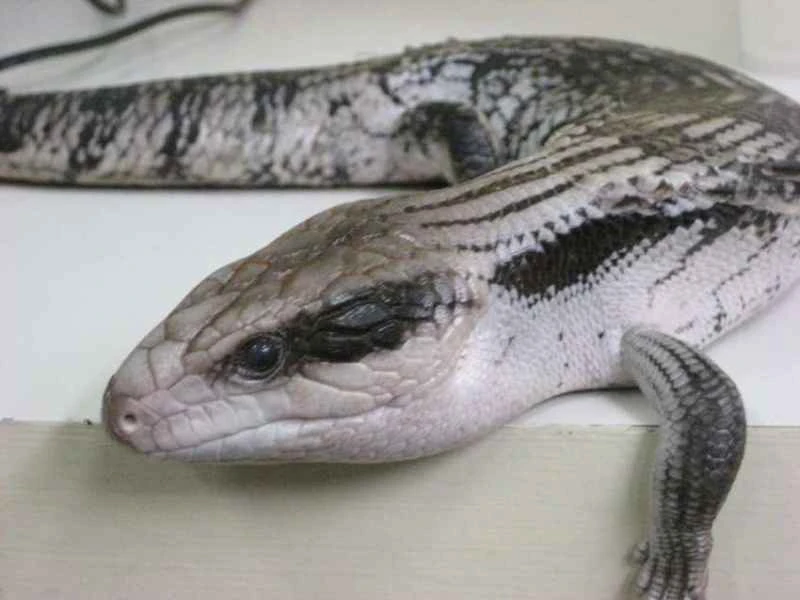
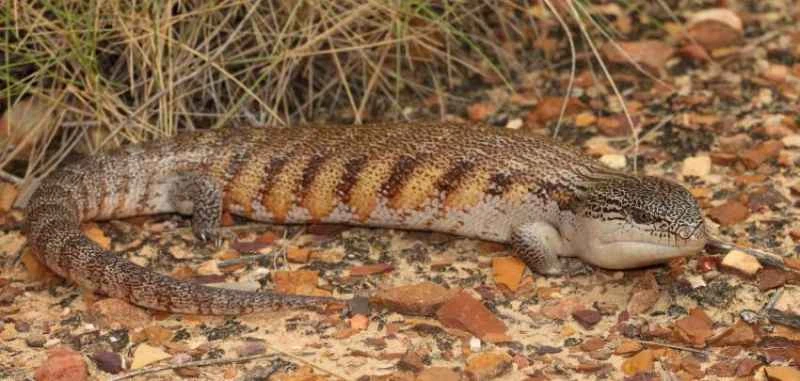
Its body is stout and cylindrical, with a broad head, short and strong limbs, and a short, thick tail. The back is mostly grayish-brown, yellowish-brown, or olive-colored with dark brown to black horizontal bands or irregular stripes, forming a mottled pattern; the underside is lighter in color, mostly cream or pale gray. Most striking is its broad, shiny blue tongue, which is particularly noticeable during defensive displays.
Detailed introduction
The Eastern Blue-tongue Skink ( Tiliqua scincoides scincoides ) is one of Australia's most famous and common large skinks, belonging to the genus *Tiliqua* in the family Skinidae. They are named for their striking blue tongues used in a menacing manner. They are robust with short, stout limbs and are widely distributed in cities, farmlands, and natural scrublands throughout eastern Australia, making them a common sight in many homes. In some areas, the Eastern Blue-tongue Skink is also a popular pet reptile and a well-known educational animal.
Classification and nomenclature
The Eastern Blue-tongue Skink belongs to the class Reptilia, order Squamata, suborder Scalypiformes, family Scincidae, and genus * Tiliqua *. *Tiliqua scincoides* is a complex species containing several subspecies, with * Tiliqua scincoides scincoides * being the most prominent. It is mainly distributed along the eastern coast and adjacent inland areas of Australia. Its English names, Eastern Blue-tongue Lizard or Eastern Blue-tongued Skink, emphasize its distinctive blue tongue. The genus *Tiliqua* also includes closely related species such as the Northern Blue-tongue and the Indonesian Blue-tongue, making it a well-known group of lizards in both pet and educational settings.
Appearance features
The Eastern Blue-tongued Skink is robust, with a cylindrical body, short and powerful limbs, and a short, thick tail. Adults have a broad head, a blunt snout, and medium-sized eyes. Its most distinctive feature is its large, bright blue tongue—when startled or threatened, it opens its mouth wide, extends its blue tongue, puffs out its body, and hisses to intimidate potential enemies. Its back is typically grayish-brown, yellowish-brown, or olive-colored, with a series of dark brown to black horizontal or irregular bands, creating a "mottled tiger stripe" or "wide stripe" pattern. The underside is lighter, mostly cream or pale gray. Its large, slightly rough scales give it a "sturdy, clumsy" appearance, but it is actually quite agile.
Distribution range and habitat
The Eastern Blue-tongued Skink is mainly distributed in eastern Australia, from southeastern Queensland, through New South Wales and the Australian Capital Territory to parts of Victoria and South Australia. They are highly adaptable to different habitats, found in open woodlands, scrublands, grasslands, farmland edges, and gardens, lawns, and roadside greenbelts in urban and suburban areas. Typical microhabitats include under low shrubs, piles of fallen logs and stones, leaf litter at garden edges, and at the base of hedges. Because they are adept at utilizing human-created environments, they can establish stable populations even in urban residential areas, provided there is sufficient vegetation cover and hiding places.
Lifestyle Habits and Behaviors
The Eastern Blue-tongued Skink is a diurnal animal, most active during the day when sunlight is plentiful and temperatures are suitable. They prefer to venture out in the cooler early morning and afternoon hours, basking in the sun to regulate their body temperature before slowly foraging among the grass and bushes. When threatened, typical defensive behaviors include: opening their mouths wide, extending their blue tongues, hissing, expanding their bodies laterally, and occasionally feigning a charge to scare away predators or humans. If the intruder continues to approach, they may bite, but generally do not actively pursue. In winter or during cold seasons, they significantly reduce their activity, even entering a state similar to "sluggishness, semi-hibernation," remaining in burrows or hiding places for extended periods.
feeding habits
The Eastern Blue-tongued Skink is a typical omnivorous lizard with a highly diverse diet. Its animal-based diet includes snails, slugs, beetles, crickets, other insects and larvae, spiders, lizard larvae, and occasionally young rodents; its plant-based diet includes tender leaves, flowers, berries, fallen fruit, and some juicy vegetables. In urban and suburban gardens, they are important helpers in controlling "gardening pests" such as snails and slugs. Under captive conditions, they are usually supplemented with insects, lean meat, small amounts of eggs, and various fruits and vegetables to simulate their diverse diet in the wild.
Reproduction and life cycle
Like many blue-tongued skinks, the eastern blue-tongued skink is viviparous or ovoviviparous (broadly defined viviparous), with the larvae completing most of their development inside the female's body and ultimately being born as live offspring. The breeding season typically occurs in spring, during which males actively seek out females in their habitat, exhibiting chasing and courtship behaviors. After mating, the female undergoes a gestation period of several months, giving birth to about ten offspring per litter, the exact number depending on the mother's size and health. Newborn larvae resemble adults in appearance but are smaller in size, and are able to feed and move independently shortly after birth. The eastern blue-tongued skink has a moderate growth rate, reaching sexual maturity within a few years; in the wild, they can live for about ten years, and in captivity with good conditions, their lifespan is often even longer, reaching fifteen years or more, sometimes approaching twenty years.
Relationship with humans
The Eastern Blue-tongued Skink is non-venomous to humans and generally does not attack them unprovoked. They are frequently found in residential areas, often in gardens, driveways, or roadside bushes. As an omnivore, they help reduce garden pests by preying on snails, slugs, and some insects; they also nibble on fallen fruits and vegetables. Due to their docile appearance and relatively gentle temperament, the Eastern Blue-tongued Skink is a very popular pet lizard and educational display species in many areas. However, it is important to note that individuals still possess sharp teeth, and defensive bites can cause bleeding and pain. Therefore, it is best to maintain a distance when observing them in the wild and avoid handling or disturbing them.
Protecting the status quo and threats
Currently, the Eastern Blue-tongued Skink is not generally considered an endangered species and is usually listed as "Least Concern" on the IUCN Red List, remaining common in many suitable habitats and urban fringe areas. However, local populations may face multiple pressures, including road traffic fatalities, predation by domestic cats and dogs, habitat fragmentation, and indirect impacts from pesticides and herbicides. Some individuals may also be mistakenly killed as "venomous snakes." Conservation measures include: preserving some shrubbery and natural hiding places in yards, reducing unnecessary use of chemical agents, installing speed limit and wildlife warning signs near roads, and raising public awareness through public education about the Blue-tongued Skink as a "non-toxic, beneficial" yard visitor and an important part of the ecosystem.
Frequently Asked Questions
Q1: Is the Eastern Blue-tongued Skink poisonous? Does it bite?
The Eastern Blue-tongued Skink lacks venom glands and is not classified as a venomous lizard, posing no threat to humans. However, it possesses a strong bite and sharp teeth, and may bite defensively if roughly handled or cornered, causing skin abrasions and pain. Therefore, it is best to observe it from a distance when encountering it in the wild, rather than attempting to catch it with bare hands.
Q2: Why does the Eastern Bluetongue Skink stick out its blue tongue?
Blue-tongued skinks exhibit typical deterrent behavior. When threatened, they suddenly open their mouths wide, extend their blue tongues, and simultaneously hiss and inflate their bodies to create a strong visual contrast, scaring away predators or potential threats. This behavior is safer than direct attack and serves as a strategy to reduce the risk of conflict.
Q3: Will the Eastern Blue Tongue Skink damage garden plants?
Eastern blue-tongued skinks are omnivorous, feeding on insects and snails, as well as small amounts of fruit and vegetables. Some gardeners may notice that ripe strawberries or fallen fruit have been bitten, but overall, they are very effective at controlling horticultural pests by preying heavily on snails, slugs, and some insects, and the "benefits" generally outweigh the minor fruit loss.
Q4: Is it okay to keep the Eastern Blue Tongue Skink as a pet in Australia?
In some states and territories, eastern blue-tongued skinks can be kept as pets with a legal permit, but specific regulations vary by state. Keeping them requires a spacious enclosure, a suitable temperature gradient, hiding places, and a varied diet, and it's essential to ensure they are legally bred individuals, not illegally collected wild individuals. For ordinary tourists and residents, the most humane approach is to avoid disturbing wild individuals and provide them with some habitat in their own yards.