Basic Information
Scientific classification
- Chinese name: Diamond Python
- Scientific name: Morelia spilota spilota
- Classification: Squamata
- Family and genus: Pythonidae, genus *Carpet Python*
Vital signs data
- Body length: Adults typically reach a total length of about 1.8–2.7 meters, with very large individuals exceeding 3 meters. It is one of the larger non-venomous pythons in Eastern Australia.
- Weight: Weight varies greatly depending on individual size and nutritional status, with most adults weighing between several kilograms and more than ten kilograms.
- Lifespan: In the wild, individuals can generally live for 10–15 years. Under good captive conditions and proper care, their lifespan can reach 20 years or even longer.
Significant features
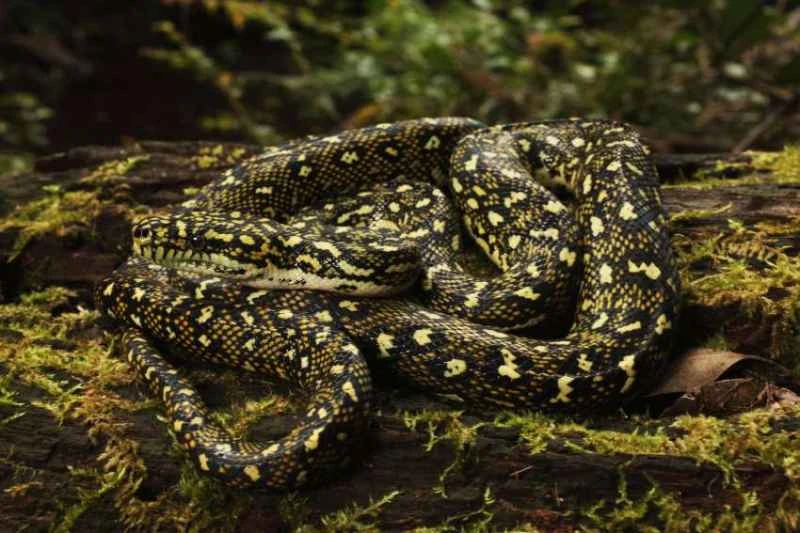
With its robust body and ornate patterns, covered in yellowish-white "diamond-shaped" markings, this is a typical large, non-venomous python of eastern Australia. It preys on mammals and birds by constricting and strangling them, and plays an important ecological role in controlling rodents.
Distribution and Habitat
It is mainly distributed in the coastal and hilly areas of New South Wales and Victoria in eastern Australia, inhabiting eucalyptus forests, moist or dry sclerophyllous forests, rocky slopes, thickets and farms, and is also often found in gardens, sheds and roof mezzanines in semi-suburban residential areas.
Appearance
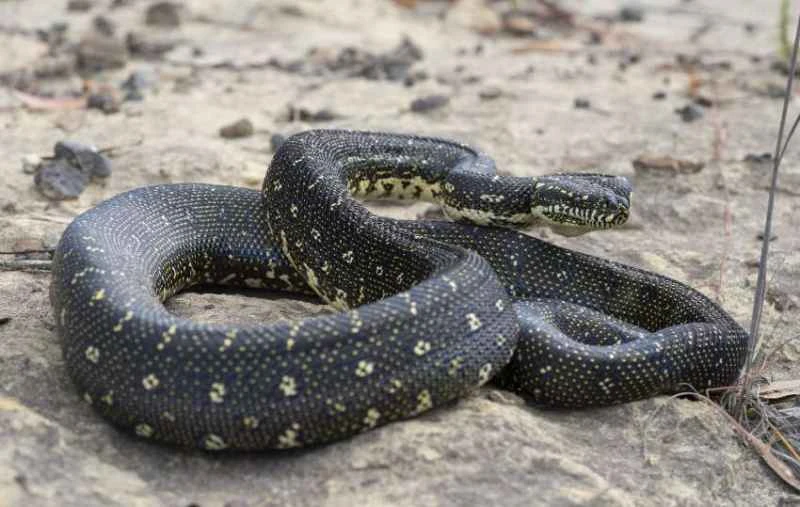
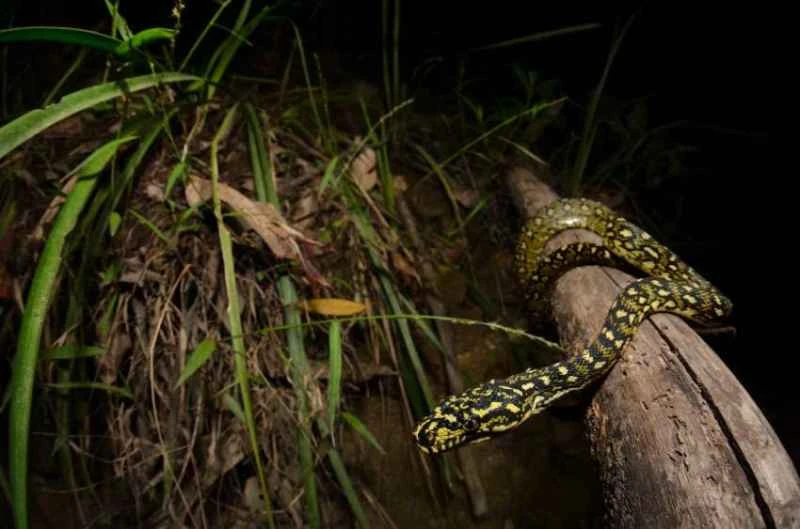
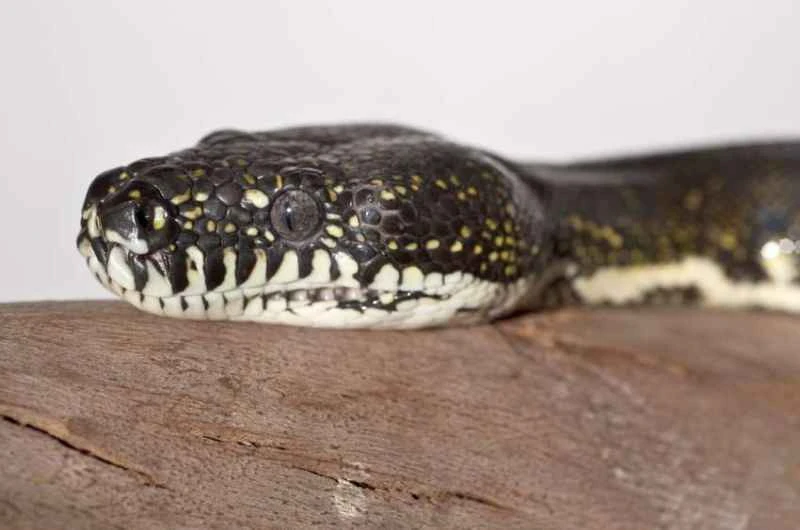
It has a robust and powerful body, a slightly triangular head, and a back that is mostly dark green, blackish-green, or blackish-brown, covered with cream-colored or yellowish-white spots and diamond-shaped markings, forming a complex "diamond" pattern. The belly is lighter in color, mostly pale yellow or grayish-white. The scales on its body are smooth and glossy, and its tail has a certain ability to coil, making it suitable for climbing among branches and rocks.
Detailed introduction
The Diamond Python (scientific name * Morelia spilota spilota *) is one of Australia's well-known non-venomous large pythons, belonging to the genus *Morelia* in the family Pythonidae. It is a coastal subspecies of the Carpet Python complex. It is mainly distributed in the coastal, hilly, and forested areas of New South Wales and Victoria in eastern Australia, and is named for the dense yellow-white "diamond-like" markings on its body. Diamond pythons are relatively docile and generally not aggressive towards humans, making them important medium to large predators in the local ecosystem.
Classification and nomenclature
The diamond python belongs to the class Reptilia, order Squamata, suborder Serpentes, family Pythonidae, and genus Morelia . Its scientific name, *Morelia spilota spilota *, is generally considered a subspecies of the carpet python, often referred to in English as Diamond Python or Coastal Carpet Python (with Diamond Python emphasizing its distinctive markings). Taxonomically, the carpet python complex includes several subspecies and geographic types, with significant differences in body color and size across different regions. The diamond python is uniquely named for its dark base color layered with regular, light-colored diamond-shaped markings.
Appearance features
Diamond pythons are large, robust, and powerful snakes. Their heads are slightly triangular and wider than their necks, with medium-sized eyes. The back is typically dark olive green, blackish-green, or dark brown, densely covered with yellowish-white or cream-colored spots and diamond-shaped markings arranged in complex diamond-like or reticulated patterns; some individuals are darker overall, with the patterns only faintly visible in light. The underside is lighter in color, generally pale yellow, cream, or grayish-white, and may have scattered spots. The scales are smooth and glossy, the trunk is muscular, and the tail has a certain degree of constricting and gripping ability, aiding in climbing branches and rocks. Overall, they are typical large, constricting pythons with striking and ornate markings.
Distribution range and habitat
Diamond pythons are primarily distributed in the temperate and subtropical regions of eastern Australia, particularly the eastern coastal and mountainous areas of New South Wales and parts of Victoria. Typical habitats include eucalyptus forests, moist or dry sclerophyllous forests, rocky slopes, scrublands, farm perimeters, and gardens and sheds in semi-suburban residential areas along the coast and hills. They are both terrestrial and adept at climbing trees and buildings; during the day they often hide in tree hollows, roof crevices, rock crevices, or dense vegetation, and are more active at night and at dusk.
Lifestyle Habits and Behaviors
Diamond pythons are mostly twilight to nocturnal, becoming more active after dusk and preferring to rest or bask in the sun in safe locations during the day to regulate their body temperature. They can inhabit the ground or often climb trees, rocks, or high places on buildings to ambush or patrol. When threatened, some individuals will choose to retreat and hide quickly. If cornered or repeatedly provoked, they may coil, raise their heads, hiss, and adopt attack postures, but generally do not actively pursue humans. Because they are non-venomous, diamond pythons primarily rely on constriction to kill their prey rather than venom.
feeding habits
Diamond pythons are typical carnivorous constricting pythons, primarily feeding on small to medium-sized mammals and birds, such as mice, opossums, rabbits, small marsupials, arboreal birds and their nestlings, and also preying on lizards and other small vertebrates. When near human settlements, they often frequent gaps near granaries, chicken coops, and houses, primarily hunting rodents, thus helping to control rodent populations to some extent. When hunting, the diamond python first swiftly bites its prey with its head, then immediately coils tightly around it, causing suffocation and circulatory obstruction. Once the prey stops struggling, it swallows it whole.
Reproduction and life cycle
Like many pythons, the diamond python is an oviparous species. The breeding season is primarily from spring to early summer, during which time the male increases its range to find females. After mating, the female lays her eggs in a secluded, safe, and relatively stable environment (such as tree hollows, woodpile, roof crevices, or rock crevices), typically laying ten to twenty eggs per clutch. After laying the eggs, the female coils around them to "guard the eggs and incubate them," using subtle muscle tremors and body heat to maintain a suitable temperature until the hatchlings emerge. Once hatched, the young are independent and begin preying on small lizards and young mice. Diamond pythons grow relatively slowly but have a long lifespan; wild individuals can live up to 15 years, and in captivity, they can live up to 20 years or even longer.
Relationship with humans
Diamond pythons are non-venomous snakes with no medical significance to humans and generally do not attack unprovoked. Most encounters with humans occur near farms, semi-suburban residential areas, or forest trails, where they are often found under eaves, in shed beams, or in gardens. For farmers, diamond pythons may occasionally threaten poultry (e.g., attacking smaller birds in chicken coops), but they also act as natural rodent predators, consuming large numbers of rodents and other rodents. In many parts of Australia, native pythons are protected by law, and indiscriminate killing and illegal trade are prohibited. The correct approach is to maintain distance when encountering a diamond python and allow it to leave on its own; if removal is necessary, contact local wildlife rescue or professional snake catchers.
Protecting the status quo and threats
As part of the carpet python complex, the diamond python population as a whole is generally classified as "Least Concern" on the IUCN Red List and remains relatively common in many suitable habitats. However, in localized areas, diamond pythons still face challenges such as habitat loss and fragmentation, road traffic fatalities, entanglement in electric fences and bars, illegal capture, and deliberate killing by humans due to misunderstanding and fear. Urban expansion and agricultural development may reduce continuous forest and shrub habitats, making some populations more reliant on greenbelts, parks, and large tracts of private land. Effective measures for the conservation of diamond pythons include: maintaining and restoring forest and shrub corridors, providing appropriate wildlife-friendly facilities around roads and residential areas, restricting illegal hunting and trade, and educating the public about the important role of non-venomous pythons in rodent control and maintaining ecological balance.
Frequently Asked Questions
Q1: Are diamond pythons venomous? Do they bite?
Diamond pythons are non-venomous and do not possess venom that could be fatal to humans. They may bite defensively if they feel gripped or cornered, but these bites primarily cause skin abrasions and bleeding, and usually do not pose the serious risk of poisoning like venomous snake bites.
Q2: Will diamond pythons threaten pets or poultry?
Diamond pythons primarily feed on wild rodents and birds, but if chicken coops are poorly secured or small pets are small in size, they can indeed become prey. Strengthening chicken coops, keeping an eye on small pets at night, and reducing garbage and feed that attract rodents can decrease the chances of conflict with the python.
Q3: What should I do if I encounter a diamond python in Australia?
The safest approach is to maintain a safe distance and allow the snake to leave on its own; do not attempt to strike, capture, or provoke it. If the diamond python remains in a residential area for an extended period and causes disturbance, contact your local wildlife rescue organization or a licensed snake catcher for professional removal.
Q4: Are diamond pythons suitable as pets?
In some countries and regions, diamond pythons and their close relatives, carpet pythons, are indeed kept as ornamental snakes. However, these large pythons require spacious, sturdy enclosures, stable temperature and humidity, suitable climbing structures, and a long-term, stable food source. They also have long lifespans and are not suitable as completely "beginner" pets. Any keeping of these snakes must comply with local laws, prioritizing legally bred individuals and avoiding the illegal capture of wild-caught individuals.