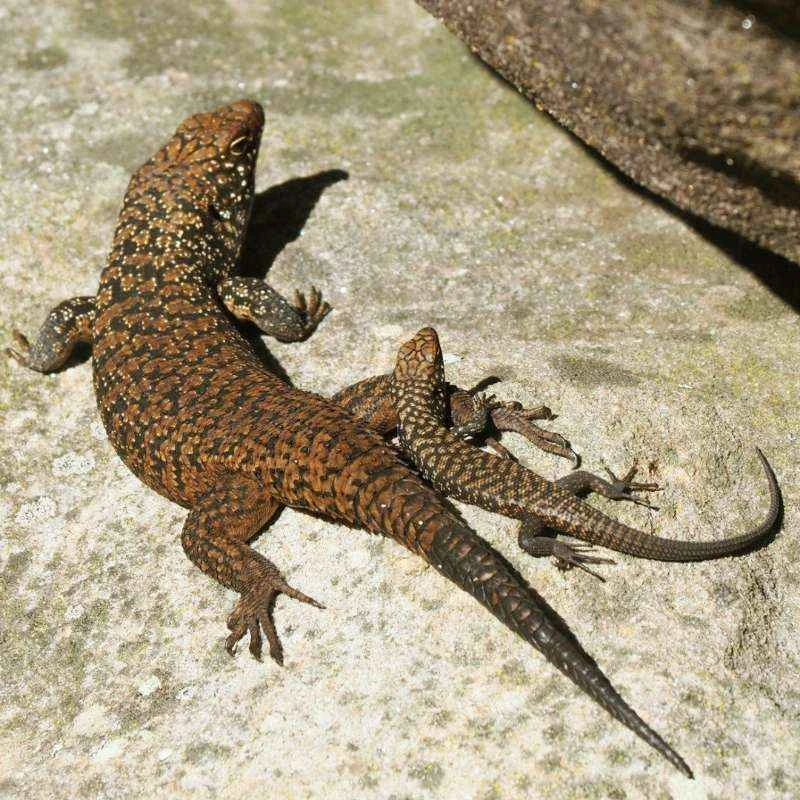
Basic Information
Scientific classification
- Chinese name: Cunningham skink
- Scientific name: Egernia cunninghami
- Classification: Squamata
- Family and genus: Skinkaceae, Egnia skink
Vital signs data
- Body length: Adults typically have a snout-vent length of about 18–25 cm, and the total length including the tail can reach 25–40 cm, making them one of the larger skinks.
- Weight: Weight varies depending on individual size and nutritional status, with most adults weighing approximately 200–400 grams.
- Lifespan: Individuals in the wild are expected to live for more than 10 years, and under good captive conditions, their lifespan can exceed 20 years.
Significant features
With its robust body, spiky scales covering its tail, preference for rocky habitats, and relatively complex "family-like" social structure, it is one of the typical species for studying lizard sociality.
Distribution and Habitat
It is mainly distributed in parts of New South Wales, Australian Capital Territory, Victoria and South Australia in southeastern Australia. It inhabits rocky slopes, boulder piles, cliff crevices and the surrounding edges of eucalyptus forests and shrublands, and often uses rock crevices and caves as hiding and overwintering sites.
Appearance
With a sturdy body and powerful limbs, the head is slightly triangular, and the tail is short, thick, and covered with distinctly spiny scales. The back is mostly dark brown, blackish-brown, or olive-brown, dotted with light-colored spots and short stripes, while the belly is lighter in color. The rough scales and mottled patterns provide excellent camouflage and protection in rocky environments.
Detailed introduction
The Cunningham skink (scientific name *Egernia cunninghami *) is a large skink belonging to the genus *Egernia*. It is primarily found on rocky slopes, cliffs, and forest edges in southeastern Australia, and is one of the most representative "rock-dwelling skinks" of the region. The Cunningham skink is renowned for its robust body, distinctive spiny scales, and complex social behavior, and is considered an important species for studying lizard sociality and long-term pairing relationships.
Classification and nomenclature
Cunningham skinks belong to the class Reptilia, order Squamata, family Scincidae, and genus Egernia . This genus includes several large skink species, such as closely related groups to the blue-tongued skink, known for their robust bodies and relatively sophisticated social behavior. The scientific name * Egernia cunninghami* is named after the British naturalist Allan Cunningham, hence its common transliteration in Chinese as "坎宁安石龙子" (Kǎnníngān shílóngzi). In English, it is sometimes referred to as Cunningham's Spiny-tailed Skink, highlighting the characteristic spiny scales on its tail.
Appearance features
The Cunningham skink is robust, with a sturdy body, strong limbs, and a short, thick tail covered in prominent, spiny scales—one of its most distinctive features. Its head is slightly triangular, with a blunt snout, medium-sized eyes, and clearly visible ear openings. The back is typically dark brown, blackish-brown, or olive-brown, speckled with light brown, cream, or grayish-white spots and short stripes, creating irregular mottled patterns. The underside is relatively lighter, mostly gray, cream, or pale yellowish-brown. Its rough, hard scales, thick tail, and overall "armor-like" appearance provide both protection and excellent camouflage in rocky environments.
Distribution range and habitat
Cunningham skinks are mainly distributed in southeastern Australia, including New South Wales, the Australian Capital Territory, Victoria, and parts of South Australia. They prefer habitats in higher elevations with abundant exposed rocks, such as rocky slopes, granite boulder piles, cliff crevices, and surrounding eucalyptus forest edges and scrublands. Typical activity areas include rock crevices, passageways between rock piles, and low shrubs and grasses adjacent to rocks. Cunningham skinks often use rock crevices and caves as "safe bases," and when threatened, they quickly burrow into narrow crevices, leaving only their thick tails exposed to block the entrance, making it difficult for predators to drag them out.
Lifestyle Habits and Behaviors
Cunningham skinks are typical diurnal lizards, most active during the day when there is plenty of sunshine and the temperature is suitable. In the early morning, they first climb onto rocks to bask in the sun and warm up, then begin to forage among the rocks and vegetation. Unlike many solitary lizards, Cunningham skinks exhibit a relatively complex social structure: in the wild, it is common to see a single adult pair sharing the same rock crevices with several juveniles of different ages, a situation aptly described as a "lizard family." Research indicates that individuals may maintain stable spatial overlap and kinship ties over long periods, with some pairs even lasting for many years. They exhibit territorial defensive behaviors, using displays of posture, body swelling, threatening mouth openings, and even chasing to drive away intruders.
feeding habits
Cunningham skinks are omnivorous lizards, consuming both animal and plant matter. Their animal diet includes insects (such as beetles, crickets, and grasshoppers), spiders, and other small invertebrates, and they opportunistically prey on small lizards or other small vertebrates. Their plant diet consists of tender leaves, flowers, fruits, and succulent plant tissues, and may constitute a larger proportion during certain seasons. This diverse diet helps them maintain energy balance in rocky ecosystems where climate and food resources fluctuate significantly.
Reproduction and life cycle
Cunningham skinks are viviparous or ovoviviparous (viviparous in a broad sense). The larvae complete most of their embryonic development inside the female, ultimately being born as live offspring. The breeding season is typically in spring, though the exact timing varies slightly depending on latitude and climate. After mating, the female carries the gestation period for several months, with litters usually ranging from several to over ten offspring. Newborn larvae are small but resemble adults in appearance, possessing the same rough scales and short, stout tails, and can move independently shortly after birth. Cunningham skinks grow relatively slowly, often taking several years to fully mature, but they also have a relatively long lifespan, potentially surviving for over ten years in the wild, and even twenty years or more in captivity under excellent conditions.
Relationship with humans
Cunningham skinks pose no direct threat to humans; they are non-venomous and do not actively attack humans. In most cases, people only see them from a distance while hiking or rock climbing, basking on rocks or quickly darting into crevices. As medium-sized omnivorous lizards, they play a role in the ecological balance of rocky ecosystems and surrounding vegetation by preying on insects and other invertebrates and participating in seed dispersal. Subject to local laws, Cunningham skinks are also featured in some reptile houses and by professional breeders for educational and public awareness purposes. For the average tourist and resident, maintaining a distance and appreciating their natural behavior without capturing or disturbing them is the best way to coexist harmoniously with these lizards.
Protecting the status quo and threats
Currently, the Cunningham skink is not generally considered endangered and remains relatively common in many suitable habitats, typically listed as "Least Concern" on the IUCN Red List. However, local populations may still be affected by habitat fragmentation, rock quarrying, urban expansion, road construction, and human trampling and disturbance. Domestic predators such as cats and dogs, as well as introduced foxes, may also pose threats to juveniles and adults. In the future, protecting typical rocky habitats, avoiding high-density lizard populations when planning hiking trails and climbing routes, controlling the number of introduced predators, and raising public awareness of the Cunningham skink's ecological role through public education will all contribute to maintaining the long-term stable presence of this species in the rocky ecosystems of southeastern Australia.
Frequently Asked Questions
Q1: Are Cunningham skinks poisonous? Are they dangerous to humans?
Cunningham skinks lack venom glands and are not considered venomous lizards, thus having no medical significance for humans. They are generally cautious and will retreat into rock crevices rather than attack if disturbed. Even in the rare instances where they are forced to bite, the damage is usually minor.
Q2: Why is it said that the Cunningham skinks have a "family-like" social structure?
Field observations and studies have revealed that Cunningham skinks often share the same rock crevices or piles of stones in small groups, including a pair of adult parents and several juveniles or subadults of different ages. Individuals may maintain stable relationships over a long period, demonstrating a degree of kinship-based sociality, which is relatively rare among lizards.
Q3: Can the Cunningham skink survive well in an artificial environment?
Under legal and professional conditions, Cunningham skinks can survive long-term in captivity and be used for exhibitions and public education. They require spacious rock formations, ample hiding places, suitable temperature gradients, and a balanced diet. Due to their long lifespan and sensitive behavior, they are not suitable as completely "beginner" pet lizards.
Q4: How can you observe Cunningham skinks in the wild without disturbing them?
When hiking or rock climbing in their distribution areas, you can quietly stop at the foot of rocky slopes or cliffs on a sunny, warm day to observe from a distance whether lizards are sunbathing or active near the rock surfaces and crevices. Using binoculars or a telephoto lens allows you to observe their details and behavior without getting too close, avoiding startling them or disturbing their habitat.


