Basic Information
Scientific classification
- Chinese name: Strong Singing Sheep Tree Frog
- Scientific name: Ranoidea robusta
- Order: Anura
- Family and genus: Tree frog (Rhizophora spp.)
Vital signs data
- Body length: Adults are typically 3–4.5 cm in length, with females being slightly larger and more robust, making them medium-sized tree frogs.
- Weight: Individual body weight is usually a few grams, but varies depending on body length, sex and nutritional status.
- Lifespan: It is estimated that it can survive for several years in the wild, and can participate in the breeding season multiple times in areas with stable environments and abundant food.
Significant features
The bleating tree frog, common in eastern Australia, is relatively robust and adept at utilizing farmland, ponds, and artificial wetlands. The male frog's bleating call during the breeding season is highly distinctive.
Distribution and Habitat
It is limited to coastal and near-coastal areas such as southeastern Queensland and northeastern New South Wales in eastern Australia, and is mainly found in open woodlands, shrublands, farmland edges, and vegetation near various still and temporary bodies of water.
Appearance
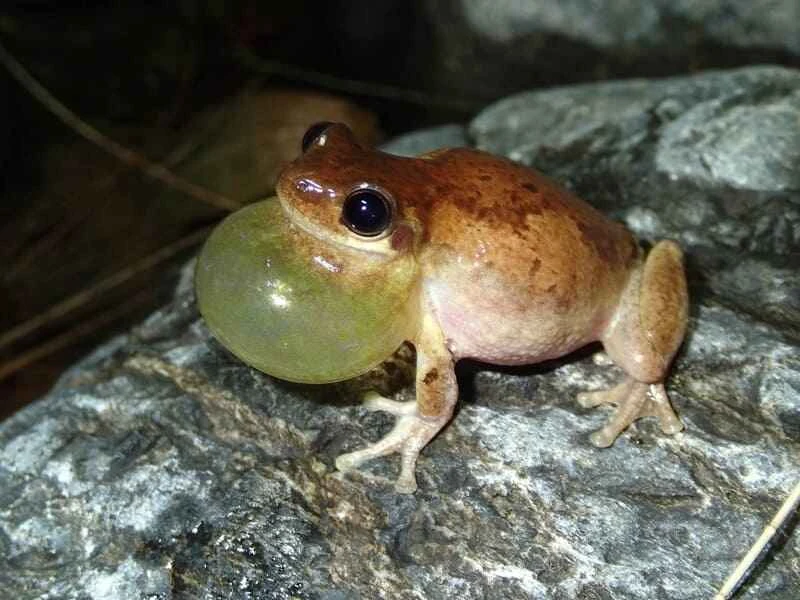
The body is short and stout, with a broad head and blunt snout. The back is grayish-brown to olive-brown with irregular dark markings. The limbs are thick with horizontal stripes. The toes have suckers and some webbing. The belly is milky white or light yellow. Male frogs have prominent vocal sacs in their throats.
Detailed introduction
The Robust Bleating Tree Frog is a medium-sized, native Australian tree frog with a distinctive call, often considered to belong to the genus *Ranoidea robusta* (some literature still uses the older genus name *Litoria *). It belongs to the family Hymenopteridae and is named for the loud bleating sound of the males during the breeding season, which resembles the bleating of a lamb.
Classification and nomenclature
Chinese reference name: Robust Bleating Tree Frog (name summarized using common translations);
English name: Robust Bleating Tree Frog;
Scientific name: Ranoidea robusta (some sources still use Litoria robusta );
Family: Hylidae → Genus: Ranoidea
Appearance and Identification Features
The robust groin tree frog is more robust and sturdy in appearance than closely related species such as the slender groin tree frog.
Size: Adults are typically 3–4.5 cm in length, with males being slightly smaller and females being more robust;
Back color: The back is mostly grayish-brown, olive-brown or yellowish-brown, sometimes with a slight green tint, and usually has irregular dark spots or cloud-like patterns.
Body shape: The body is relatively short and stout, with a wide head and a blunt snout, making it appear more robust compared to the "slender" tree frog.
Limbs: The limbs are relatively strong, the hind limbs are well-developed, and the toes have obvious suction cups and some webbing, which are suitable for climbing and jumping among low vegetation and bushes.
Abdomen: The abdomen is mostly milky white or light yellow, with a slightly rough texture;
Back markings: Some individuals have dark stripes or irregular patches on their backs, and horizontal dark bands can be seen on their limbs;
Tympanic membrane: The tympanic membrane is clearly visible and located behind the eye;
Throat: Male frogs have well-developed vocal sacs in their throats, which inflate significantly into "balloons" when they call.
Distribution range and habitat
The strong bleating ram tree frog is a local tree frog in eastern Australia :
They are mainly distributed in coastal and near-coastal areas such as southeastern Queensland and northeastern New South Wales;
In some areas, its distribution partially overlaps with that of other species of the bleating tree frog.
Typical habitats include:
Open woodlands, scrublands, farmland edges, and suburban gardens;
Near still ponds, farm ponds, roadside puddles, swamps, and temporary storm drains;
They typically inhabit low shrubs, reed beds, and waterside grasses, and are typical "adaptors to human-modified landscapes".
Lifestyle
The Strong-sounding Sheep Tree Frog is a nocturnal arboreal/semi-arboreal frog .
During the day, they mostly rest in rocks, tree bark crevices, dense grass, or vegetation near water.
They are most active from dusk to night, especially during the warm, humid season with frequent rainfall;
They are adept at climbing and jumping, and are often found near waterside plants, fences, and places where lights attract insects near houses.
vocal characteristics
The call is one of the key characteristics that identifies the strong bleating horn tree frog:
The male frog emits a series of high-pitched, short, and slightly "metallic" calls, which are described as "the bleating of a lamb" or "the mournful quacking of a quack."
On rainy nights or during the breeding season, multiple male frogs gather around the water and sing in a loud chorus.
Compared to its close relative, the slender-bodied tree frog, the call is usually more resonant and powerful.
feeding habits
Similar to other tree frogs in the family Rain Frogidae, the Strong Sheep Tree Frog primarily feeds on small invertebrates:
Insects such as moths, beetles, crickets, and grasshoppers;
Spiders and other arthropods;
They often prey on nocturnal insects attracted to them near lights or on vegetation by water.
Reproduction and Development
Reproductive activity is closely related to rainfall:
Their breeding season is mostly during the warm and rainy spring and summer.
Male frogs call out to attract female frogs at the edges of water bodies such as ponds, ditches, and temporary water pits, or on aquatic vegetation.
Female frogs lay their eggs in still water, and the eggs often appear as floating egg masses or attached to plants near the water surface.
Tadpoles develop in water, and after completing the metamorphosis from tadpole to froglet, they crawl out of the water and live in the surrounding grass and bushes.
Protecting the status quo and threats
Based on current data, the Strong-sounding Tree Frog is still relatively common in its distribution area and is generally considered a species of low concern (close to Least Concern or Least Concern) on a global scale.
Potential threats include:
Wetland landfill and water pollution have led to a reduction in breeding habitats;
The potential effects of pesticides and chemicals on the health of tadpoles and adult frogs;
Habitat fragmentation caused by localized urbanization.
Because of its ability to adapt to the human environment, the robust yakshorn tree frog can maintain a relatively stable population in many areas, provided that water bodies, vegetation are preserved and pollution is reduced.
Frequently Asked Questions
Q1: Why is it called "Bleating Tree Frog"?
Because the male frog's call is high-pitched and short, it sounds somewhat like the bleating of a lamb.
When a group of male frogs sing together by the water, it sounds like a continuous bleating of sheep in the background, hence the name.
Q2: What is the difference between the strong bleating tree frog and the "slender bleating tree frog"?
The former has a thicker body and a wider head, making it more "robust" overall; the latter has a more slender body.
The two types of calls also differ slightly in timbre and rhythm. In the wild, they are usually identified by combining body shape, distribution and calls.
Q3: Do the Strong Sheep Tree Frogs appear near cities or farmlands?
Yes. It can make good use of artificial wetlands such as farmland ponds, artificial pools, roadside puddles, and suburban gardens.
As long as there is some vegetation cover and good water quality in the surrounding area, you may be able to hear or see them.
Q4: Is this tree frog poisonous to humans?
It is generally believed to be non-toxic to humans, but like most amphibians, the skin secretions may cause mild irritation to mucous membranes.
If brief contact is necessary, it is recommended to wear gloves or wash your hands with water afterwards, and avoid rubbing your eyes or putting them in your mouth.


