Basic Information
Scientific classification
- Chinese name: Scimitar-horned antelope
- Scientific name: Scimitar-horned oryx, Oryx dammah
- Classification: Hoof Order
- Family and genus: Bovidae (family Bovidae), genus Antelope
Vital signs data
- Body length: Head and body length 140–200 cm; shoulder height approximately 100–125 cm
- Weight: 90–140 kg for both males and females (major regional variations)
- Lifespan: Approximately 15–18 years in the wild; up to 20 years or more in captivity.
Significant features
Drought-resistant and can tolerate long periods with little water; white fur reflects sunlight; reintroduced as a typical conservation species; long, curved, sickle-shaped horns.
Distribution and Habitat
Semi-arid steppes, sandy steppes, and shrublands on the edge of the Sahel-Sahara
Appearance
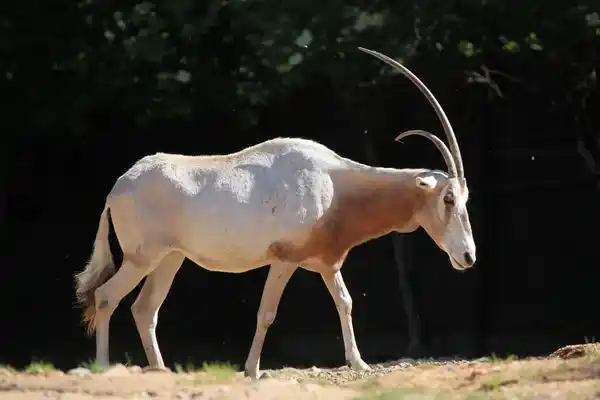
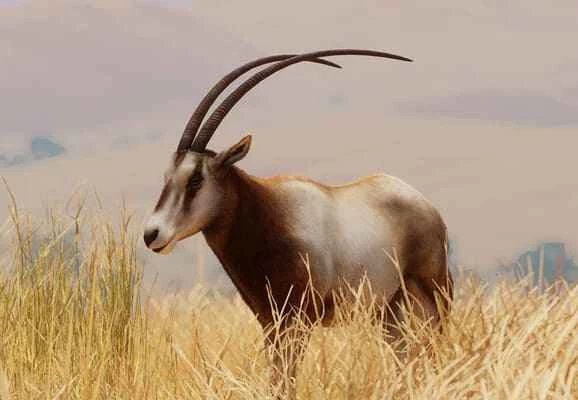
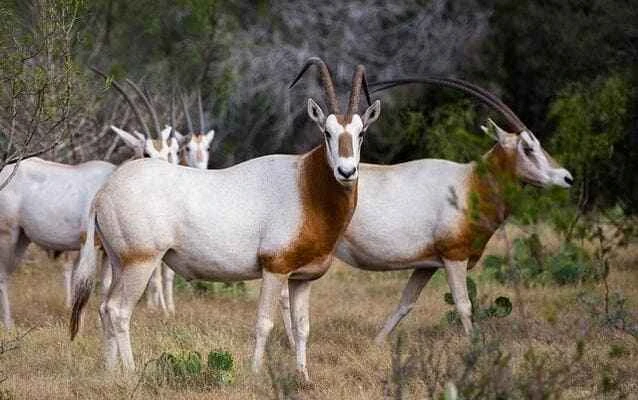
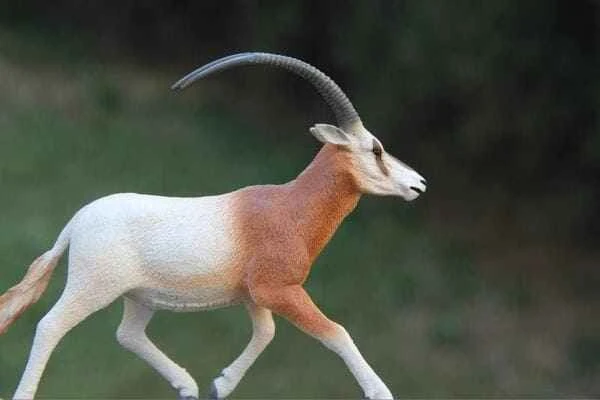
Its body color is mainly white/milky white, with brownish-orange patches on the neck and chest; its two long horns curve symmetrically backward, and can be more than 1 meter long; its wide hooves are good for walking on sand.
Detailed introduction
The scimitar-horned oryx (Oryx dammah ), belonging to the genus Oryx in the family Bovidae, is native to the Sahara-Sahel region of North Africa. Due to long-term overhunting, habitat loss, and drought stress, this species was assessed as "Extinct in the Wild (EW)" in the 2000s. In recent years, multiple captive-breeding and reintroduction programs have been implemented in Chad and other areas, establishing breeding populations in areas such as the Ouadi Rimé–Ouadi Achim Reserve, showing promise for recovery. However, it remains highly dependent on continued management and financial support.
Distribution and Habitat
Historically, it was widely distributed in the semi-arid steppes, Sahel shrublands, and sandy steppes of Mauritania, Mali, Niger, Chad, Libya, and Egypt. Adapted to extremely arid environments, it can survive for extended periods without direct drinking by consuming dew and metabolic water at night. Its current wild distribution primarily originates from reintroduction core areas and experimental release sites.
Behavior and Ecology
Scimitar-horned oryxes mostly live in small groups , feeding on the leaves of herbs and woody plants, as well as the pods of leguminous shrubs in open areas. They migrate seasonally to chase newly grown grass after rainfall. During the daytime heat, they rely on their white fur and body temperature regulation to reduce heat load; their long, arched horns serve both for defense and as a display of status among themselves.
Reproduction and life cycle
Females typically reach sexual maturity at 2–3 years of age, with a gestation period of approximately 8–9 months. They usually give birth to one offspring, but twins are rare. Their lifespan can reach 18–20 years (longer in captivity). When rainfall is good and food is plentiful, there can be relatively synchronized birth peaks.
Threat factors
Overhunting and the proliferation of firearms following armed conflict (primary historical causes).
Habitat loss and fragmentation : increased pressure from motorized grazing, shrubland formation, and well/road construction.
Extreme drought and climate variability : Increased survival risk in marginal habitats.
Protection Status Quo and Measures
Captive breeding and reintroduction : Genetic pedigrees were provided by zoos/breeding centers in multiple countries, and multiple batches were released back into Chad and other places; survival was maintained through satellite collars, aerial patrols, and community co-management.
Community and anti-poaching : hiring local rangers, compensation mechanisms and ecotourism pilot programs.
Genetics and population management : Control inbreeding and release in batches to increase the effective population size.
Fun Facts
Because of its long, curved horns and pure white body, the scimitar oryx is believed to be related to the image of the "unicorn" in medieval legends.
Frequently Asked Questions
Q1: What are the differences between the scimitar oryx and other species in the genus oryx?
The dammah is predominantly white with brownish-orange patches on its chest and neck, and has the longest and most curved horns; the leucoryx is smaller and has straighter horns; the beisa and gazella have more distinct facial and lateral markings.
Q2: Can you still see them in the wild now?
Historically classified as "Extinct in the Wild (EW)," reintroduced populations have been found in places like Chad, and they are generally only visible in managed protected areas.
Q3: How can you survive in the desert?
Its metabolism and behavior are highly adapted: it feeds at night and in the early morning, its white coat reflects heat radiation, it reduces daytime activity, and it can obtain some water from its food and reduce water loss.
Q4: How can we help this species?
Support conservation organizations involved in release programs, avoid purchasing animal products of unknown origin, and pay attention to community co-management and anti-poaching projects in the Sahel region.


