Basic Information
Scientific classification
- Chinese name: Christmas tree worm
- Scientific name: Spirobranchus giganteus
- Classification: Annelids
- Family and genus: Serpulidae Spirobranchus
Vital signs data
- Body length: tube length 2–4 cm (to 5–6 cm); crest diameter 2–5 cm
- Weight: Extremely light, varies greatly depending on the individual and tube length.
- Lifespan: Several years (longer in stable reef areas)
Significant features
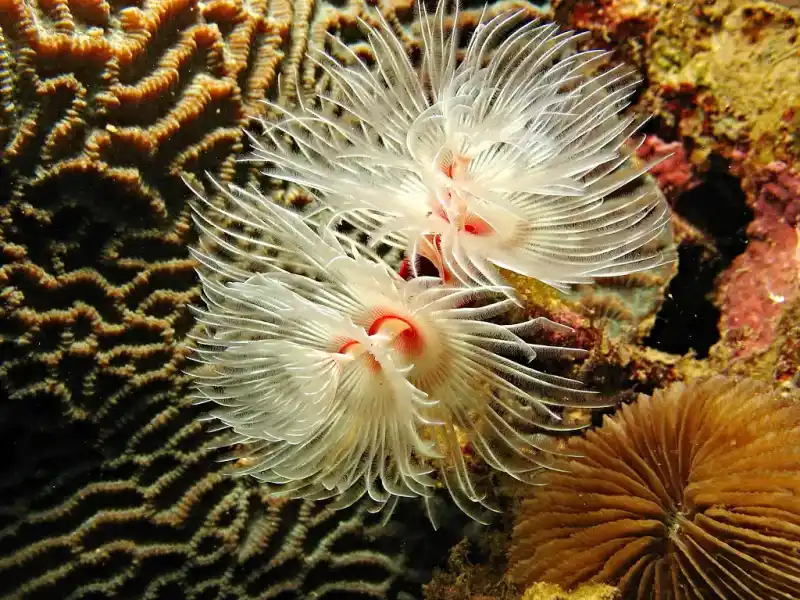
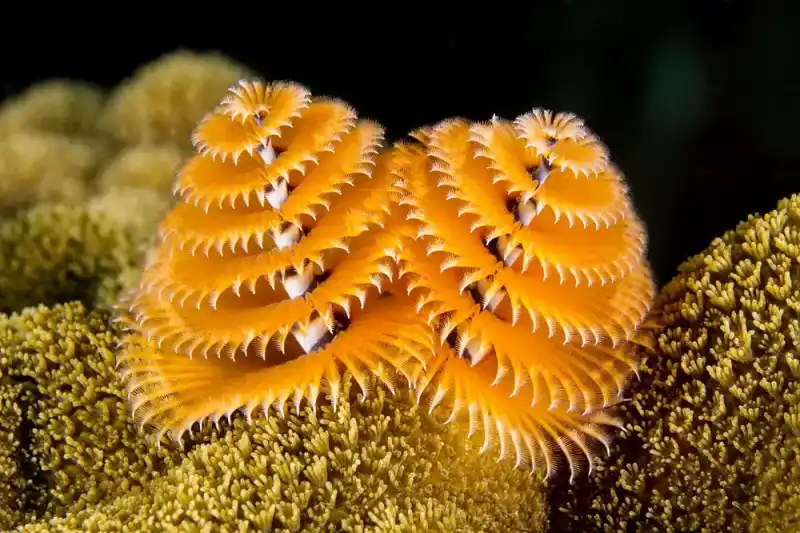
It uses a double-clustered spiral crest for filter feeding and respiration; it lives in calcareous tubes and has a tethered cap; it often lives in symbiosis with live corals.
Distribution and Habitat
Tropical Indo-Pacific and Atlantic coral reefs, 1–25+ m, with well-lit reef surfaces/slopes/lagoons.
Appearance
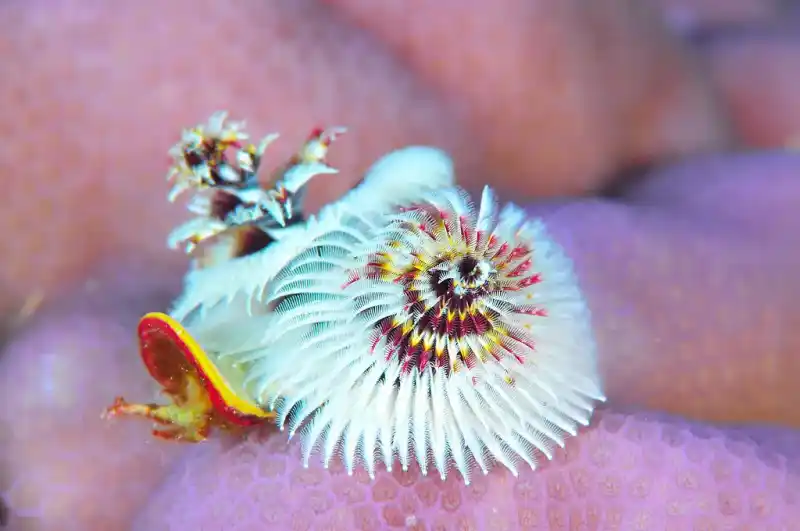
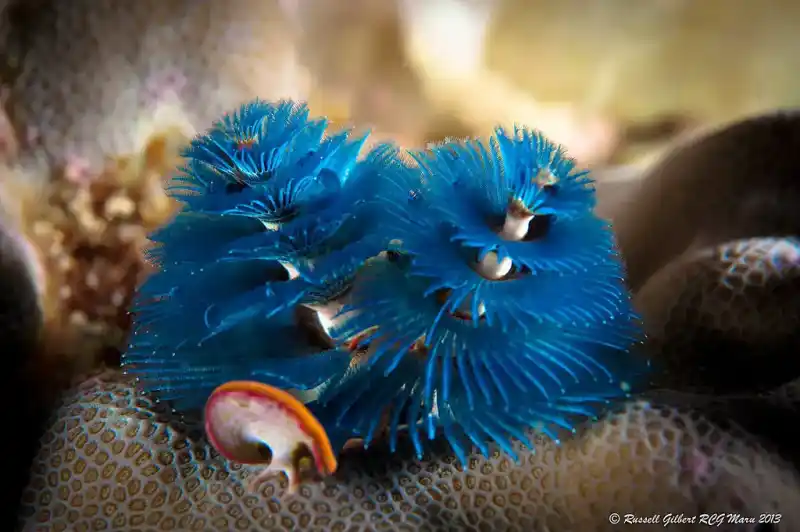
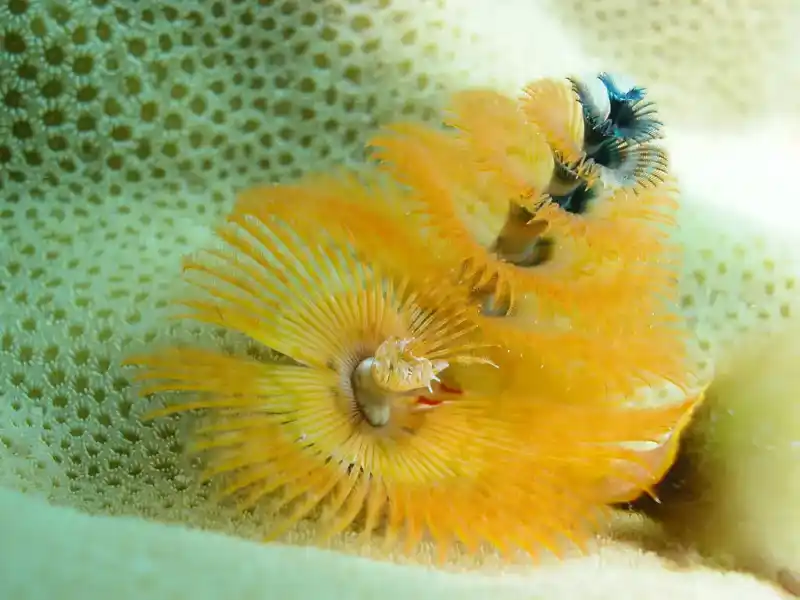
White/beige calcareous tubes; crest yellow/orange/red/blue/white, etc.; cork often has spikes or crown structure.
Detailed introduction
The Christmas tree worm ( Spirobranchus giganteus ) is a typical tube-dwelling ring-tailed worm belonging to the family Serpulidae in the class Polychaeta. Its double-clustered spiral crest, used for filter feeding and respiration , resembles a colorful "Christmas tree," making it a highly recognizable species commonly found on tropical coral reefs.
Ecology and Biology
Living form: After settling in the colony, the larvae secrete calcium carbonate ducts and remain attached to them for life; when disturbed, they instantly retract and seal the ducts with an operculum .
Feeding: It relies on cilia and mucus to suspend and feed on planktonic microbodies and organic particles (POM).
Relationship with corals: They often burrow into the skeletons of living corals and have a symbiotic to mild competitive relationship with reef-building corals.
Reproduction: External fertilization; planktonic larvae eventually settle and pupate into adults.
Morphology and Recognition
The adult body is hidden within white to beige calcareous tubes , with only the crest and operculum exposed. The crest is diverse in color, with yellow, orange, red, blue, and white being common, and the two clumps may be different colors. The operculum has varied morphology, often with spines or crown-like protrusions , and exhibits regional differences.
Body size and lifespan
Tube length: commonly 2–4 cm (can reach 5–6 cm); crest diameter 2–5 cm.
Lifespan: Generally several years , longer in stable reef areas.
Distribution and Habitat
Widely distributed in tropical Indo-Pacific and Atlantic coral reefs (including the Red Sea and Caribbean Sea), they prefer well-lit reef surfaces, reef slopes and lagoons , with water depths of approximately 1–25+ m.
Ecological significance and threats
Ecological role: an important small filter feeder , promoting the cycling of particulate organic matter and providing micro habitats.
Threats: Coral reef degradation, increased sediment load and pollution; coral bleaching can indirectly affect their settlement and survival.
IUCN: This site is treated as Unevaluated (NE) .
Frequently Asked Questions
Q1: Why is it called a "Christmas tree"? Because its double-clustered spiral crest resembles a small Christmas tree, and it can be independently opened and closed.
Q2: Can adults leave the tube? No ; once settled, they live in the tube for life, and will retreat when disturbed, sealing their mouths with a plug .
Q3: Will it damage corals? Generally, the impact is limited; localized high density may compete for space with the coral surface.
Q4: Does it "disappear" when you get close? It is extremely sensitive to shadows and vibrations and will instantly retract; it will reopen the umbrella after a short wait.