
Basic Information
Scientific classification
- Chinese name: Red-headed Kingfisher
- Scientific name: African Dwarf Kingfisher, Ispidina lecontei
- Classification: Climbing birds
- Genus and species: Order Coraciiformes, Family Kingfisher, Genus *Echinochloa*
Vital signs data
- Body length: Approximately 10 centimeters
- Weight: 9-12g
- Lifespan: No verification data available.
Significant features
The Red-headed Kingfisher is the smallest of all kingfishers.
Distribution and Habitat
The Red-headed Kingfisher is distributed in south-central Africa (including the southern Arabian Peninsula and the entire African continent south of the Sahara Desert (Tropic of Cancer), eastern Liberia, Ghana, southwestern Nigeria, Cameroon, Gabon, Congo, Uganda, Angola, and southwestern Sudan).
The Red-headed Kingfisher primarily inhabits tropical rainforests and dense forests, but has also been found in some open environments, such as oil palm plantations. Its distribution ranges from sea level to altitudes of 1400 meters.
Appearance
The Red-headed Kingfisher is 10 cm in length; males weigh 9-11 g, and females weigh 9.5-12 g. Its lores and eyes are black. The forehead is black, the head is red, the nape and back are lilac, with a white patch on each side of the nape. The wattle, back, and tail are bluish-purple, with the tail and wings becoming darker. The chin and throat are white, and the underparts (chest, abdomen, and underwings) are yellowish-red. The bill is red, and the iris is dark brown. The legs are red.
The juvenile bird has a black forehead, a bluish-black head and wings, a darker bluish-black chin and shoulders, and a bright blue back and tail. The chin and throat are white. The abdomen is greyish-white with reddish tinge, and pale yellow. The black beak has a white edge, and the lower jaw to the base of the beak is red.
The tail is shorter than the beak; the wings are pointed and long; the plumage is not black and white. The beak is thick, straight, long and strong, with a rounded ridge; the nasal groove is not prominent; the wingtips are long, with the first primary flight feather being slightly shorter and the third and fourth feathers being the longest; the tail is short and rounded; the body plumage is bright and glossy, often with blue or green.
Detailed introduction
The red-headed kingfisher, scientifically known as *Ispidina lecontei*, African Dwarf-kingfisher, has two subspecies: (1. *Ispidina lecontei ruficeps*, distributed from eastern Liberia to Ghana; 2. *Ispidina lecontei lecontei*, distributed in southwestern Nigeria, Cameroon, Gabon, Congo, Uganda, Angola, and southwestern Sudan).
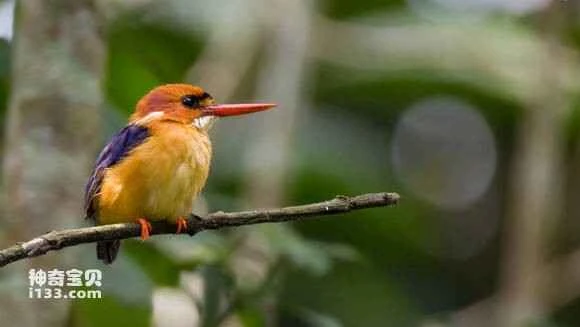
The Red-headed Kingfisher is a small, brightly colored forest kingfisher. It typically inhabits dense forests and riverbanks near water, usually hunting alone or in pairs. Like most forest kingfishers, it is entirely carnivorous, foraging for prey in leaves or soil. Its diet is primarily limited to insects such as dragonflies, beetles (larvae and adults), ants, and large flies, with a particular fondness for army ants. It also consumes various aquatic animals.
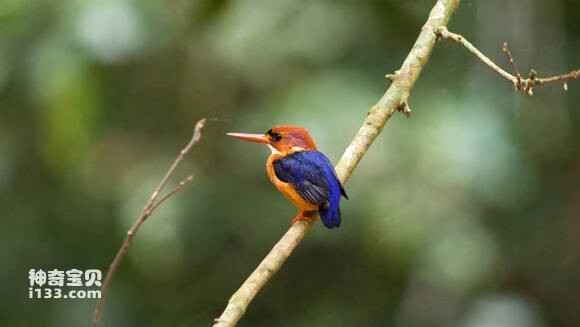
The red-headed kingfisher is particularly fond of playing in the water during the breeding season. Two birds face each other, staying very close, generally less than 50 centimeters apart. Their beaks are almost vertically aligned, and they call to each other in a duet. Egg-laying time varies by region; in Cameroon it is February, while in Gabon it is from November to February. They nest in earthen cliffs or river embankments, digging tunnel-like burrows with their beaks, about 15 centimeters long and 5 centimeters high. These burrows are generally unlined. The eggs are laid directly on the ground inside the nest.
Listed in the IUCN Red List of Birds, ver 3.1: 2008.
Protect wild animals and ban the consumption of wild game.
Maintaining ecological balance is everyone's responsibility!


