Basic Information
Scientific classification
- Chinese name: Great Flamingo
- Scientific name: Great Flamingo, Flamingo
- Classification: Wading birds
- Family and genus: Great Flamingo
Vital signs data
- Body length: 130-142 cm
- Weight: 2.5-3.5 kg
- Lifespan: 20-50 years
Significant features
It is about the size of a stork, with a short, thick beak, a slender neck that curves in an "S" shape, and extremely long legs.
Distribution and Habitat
They mainly inhabit wide, shallow water areas rarely visited by humans, including shallow areas of saltwater lakes and freshwater habitats, swamps and lagoons, such as lagoons, estuaries, mudflats and coastal or inland lakes, usually only a few centimeters deep, where a rich variety of algae grow. They mainly feed on algae and plankton in the mud or shallow water.
Appearance
The Greater Flamingo is similar in size to a stork, with a short, thick bill that curves downwards in the middle of the upper bill and a larger, grooved lower bill. The tip of the bill is black, the middle is pale red, and the base is yellow. It has a long, curved neck in an "S" shape, and long, slender red legs that are bare. The three forward-facing toes have a tread, while the hind toe is short and does not touch the ground. Its wingspan exceeds 150 cm, and the wings are of moderate size and reddish in color. The tail feathers are very short. The body feathers are white with a rose tinge, the flight feathers are black, and the coverts are deep red. Males and females are similar in appearance. It is a large wading bird with brightly colored and varied plumage, primarily crimson.
Detailed introduction
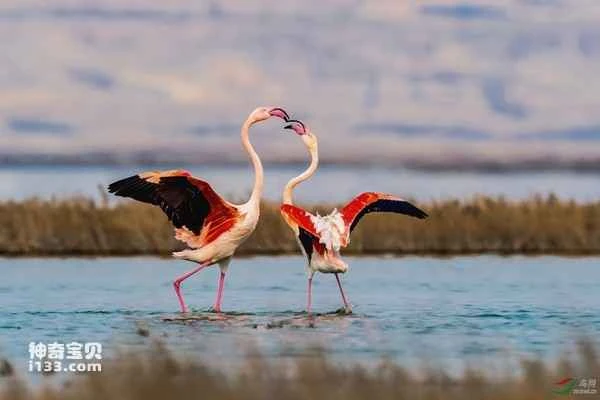
The Greater Flamingo belongs to the genus *Flamingo* in the family Pterodactylidae, order Flamingo, class Aves, phylum Chordata. There are six species in one genus : approximately 80-160 cm tall, 130-142 cm long, and weighing 2.5-3.5 kg. It is considered a vagrant and is very rare. Greater Flamingos have high ornamental value; they are gentle, timid, and alert, making them popular pets in zoos. They are listed in the national list of terrestrial wild animals of beneficial or important economic and scientific research value.
Also known as the Greater Flamingo, Flamingo, or Firecracker, males and females are similar in appearance, with males slightly larger than females. The Greater Flamingo is about the size of a stork, with a short, thick bill that curves downwards in the middle of the upper bill and a larger, grooved lower bill. The tip of the bill is black, the middle is pale red, and the base is yellow. It has a long, curved neck in an "S" shape, and long, thin, bare red legs with a tread between the three forward-facing toes and a short, non-touching hind toe. Its wingspan can reach over 150 cm, with moderately sized wings that are reddish on the sides. The tail feathers are very short. The body feathers are white with a rose tinge, the flight feathers are black, and the coverts are deep red. Males and females are similar in appearance; it is a large wading bird with brightly colored plumage. Its plumage is mainly vermilion, especially the feathers at the base of the wings, which are glossy and shine, making it appear like a blazing fire from a distance, hence its name.
The red color is not the flamingo's natural plumage color, but rather comes from the plankton it ingests . ( According to a 2008 study by Professor Francesco Buda and his research team at Leiden University in the Netherlands, precise quantum computing revealed that the alluring bright red color of flamingos, salmon, shrimp, and crabs is due to their high content of astaxanthin , a form of vitamin A. Animals cannot synthesize astaxanthin , and shrimp and crabs obtain it primarily by consuming algae and plankton.) The flamingo mainly feeds on aquatic algae, protozoa, small worms, and insect larvae, occasionally also consuming small mollusks and crustaceans. Its feeding method is unique and fascinating: it bends its long neck, flips its head, and then, while walking, uses its curved beak to sweep left and right, touching the bottom to collect food. Due to its unique beak structure—a deep groove in the lower beak and a shallow, lid-shaped upper beak with sparse serrations and fine hairs along the edges—when inverted in water, it acts like a large sieve, quickly drawing in water, filtering it out, and retaining food in its mouth. Additionally, its large tongue helps to expel water and prevents it from swallowing large objects. By consuming small shrimp, fish, algae, and plankton, it transfers ASTA ( associated amino acids), giving its originally white feathers a vibrant red hue. The more vibrant the red, the more robust the flamingo's physique, the more attractive it is to mates, resulting in superior offspring.
Great flamingos live and forage in flocks, mainly inhabiting wide, shallow water areas rarely visited by humans, such as shallow waters of salt lakes, marshes, and lagoons, usually only a few centimeters deep. The water is rich in various algae, and they mainly feed on algae and plankton in the silt or shallow water.
flamingos also exhibit migratory behavior, especially those populations living in Central America, which migrate to the Florida peninsula, surrounded by water on three sides, in the southern United States for a period of time each year at the end of the year. Near Miami, Florida, lies the world-famous Shearry Racecourse, where winter horse racing coincides with the arrival of the flamingos. During this time, the racecourse is always packed with people, creating a vibrant and bustling atmosphere. Even bars, restaurants, shops, and hotels are named after flamingos. Red flags symbolizing the flamingo flutter everywhere, and staff drive red cars to bring flocks of flamingos from the island to the racecourse, creating a fiery red world. Visitors also enjoy sending nearly a million postcards featuring photos or images of flamingos from here, giving most people the feeling that "this place is the flamingo's homeland."
Great flamingos are gregarious animals, often gathering in flocks of thousands, even exceeding 100,000 . They stand closely packed together, their calls, similar to those of geese, rising and falling in a deafening chorus. From a distance, their red legs resemble a forest, like spiders, their long necks constantly shifting and wriggling – a truly magnificent sight. Viewed from an airplane, the landscape is a sea of red, stretching for kilometers, like a giant red carpet, or a surging red wave on a marshy plain – a vibrant and breathtaking scene.
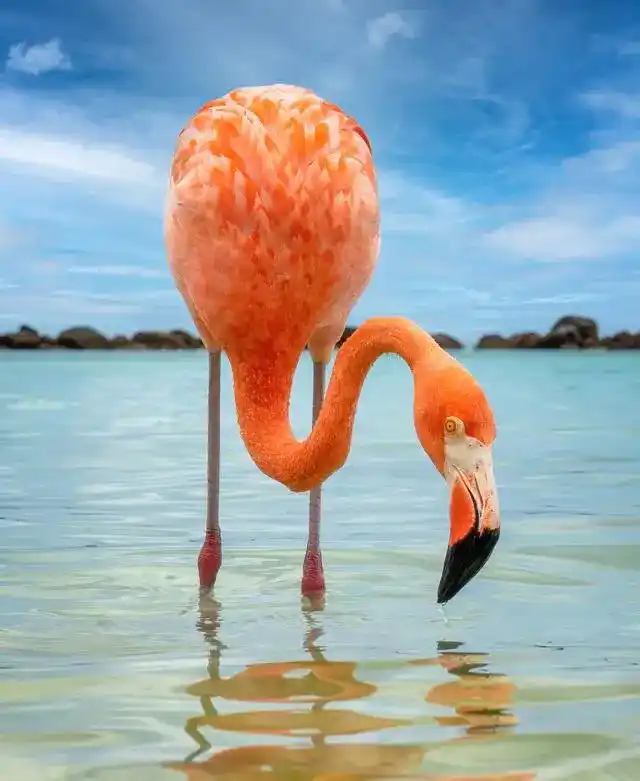
Greater flamingos are gentle in nature, usually appearing timid and alert, and are also excellent swimmers. When flying, they can stretch their necks and legs into a straight line, and once one takes to the sky, a large flock will follow closely, calling out as they fly, like a red ribbon streaking across the blue sky and white clouds.
The Greater Flamingo is distributed in West Asia, North Africa, the Atlantic coast of the Americas, and Southern Europe. In China, it is found in Xinjiang, Qinghai, Yunnan, and Hubei provinces. It is also found in Afghanistan, Angola, Armenia, Azerbaijan, Bahrain, Bangladesh, Botswana, Burundi, Angkor Wat, Cape Verde, Comoros, Cyprus, Djibouti, Egypt, Eritrea, Ethiopia, France, Gambia, Gibraltar, Greece, Guinea, Guinea-Bissau, India, Islamic Republic of Iran, Iraq, Israel, Italy, Jordan, Kazakhstan, Kenya, Kuwait, Lebanon, Libya, Macedonia, and Madagascar. Gascoigne, Malawi, Maldives, Mauritania, Mayotte, Morocco, Mozambique, Namibia, Nepal, Oman, Pakistan, Palestine, Portugal, Qatar, Russian Federation, São Tomé and Príncipe, Saudi Arabia, Senegal, Seychelles, Sierra Leone, Slovenia, Somalia, South Africa, Spain (Canary Islands - migratory birds), Sri Lanka, Sudan, Syrian Arab Republic, United Republic of Tanzania, Tunisia, Turkey, Turkmenistan, Uganda, United Arab Emirates, Uzbekistan, Western Sahara, Yemen, Zambia, Zimbabwe.
Migratory birds: Austria, Belarus, Belgium, Bulgaria, Cameroon, China, Cocos Islands, Democratic Republic of Congo, Croatia, Czech Republic, Denmark, Equatorial Guinea, Finland, Germany, Hungary, Kyrgyzstan, Latvia, Lesotho, Malta, Mauritius, Mongolia, Montenegro, Niger, Norway, Poland, Réunion, Romania, Serbia, Slovakia, Swaziland, Sweden, Switzerland, Tajikistan.
Drifting birds: The nominate subspecies ( roseus ) has been recorded in flocks and as a single bird in northwestern China, with one recorded bird in Dongting Lake. It may have broken away from a breeding population in central Afghanistan or Kazakhstan and entered China.
Evidence suggests that flamingo ancestors began to diverge as early as the Miocene epoch, 30 million years ago, much earlier than most other birds. Fossils discovered in 1976 suggest that their ancestors were shorebirds similar to sandpipers and plovers. Fossilized flamingo footprints dating back approximately seven million years have been found in the Andes Mountains.
The world's oldest flamingo, aged 83 , passed away on January 30 , 2013 , at Adelaide Zoo in Australia.
It was already an adult when it arrived in Australia in 1933. The oldest great flamingo is in Australia, having lived for at least 75 years, but its true age is unknown.
In December 2012 , the Greater Flamingo was first recorded in the wild in Sichuan.
The first wild flamingo was discovered in Qinghai in November 2013 .
In 2016 , the Greater Flamingo, a rare bird species, was discovered in the wetlands of Lianyungang, Jiangsu Province.
Greater flamingos breed in groups, with hundreds or even thousands gathering to form a courtship flock. Mating is primarily monogamous; the male hops onto the female during mating, making sex identification clear only then. They nest once a year, usually building a new nest atop an older one. The nest is elevated above the water, typically on a peninsula-shaped mound or mudflat surrounded by water on three sides. Sometimes, they build a small "island" in the water using weeds. When building the nest, they roll damp mud into small balls with their beaks, mixing in fibrous materials like grass stems. They then use their feet to layer the mud, creating a fortress-like structure with a concave top and a height of 12.7-45.7 cm and a diameter of 38-76 cm. The nest is unique, sturdy, and durable, resistant to heavy rain. The nests of each group are often arranged neatly, forming a very orderly "small village". The distance between the nests is mostly about 60 centimeters. There are also many small ditches dug inside to communicate with the water surface. This way, during the incubation period, they can enter the water at any time to forage, stand in the shallow water to look out, or dive into the water to swim.
During nesting, the birds can sometimes become fierce and aggressive, occasionally engaging in minor conflicts over territory or nesting materials. Some impatient individuals will rush into the nest to lay and incubate their eggs before the mud has dried. The eggs are pale white, and they breed from June to July each year, laying only 1-2 eggs per clutch. Incubation is shared by both the male and female; while one incubates, the other guards the nest. The incubation period is approximately 28-32 days. Once hatched, the chicks can walk as soon as their feathers dry, and swim the following day. After 4-5 days, they become quite active, but primarily survive by feeding on the milky substance secreted from the adult bird's crop.
The chicks have gray, filamentous downy feathers and gray legs. Their beaks are straight, not curved. Around two and a half months old, the chicks learn to fly. After a year, they are almost as large as adults, but their plumage remains gray until the third year when they turn red and reach sexual maturity. Their lifespan is approximately 20-50 years.
Subspecies differentiation
It is a single species with no subspecies differentiation.
Note: Species classification previously divided the Greater Flamingo into two subspecies: the American subspecies ( Phoenicopterus roseus ruber ) and the nominate subspecies ( Phoenicopterus roseus roseus ). It wasn't until 2012 that the International Union for Conservation of Nature ( IUCN ) classified it as two separate species: the Greater Flamingo ( Phoenicopterus roseus ) and the Caribbean Flamingo ( Phoenicopterus ruber ).
Listed in Appendix II of the 2019 edition of the Convention on International Trade in Endangered Species of Wild Fauna and Flora ( CITES ).
Listed as Least Concern ( LC ) on the IUCN Red List of Threatened Species 2018 ver 3.1 .
This species has been included in the "List of Terrestrial Wild Animals of Beneficial or Important Economic and Scientific Research Value under State Protection" (Item 37 ) issued by the State Forestry Administration of China on August 1, 2000 .
This species has a wide distribution range and does not approach the threshold for vulnerable or endangered status (distribution area or fluctuation range less than 20,000 square kilometers, habitat quality, population size, fragmentation of distribution area), and its population trend is stable. Therefore, it is assessed as a species with no survival crisis.