Basic Information
Scientific classification
- Chinese name: White-capped Albatross
- Scientific name: Thalassarche cauta, White-capped Albatross
- Classification: Waterfowl
- Family and genus: Procellariiformes, Albatrossidae, Albatross spp.
Vital signs data
- Body length: 90-100 cm
- Weight: No verification information available.
- Lifespan: 20-40 years
Significant features
Albatrosses are most numerous on New Zealand's South Island
Distribution and Habitat
Distributed in south-central Africa (including the southern Arabian Peninsula and the entire African continent south of the Sahara Desert (Tropic of Cancer), the Indian Ocean (including Madagascar and its surrounding islands), South America (including Colombia, Venezuela, Guyana, Suriname, Ecuador, Peru, Bolivia, Paraguay, Brazil, Chile, Argentina, Uruguay, and the Falkland Islands), the Pacific Islands (including Taiwan, the Dongsha Islands, Xisha Islands, Zhongsha Islands, and Nansha Islands of China, as well as the Philippines, Brunei, Malaysia, Singapore, Sumatra and Java of Indonesia, and Papua New Guinea), and Australia and New Zealand (including Australia, New Zealand, Tasmania, and their surrounding islands).
They are the most numerous albatrosses on New Zealand's South Island, and their endangered status is much lower than that of the Royal Albatross. Their main breeding grounds are the small islands in the sub-Antarctic waters south of the South Island.
Appearance
The white-capped albatross has a blackish-grey back and tail feathers, and a yellow beak tip. It is 90-100 cm long and has a wingspan of 220-256 cm.
Detailed introduction
The white-capped albatross, scientifically known as *Thalassarche cauta*, has two subspecies.
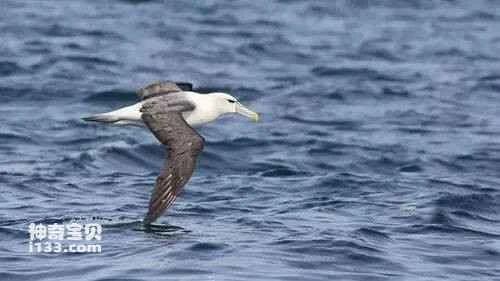
The white-capped albatross's primary diet consists of fish, with crustaceans and tunicates also forming part of its food. White-capped albatrosses breed annually in their breeding colonies. Most eggs are laid in late September, with incubation in December; chicks hatch primarily in April. They return to their breeding colonies within at least three years of birth, typically beginning breeding at least five to six years of age, almost always at their post-breeding colonies. White-capped albatrosses typically dive to depths of up to 3 meters and can swim to depths exceeding 7 meters.
International Union for Conservation of Nature (IUCN) Red List protection level: Near Threatened (NT).
Protect wild animals and ban the consumption of wild game.
Maintaining ecological balance is everyone's responsibility!