Basic Information
Scientific classification
- Chinese name: Pink-cheeked Kingfisher
- Scientific name: Ispidina picta, African Pygmy-kingfisher
- Classification: Climbing birds
- Genus and species: Order Coraciiformes, Family Kingfisher, Genus *Echinochloa*
Vital signs data
- Body length: Approximately 12 centimeters
- Weight: 9-16g
- Lifespan: No verification data available.
Significant features
Distribution and Habitat
The Pink-cheeked Kingfisher is found in south-central Africa (including the southern Arabian Peninsula and the entire African continent south of the Sahara Desert (Tropic of Cancer)).
The Pink-cheeked Kingfisher tends to frequent woodlands and dry grasslands. Therefore, they are found in dry grasslands, scrublands, and savannas. However, they can also be found near rivers, in densely planted grasslands, swamp forests, dense evergreen forests, plantations, farms, gardens, and meadows. They are distributed in areas of South Africa up to 1500 meters above sea level and in East Africa up to 2000 meters.
Appearance
The Pink-cheeked Kingfisher is 12cm in length, with males weighing 11-16g and females 9-15g. Males and females are similar. Adults have a bluish-black sheen on the crown of their forehead. They have red eyebrows, black lores, and lilac cheeks. Each side of the neck has a large white or pale yellow patch. The neck is red, with bluish-purple folds, back, and tail. The tail and wings are black. The chin and throat are white. The wings have yellowish-red hues. The bill is red, and the iris is dark brown. The legs are orange-red. Juveniles have darker plumage, with pale blue folds and back. The black bill has some yellow tinge, and the legs are pink.
Detailed introduction
The Pink-cheeked Kingfisher, scientifically known as *Ispidina picta*, is also called the African Pygmy-kingfisher. It has three subspecies: (1. *Ispidina picta pictus*, distributed in Senegal, Eritrea, and Uganda; 2. *Ispidina picta ferrugineus*, distributed in Uganda, Angola, Zambia, Tanzania, Guinea-Bissau, and Botswana; 3. *Ispidina picta natalensis*, distributed in Angola, Tanzania, Zanzibar, South Africa, Zaire, Uganda, and Sudan.)
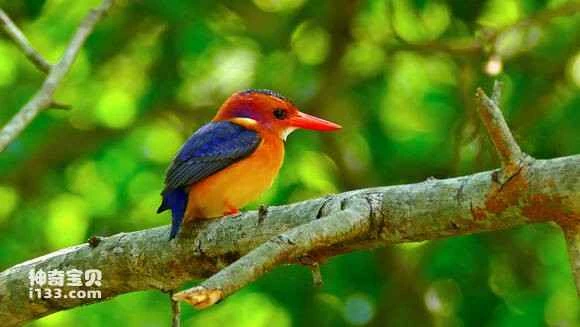
The Pink-cheeked Kingfisher is a solitary, peaceful, and quiet bird. They spend considerable time perched on branches near the water, occasionally shaking their heads and briefly flicking their tails. They dedicate most of their time to hunting prey, and also catch insects in flight. These birds migrate, with the timing varying depending on the subspecies' distribution area.

Like most kingfishers, the Pink-cheeked Kingfisher is entirely carnivorous. It forages for prey in leaves or mud. Its main diet consists of insects such as crickets, spiders, scorpions, and snails. It also eats various aquatic animals. Although it frequently spends time near water and bathes often, it does not fish, only occasionally catching small frogs.

The breeding season for the Pink-cheeked Kingfisher varies depending on latitude: from September to November in Mauritania and Mali, from March to October in South Africa and West Africa, from March to June and October to November in East Africa, from January to March and August to October in Zaire and Angola, and from October to December to March in other parts of southern Africa.
The Pink-cheeked Kingfisher typically nests on earthen cliffs or river embankments. Both male and female use their beaks to dig tunnel-like burrows, 30 to 60 centimeters long, for the nest. These burrows are usually unlined. The female lays 4 to 6 eggs directly on the ground inside the nest.
Listed in the IUCN Red List of Birds, ver 3.1: 2008.
Protect wild animals and ban the consumption of wild game.
Maintaining ecological balance is everyone's responsibility!