Basic Information
Scientific classification
- Chinese name: Laughing Kookaburra
- Scientific name: Albino Blue Kingfisher, *Dacelo novaeguineae*, Laughing Kookaburra, Laughing Jackass
- Classification: Climbing birds
- Genus and species: Order Coraciiformes, Family Kingfisher, Genus *Laughing Kookaburra*
Vital signs data
- Body length: 42-46 cm
- Weight: About 500g
- Lifespan: Approximately 15 years
Significant features
It is considered one of Australia's iconic birds and was used as a mascot at the Sydney Olympics.
Distribution and Habitat
The laughing kookaburra is commonly found in eastern and southern Australia, and also in Tasmania and New Zealand. It is primarily distributed across the Cape York Peninsula, south of Cooktown, south of Flinders in South Australia, and New South Wales.
It is found in the edges and clearings of lush forests in eastern and southwestern Australia, as well as in open scenic areas and hunting grounds. It is also found in wooded meadows and near towns.
Appearance
The Laughing Kookaburra is a fish-eating bird of the kingfisher family found in eastern Australia. It measures 42-46 cm in length, has a bill 8-10 cm long, and weighs 500 grams. It is one of the two largest kingfishers, along with the Great Kingfisher. It gets its name from its call, which sounds like maniacal laughter. The Laughing Kookaburra has a large white head with a small brown cap on top. Its cheeks have brown patches. It has a large, powerful, black beak. Its upper body is greyish-brown, with a greyish-white belly. The male has blue wings for identification. Its chest and belly are white, and its tail is long, with brown and black stripes. Its legs are short and grey.
The beak is thick, straight, long, and strong, with a rounded ridge; the nasal groove is indistinct; the wingtips are long, with the first primary flight feather being slightly shorter, and the third and fourth being the longest; the tail is short and rounded; the head is large, the neck is short, the wings are short and rounded, and the tail is also mostly short; the beak is large and pointed, with a blunt cusp; the legs are very short, the toes are thin and weak, the fourth toe is mostly fused with the third toe, and only fused with the second toe at the base. The preen gland is covered with (protruding feathers). Coracoid bones are present on both sides, and there are four notches on the posterior margin of the sternum; the manubrium of the sternum is simply formed by external spines.
Detailed introduction
The laughing kookaburra, scientifically known as *Dacelo novaeguineae*, is also called the Laughing Kookaburra or Laughing Jackass. It has two subspecies.
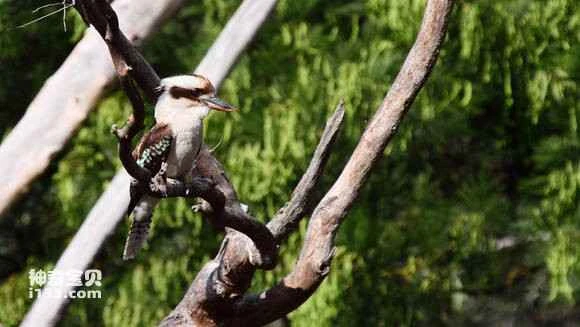
Laughing kookaburras live in flocks, each consisting of 1-5 families, including several pairs of parents and their two generations of offspring. They are highly territorial and will swarm to attack any intruders, even daring to confront birds of prey such as eagles. They protect their territory year-round. Because their calls can be heard at dawn or sunset, they are known as the "clock of the forest dwellers."
The laughing kookaburra is a resident bird of woodlands. However, unlike most other kingfisher species, it does not rely solely on fishing for survival. In addition to fish, it also preys on mice, frogs, lizards, crayfish, snails, and insects. Its most distinctive feature is its ability to prey on reptiles much larger than itself, such as venomous snakes. It is renowned for its snake-catching skills, which are exceptionally high. An adult laughing kookaburra can easily kill large snakes such as rattlesnakes and taipans, and it will also swarm to attack even larger frilled lizards.
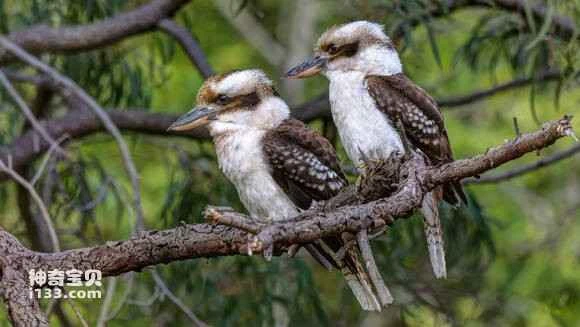
Laughing kookaburras breed from July to August each year, and are monogamous, pairing with only one mate throughout their lives. They typically build their nests in tree cavities high in dense forests. The female lays 1-5 eggs at a time, usually 2-4, which are white. The incubation period is about 25 days. The chicks can leave the nest and fly when they are about one month old. Both parents help raise the chicks for about two months. Chicks born in previous years usually live with their parents and help feed the following year's chicks. The birds can live independently at nine months old, reach sexual maturity at around one year old, and have an average lifespan of 15 years.
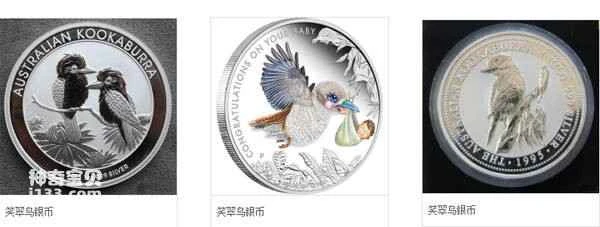
The kookaburra is a common bird in the cities and countryside of Australia. Like the kangaroo, it is very popular among Australians, and its image appears on all sorts of cultural items. The most famous example is the commemorative silver coin issued by the Perth Mint in Australia, which features a portrait of Queen Elizabeth II on the obverse and a kookaburra perched on a branch on the reverse. One of these commemorative coins has been issued every year since 1990.
Listed as Least Concern (LC) in the IUCN Red List of Threatened Species 2016 ver 3.1.
Protect wild animals and ban the consumption of wild game.
Maintaining ecological balance is everyone's responsibility!