Basic Information
Scientific classification
- Chinese name: Shawl-wearing Laughing Kingfisher
- Scientific name: Dacelo tyro, Spangled kookaburra, Aru Giant Kingfisher
- Classification: Climbing birds
- Genus and species: Order Coraciiformes, Family Kingfisher, Genus *Laughing Kookaburra*
Vital signs data
- Body length: Approximately 33 centimeters
- Weight: 128-165g
- Lifespan: No verification data available.
Significant features
Completely carnivorous, the young birds feed mainly on insects, including beetles, ants, and other insects (the latter can reach 12 cm in length).
Its gregarious lifestyle is still unclear: unlike the Blue-winged Kookaburra, which lives alone or in small groups of five, the Wrapped Kookaburra mostly resembles other kingfishers, crouching at a height of 1 to 4 meters to monitor its prey. It remains almost motionless, sometimes only moving its head and tail. When prey is spotted, it suddenly swoops down. Experts believe this kingfisher exhibits similar complex social behavior to the Australian Kookaburra, and also has nest-building "helpers" (in avian societies, individuals other than the parents help build the nest, forming a "helper" system). Furthermore, its calls, often mixed with those of the Blue-winged Kookaburra, are very similar, producing a series of "kourk" guttural sounds.
Distribution and Habitat
It is distributed in the Aru Islands of Indonesia, as well as the southern lowlands and southwestern Aru Islands of Papua New Guinea.
They inhabit woodland environments rich in resources, including riparian forests, monsoon forests, broad-leaved forests, dry grasslands, shrublands in plains, and shrublands bordering marshes. The Winged Kookaburra spends most of its time in forests, primarily living within 50 kilometers of the sea; it is a kingfisher that does not depend on aquatic environments.
Appearance
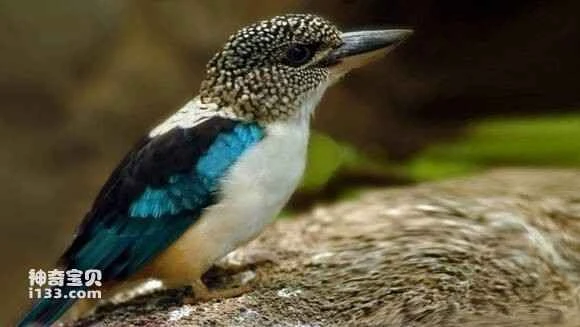
A yellow line runs below the eyes. The back is deep blue with black hues on the shoulder blades. The tail is a bright cobalt blue, with the tip and lateral feathers being darker. The chin and throat are whitish. The chest and abdomen are pale yellow, while the wings and tail are orange. The undersides of the wings, abdomen, and chest are the same color, leading to a black tail. The upper jaw is black. The iris is dark brown, and the legs are grey or greyish-green.
The beak is thick, straight, long, and strong, with a rounded ridge; the nasal groove is indistinct; the wingtips are long, with the first primary flight feather slightly shorter and the third and fourth longest; the tail is short and rounded; the body plumage is bright and glossy, often with a bluish-green hue. The head is large, the neck short, the wings short and rounded, and the tail mostly short as well; the beak is large and pointed with a blunt cusp; the legs are very short, the toes slender and weak, the fourth toe mostly fused with the third, and only fused with the second toe at the base. The preen gland is covered with (unidentified feathers). Coracoid bones are present on both sides, and there are four notches on the posterior margin of the sternum; the manubrium of the sternum is simply formed by external spines.
The bird is 33cm long, with females weighing 128-145g and males weighing 148-165g. The feathers on the head and neck (except for the chin and throat) are spotted with pale yellow, yellow and black.
Detailed introduction
The Spangled Kookaburra, scientifically known as *Dacelo tyro*, also called the Aru Giant Kingfisher, has two subspecies, which differ slightly depending on their geographical location. The Spangled Kookaburra living in the Aru Islands is predominantly dark-colored. The Spangled Kookaburra living in New Guinea has a blue upper body, a predominantly white lower body, pale yellow tail feathers, and a featherless throat.
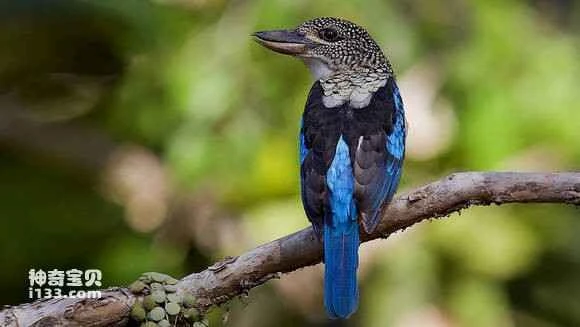
The Shawled Laughing Kookaburra perches on termite-eroded tree trunks, using its beak to carve a burrow about 5 meters above the ground to build its nest, which is 45 to 60 centimeters in diameter. The egg-laying period and number of eggs laid are currently unknown. Both parents incubate the eggs, but only the female feeds the chicks.
Listed as Least Concern (LC) on the IUCN Red List.
Protect wild animals and ban the consumption of wild game.
Maintaining ecological balance is everyone's responsibility!