Basic Information
Scientific classification
- Chinese name: Brown-bellied Laughing Kingfisher
- Scientific name: Rufous-bellied Kingfisher, Dacelo gaudichaud, Rufous-bellied Giant Kingfisher, Rufous-bellied kookaburra
- Classification: Climbing birds
- Genus and species: Order Coraciiformes, Family Kingfisher, Genus *Laughing Kookaburra*
Vital signs data
- Body length: 28-31 cm
- Weight: 110-170g
- Lifespan: Approximately 20 years
Significant features
It can produce 7 different sounds, similar to musical rhythms.
Distribution and Habitat
This is one of the most common and widespread birds in New Guinea. It inhabits coastal or monsoon forests. It lives among clusters of trees, planted teak, coastal scrub, flooded forests, mangroves, and gardens. Its range is from 500 to 1300 meters.
Appearance
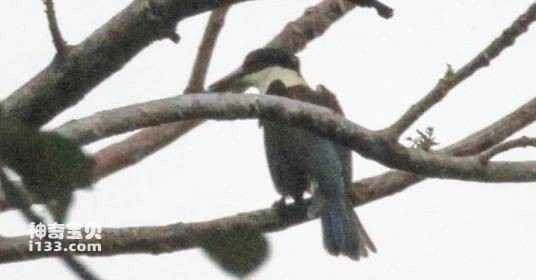
The Brown-bellied Kingfisher measures 28-31 cm in length; females weigh 110-161 g, and males weigh 138-170 g. The male has a white collar with a tawny tinge on the nape. The black cap on its head is slightly glossy. There are two small white patches on the head: one at the base of the bill and the other behind the eye. The underparts are cinnamon red. The upper back and shoulder blades are black. The lower back, tail, and area above the tail are bright blue-green. The tail is a combination of dark blue and black. The bill is white or pale yellowish-grey. The legs are dark grey. The female is similar to the male except for its reddish-brown tail. Juveniles closely resemble females, but their beaks and feathers are grey.
The beak is thick, straight, long, and strong, with a rounded ridge; the nasal groove is indistinct; the wingtips are long, with the first primary flight feather slightly shorter and the third and fourth longest; the tail is short and rounded; the body plumage is bright and glossy, often with blue or green hues. The head is large, the neck short, the wings short and rounded, and the tail mostly short as well; the beak is large and pointed with a blunt culmen; the legs are very short, the toes slender and weak, the fourth toe mostly fused with the third, and only fused with the second toe at the base. The preen gland is covered with (unidentified feathers). Coracoid bones are present on both sides, and there are four notches on the posterior margin of the sternum; the manubrium of the sternum is simply formed by external spines.
Detailed introduction
The brown-bellied kookaburra, scientifically known as *Dacelo gaudichaud*, also called the Rufous-bellied Giant Kingfisher or Rufous-bellied kookaburra, has no subspecies.
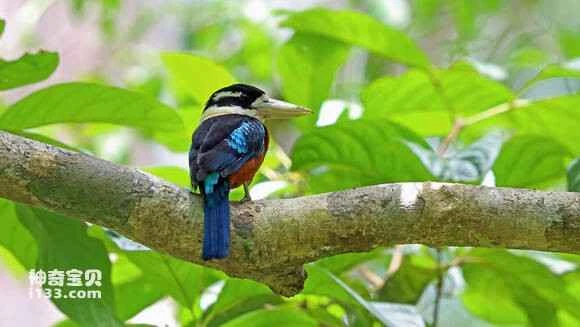
The brown-bellied kookaburra primarily feeds on insects and other invertebrates. They generally live in family units, perched in the thickets, chasing lizards and large insects. Sometimes they swoop down to dig for food. More strangely, they have evolved into unusual game birds, also preying on nesting sparrows. Their hunting method involves perching and ambush. They first perch quietly in a high, advantageous position, closely watching for any movement on the ground. Once they spot prey, they swoop down, swooping down to seize it with their beaks, and then fly back to their perch to devour it. If there are chicks, they will eventually return to the nest to feed them.
The brown-bellied laughing kookaburra can produce seven different sounds, resembling musical rhythms:
1. 'tchok' or 'tchok', strong and repetitive, like a cry.
2. 'Push, push, push' or 'Neck Couci', quickly and repeat every two seconds at a set time.
3. At intervals of one or two per second, it emits a series of barks and high-pitched sounds of strength 5 to 20.
4. During flight, it can continuously emit a rattle-drum sound.
5. Make a rapid shout of 'Eliou - Eliou - Eliou' from 3 to 6.
6. Shouting as a form of intimidation when hunting another species.
7. They all uttered low whistling calls, which looked very much like a chorus of blue-winged kookaburras.
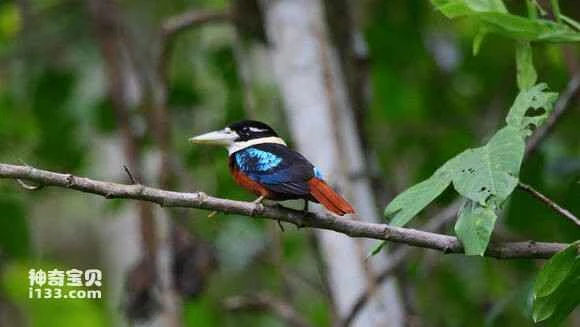
The Brown-bellied Kookaburra is a resident bird, occupying the same territory year-round. It nests in hollowed-out trees damaged by termites. Both male and female adults help each other care for the chicks. They are extremely family-oriented and often stay with their mates until death. Brown-bellied Kookaburras have a low birth rate and a long lifespan, generally living to around twenty years old. Adults typically spend a long time raising their chicks until they are independent, thus producing a maximum of one brood per season. Although competition may occur among chicks of the same genus, adult Brown-bellied Kookaburras usually do their best to help the adults raise the next generation, keeping the family closely connected.
Listed as Least Concern (LC) in the IUCN Red List of Threatened Species 2016 ver 3.1.
Protect wild animals and ban the consumption of wild game.
Maintaining ecological balance is everyone's responsibility!