Basic Information
Scientific classification
- Chinese name: Tassel Spider
- Scientific name: Portia fimbriata
- Classification: Arthropoda
- Family: Salticidae Portia Portia fimbriata
Vital signs data
- Body length: female 7–10 mm; male slightly smaller (excluding leg span)
- Weight: Small jumping spider; extremely light, varies from individual to individual.
- Lifespan: Approximately 1–2 years (major variations exist depending on environment and individual circumstances).
Significant features
Jumping spiders that specialize in hunting other spiders; they exhibit complex behavior; they are adept at camouflage and slow approach; and they possess excellent eyesight.
Distribution and Habitat
It is distributed in parts of Australia, Papua New Guinea, and Southeast Asia; it is often found in thickets, on tree branches, and near other spider webs.
Appearance
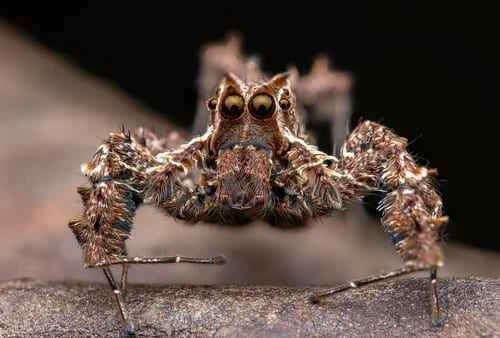
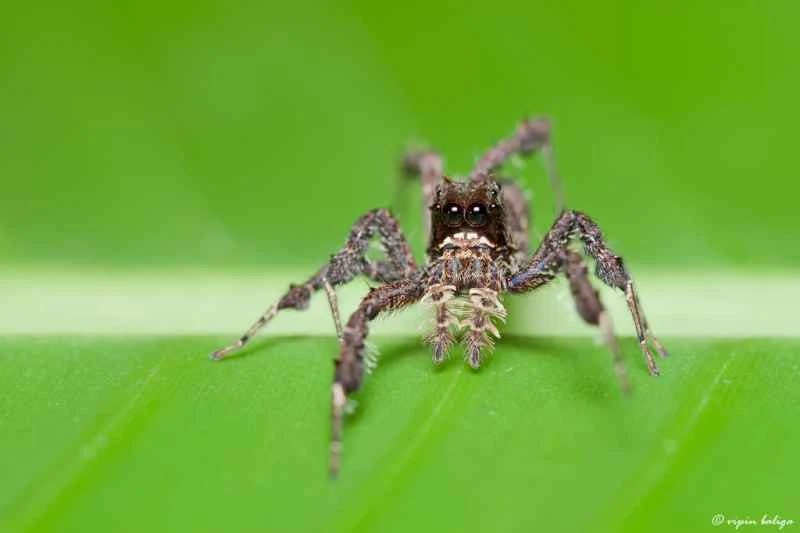
The whole body is covered with hair and fringed edges; brown and mottled, resembling withered leaves or remains in a net; the anterior and middle eyes are huge.
Detailed introduction
The fringe jumping spider ( Portia fimbriata ), belonging to the Salticidae family , is a renowned expert spider hunter , known for its exceptional eyesight, complex behavior, and specialized hunting of other spiders . Its body is covered in long hairs and fringe-like marginal hairs, resembling a clump of dead leaves or broken insects, as it moves slowly between branches and webs to approach its prey.
Ecology and Biology
Predation strategy: Primarily preys on other spiders and their egg sacs , but also consumes small insects. Often, it will feign "wind-blown debris" or "struggling insects" on the other spider's web, using irregular, light pulls on the silk to deceive the web owner and then launch a surprise attack.
Vision and intelligence: Like other jumping spiders, it has well-developed anterior and middle eyes and excellent stereoscopic vision; experiments have shown that it has route planning and simple "trial and error" abilities , and is often regarded as one of the most complex spiders in terms of behavior.
Activity time: Mainly active during the day, but when approaching prey, it will crawl very slowly or stop , blending into the dead leaves and debris in the environment.
Morphology and Recognition
Body length: female spiders are about 7–10 mm , male spiders are slightly smaller (excluding leg span).
Body shape: The body is relatively slender, with obvious long hair and fringed edges on the abdomen and feet. The outline is irregular, which is conducive to camouflage.
Body color: mostly a mottled color of brown, tan, gray and black mixed together, resembling dried plants or remains in a net.
Eye area: The large fore-median eye of a typical jumping spider is very conspicuous, and it has a "cute eye" appearance when viewed from the front.
Distribution and Habitat
Portia fimbriata is recorded in parts of Australia, Papua New Guinea, and Southeast Asia . It is often found in thickets, among branches, and near the webs of other spiders , and is commonly found in shrublands and forest edges.
Humanity and Safety
Medical significance: It has almost no medical significance to humans, is very small, has weak venom, and generally does not bite people on its own initiative.
Ecological role: On a small scale, it acts as a "spider hunter" and plays a role in regulating local spider and insect communities.
Observational value: Due to their complex behavior and unique appearance, they are often star species in popular science and macro photography .
IUCN: Portia fimbriata is currently not evaluated (NE) .
Frequently Asked Questions
Q1: Will tassel jumping spiders jump onto people? Jumping spiders use jumping to escape or hunt, but they rarely jump on humans intentionally ; they are more likely to dart around when startled.
Q2: Is it dangerous to people? There is basically no actual danger . Even if bitten, it usually causes only mild, localized discomfort and generally requires no special treatment.
Q3: How to distinguish it from a common "house spider"? Tasseled jumping spiders have longer, messier hairs , and their outlines resemble a clump of dead leaves; their behavior is very typical of "slow-motion crawling" on other spider webs.
Q4: Can I keep and observe them at home? Provided that local regulations are followed, they can be kept in a small box with branches/nets, but live small insects/spiders must be provided as food.


